

OVERVIEW
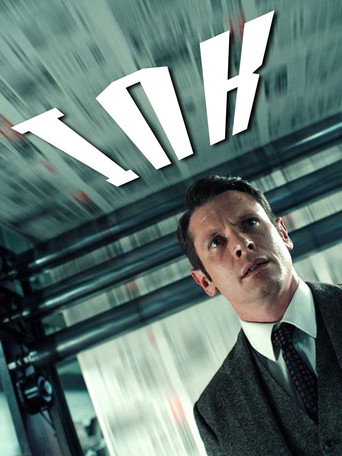
In Ink, Danny Boyle brings his characteristically restless style to the rise of The Sun, tracing its transformation from a struggling British newspaper into a populist tabloid built on scandal and sensation. In 1969, Rupert Murdoch (Guy Pearce) hires Larry Lamb (Jack O’Connell) with the goal of turning his latest acquisition into an outlet capable of beating the seemingly untouchable Daily Mirror. Lamb assembles a group of outsiders, including Jules Davies (Claire Foy), and finds the formula for success: replacing respectable news with attention-grabbing stories about sex, gossip, and shocking crimes, setting a precedent for the eventual downfall of all humanity.
BACKGROUND
James Graham began writing Ink in 2016, initially as a play, while thinking about how social media was changing the way people consumed news. Looking backward for the roots of modern populist journalism, he landed on Rupert Murdoch’s 1969 purchase of The Sun. The play became a major success in London and later on Broadway, after which Media Res optioned it and Graham began adapting it for film. The screenplay eventually reached Danny Boyle, who had already seen the stage production and quickly came aboard. Financing proved more difficult, with investors wary of both stage adaptations and the legal complications of making a film about Murdoch, until StudioCanal agreed to fully finance it. Boyle then reunited with Jack O’Connell after 28 Years Later and pushed for Guy Pearce as Murdoch despite financiers suggesting bigger Australian names. The film eventually landed the opening night slot at Venice, with Netflix acquiring the U.S. and Latin American rights the following day.
THE REVIEW
Boyle wanted to recapture the tabloid mentality of The Sun, and to do so, he brings his usual restless camera and incessant montages, resulting in what can be described as Boyle’s The Wolf of Wall Street meets Network. His style, which has persisted since Trainspotting in 1996, remains flashy and often dazzling, even if, by now, it doesn’t feel truly fresh, despite the director continuing to add new ingredients (he carries over the multi-iPhone rig from 28 Years Later and throws a disposable 360 camera into the ordeal). There are constant clever touches, such as having the characters’ eyes light up when they get high, or a chase through a house filmed in a uniquely exciting way. Daniel Pemberton’s schizophrenic score also keeps it all moving fast and furious, giving the film so much energy that its two-hour runtime flies by.
Yet there isn’t much beneath the style, and once you strip it away, you are left with a fairly straightforward underdog story, where someone tries a new strategy and eventually succeeds despite a few setbacks. We all know the implications of what these people are doing, and Boyle makes that dark destination linger throughout the film. At the same time, nothing in the screenplay feels particularly daring or complex. For a long time, we simply watch the group have ideas, incorporate them, and then watch The Sun rise on a chart comparing its circulation with the other newspapers. It is actually impressive how much mileage Boyle and his cast get out of such an unambitious screenplay.
There is one storyline in the middle of the film that finally gives the characters pause. Muriel McKay, the wife of The Sun’s deputy chairman, is kidnapped after being mistaken for Murdoch’s wife, and the team must decide what to do with a story that suddenly hits this close to home. It is around that point that Larry Lamb shows his true self, willing to exploit even the tragedy of someone close to him in order to gain a few more eyes. That instinct would become something of a landmark in human history, later stretching from sensational crime coverage and tabloid television to reality shows like To Catch a Predator, clickbait, outrage-driven news, and eventually social media doomscrolling and endless discourse.
Jack O’Connell delivers what may be a career-best turn as Lamb. Extending the villainy of his work in Sinners and 28 Years Later: The Bone Temple, he plays Lamb as a man barely containing the devil inside, and some of his expressions are downright evil. There is charm and charisma early on, as well as flickers of insecurity which disappear as the film goes on, as Lamb continues to indulge his impulses. Guy Pearce, surprisingly, plays it smaller as Murdoch, in what amounts to a stripped-down variation on his character from The Brutalist. The film is at its best in the scenes between O’Connell and Pearce, particularly in their final one (patchy makeup notwithstanding). Claire Foy has a handful of strong moments, and they are key to showing the point where Lamb goes too far, turning from underdog into a monster. Still, it’s Pearce’s closing look that lingers, and it’s unfortunate the film doesn’t quite earn it, or the montage that follows.
No Ink review would be complete without mentioning the small but noticeable use of AI in its final moments, a largely unimpactful use within the film that nevertheless stirred controversy, including ending the TIFF Q&A early and awkwardly. It animates two or three photos, and feels so insignificant to the film that it almost comes across as another argument a company can use to say that an established director has embraced the technology. Ironically, the resulting controversy generated almost as many clickbait headlines as the kind of media the film is portraying, but that’s how it goes nowadays.
FINAL THOUGHTS
Ink tells its true story in a highly energetic and entertaining way, making the rise of The Sun almost as fun as Boyle’s previous apocalyptic action horror, even if it is about as deep as that film (aka not very). It is elevated considerably by two terrific lead performances, with O’Connell giving some of the best work of his career and Pearce proving a great presence alongside him. Yet it all feels strangely safe and predictable, even Boyle’s loudly unpredictable style, and outside the scenes between O’Connell and Pearce, the film can be surprisingly dull. It knows exactly how to grab your attention, which is fitting for a film about The Sun, but, much like the newspaper, leaves you with very little afterward.
- 1Minotaur
- 2Wild Horse Nine
- 3The Man I Love
- 4Club Kid
- 5The Unknown
- 24Ink#24 of 44
- Where to watch
- Coming soonJan 8, 2027
- Where to watch
- Coming soon
 Play trailer


- Original title
- Ink
- Director
- Danny Boyle
- Cast
- Jack O'Connell, Guy Pearce, Claire Foy, Blake Harrison, Patrick Kennedy, Angus Imrie, Brian Gleeson, Bertie Carvel
- Rated
- R
- Screenwriter
- James Graham
- Composer
- Daniel Pemberton
- Cinematography
- Alwin H. Küchler, Natasha Mullan
- Editor
- Fin Oates
- Country


- Language
- English
- Distributor (CA)
- VVS Films