
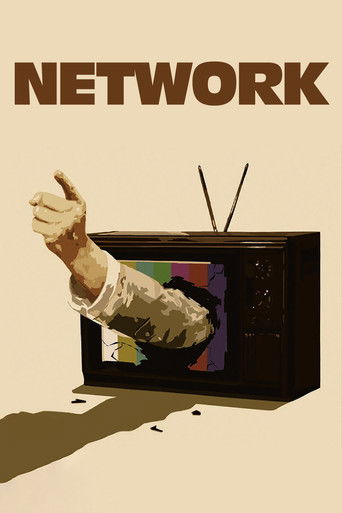

Network is a funny case—so ahead of its time in 1976 that watching it today, when its themes have become everyday reality, makes it feel almost too obvious. It’s hard to forget how radical it must have felt at the time. Writer Paddy Chayefsky spent time with news anchors and executives, and that firsthand research shaped a film that didn’t just capture the media landscape of the ’70s—it saw where it was heading.
The story follows Howard Beale, a longtime anchorman whose days are numbered after the network decides to cancel his news program as part of a corporate shake-up driven by low ratings. Faced with losing everything, he announces live on air that he plans to kill himself during an upcoming broadcast. Instead of ending his career even more prematurely, Howard’s breakdown becomes a gift to the network—particularly to Diana Christensen, the ruthless executive eager to turn his unraveling into must-see TV.
Now, in an age of viral outrage and attention-hungry headlines, Network feels disturbingly familiar—but back in 1976, it was a shock to the system. Turning a once-respected journalist into a spectacle captured just how far television was willing to go for ratings. The first act explores this brilliantly, as veteran TV figures—who once greenlit fluff pieces about naked bikers in Central Park, so weren’t paragons of integrity themselves—clash with a new wave of executives who believe that ditching real news altogether might actually make better television.
The film is at its sharpest in the debates between Faye Dunaway’s Diana and William Holden’s Max Schumacher—conversations that aren’t just about TV, but about a society grappling with the collapse of integrity itself—political, institutional, and cultural—in the cynical wake of Watergate, Vietnam, and economic unrest.
The first hour is exceptional and packed with masterclass moments. It begins with Howard and Max’s quiet, sincere exchange, which immediately paints the depth of their friendship. Then comes the moment the control room completely overlooks Howard’s on-air suicide threat—too busy lining up the commercial break to even notice. Max’s impulsive decision to let him stay on the air becomes the spark that lights the fuse for everything that follows. It all culminates in the film’s most iconic moment: a raw explosion of anger as Beale yells that society will no longer take it—an unforgettable scene that is as chill-inducing as it is tragic.
But as the film progresses, its razor-sharp focus starts to blur. The tightly wound first act gives way to a second half that branches off in multiple directions. Each subplot has something to say about society, capitalism, or personal disillusionment—but they don’t build toward a cohesive climax. The film becomes more of a collection of great scenes than a unified whole. Beatrice Straight, for example, won an Oscar for a powerful five-minute performance that, while emotional and beautifully acted, adds very little to the main plot. After Max exits the network and the old bosses are replaced, the central conflict fizzles out. It’s as if the film says everything it needs to in the first hour, then just cruises toward a good—but predictable—ending.
Peter Finch gives a great performance, portraying his character’s depression and sadness in a way that makes it easy to see he needs help, yet he remains calculated enough to make you wonder how much the character is performing. Faye Dunaway is extremely entertaining as the shallow human being that represents television. There’s a scene early on, in one of her first victories, where the movie cuts to her and we see an almost devilish look—she doesn’t care a bit that she’s playing with people’s lives and doesn’t even seem to want personal recognition. She does it all for the thrill, the challenge, and once that goal is hit, she needs to chase the next one. Beatrice Straight is heartbreaking in her one powerful scene. Ned Beatty has one great scene, though I don’t think he deserved the Oscar nomination he received for the role. My favorite performance, however, is William Holden’s. As the more grounded character in the film, Max quickly sees what Diana is going for and wants to fight it—up to a point. He, too, is detached, and in the end, doesn’t truly have the integrity to uphold the values he claims to protect, too jaded to truly resist Diana’s game.
The film’s central conflict fades too early, but its message remains loud and clear. If anything, we’ve caught up to the world Network imagined. It might be one of the few classics that could benefit from a remake—not to improve it, but to escalate it. We’re already living in a more absurd version of what it predicted.
- 1Rocky
- 2Taxi Driver
- 3Assault on Precinct 13
- 4Kings of the Road
- 5All the President's Men
- 6Network#6 of 51
- Where to watch
- Rent or buy at Apple TV Store, Google Play Movies, YouTube, Amazon Video
- Where to watch
 Prime Video
 Mubi
Mubi
 Play trailer


- Original title
- Network
- Director
- Sidney Lumet
- Genre
- Drama
- Cast
- Faye Dunaway, William Holden, Peter Finch, Robert Duvall, Wesley Addy, Ned Beatty, Arthur Burghardt, Bill Burrows
- Rated
- R
- Screenwriter
- Paddy Chayefsky
- Composer
- Elliot Lawrence
- Cinematography
- Owen Roizman
- Editor
- Alan Heim
- Country

- Language
- English
- Budget
- $3.8 million
- Box office
- $23.7 million