OVERVIEW
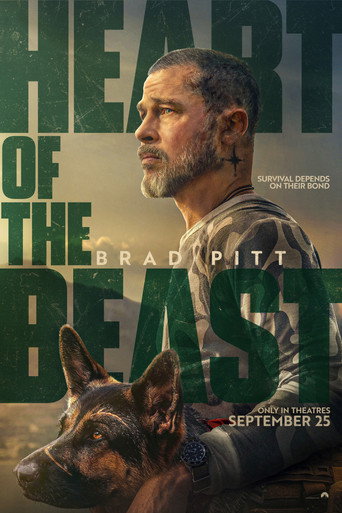
At its simplest, Heart of the Beast can be described as Brad Pitt and his dog trying not to die in the wilderness, but its real intention is to depict the profound bond that can form between a person and an animal. Depending on your affection for dogs, that may also mean two hours of sustained emotional torture built around the possibility that something terrible could happen to a very good boy. Pitt plays James Belmont, a former Army Special Forces soldier who becomes stranded deep in Alaska with Odin, his retired combat dog, after a catastrophic accident. Injured and isolated, the pair must find their way back to civilization while confronting both the dangers around them and the trauma they carried home from war.
BACKGROUND
Cameron Alexander conceived Heart of the Beast partly from his interest in military culture and combat dogs, and partly from his relationship with his own dog, Hoss. The script appeared on the 2017 Black List and spent years in development before David Ayer joined the project in 2024, following the success of The Beekeeper. Brad Pitt came aboard the following year as both star and producer, reuniting with Ayer twelve years after Fury. For Ayer, the material represented a considerable change of pace after two consecutive Jason Statham action movies (and let’s not forget the atrocious projects that preceded those), giving him the opportunity to explore more subdued themes of mourning and purpose, something he hadn’t truly done since his last film with Pitt. Although it takes place in Alaska, the film was shot around Queenstown, New Zealand, under grueling conditions. Pitt spent much of the production cold, wet, and outdoors, while Uber, the primary dog playing Odin, had previously worked as a search-and-rescue dog. Three additional dogs were used to complete the performance.
THE REVIEW
Heart of the Beast works best when it embraces being a visceral survival film: human and dog versus nature. After an unnecessary opening section with a J. K. Simmons cameo, an intense plane crash finally sets that journey in motion. From there, James and Odin face brutal weather, dangerous terrain, wild animals, and James’s failing heart, with each new challenge making the journey harder and more exhausting. This physical ordeal is where Ayer is at his strongest, capturing well the harsh conditions that carry into both Pitt’s and the dogs’ performances. Whether it is simply setting up a tent against the wind, or a larger set piece involving a ravine or wild animals, it all feels equally convincing and arduous, aided by the precise editing and punishing sound design.
Unfortunately, Ayer doesn’t fully trust that simplicity and adds a little too much to sugarcoat the journey for the audience. Its first mistake comes very early, opening the film by already showing us how it is going to end. Flash-forwards followed by a “few days earlier” card are always annoying, but entering a survival story with a gratuitous glimpse of its destination is one of the worst sins this kind of film can commit. Outside of that, there is the unnecessary but harmless conversation with J. K. Simmons, which adds very little, and throughout the film, Ayer incorporates a series of repetitive, meandering flashbacks of James and Odin going through hardship at war. These scenes feel painfully generic. We are not given much of an arc through them, just repeated reminders that the two had already gone through a lot of pain before the film began. One would have been enough, but the film keeps returning to them until it reaches ridiculous levels of saccharine sentiment in an ending montage that feels designed to squeeze out every remaining tear rather than trust what the film had already accomplished.
Yet whenever Heart of the Beast stops sabotaging itself, manufacturing scenes to needlessly remind us how emotional it is supposed to be, it becomes genuinely affecting on its own, largely because Uber gives such a convincing performance as Odin. These performances are always partly constructed in the editing room, where the best reactions from the animal are arranged, but what makes this one different is how believable the reactions themselves feel. The fear, the cold, the determination, all come through in the dog, which makes even moments where Odin is simply sitting next to his owner extremely touching. Ayer and editor Dody Dorn wisely give those reactions time, and Pitt is particularly good when playing directly against them, convincing us of their affection and long history together far more effectively than any flashback ever could. It can melt the heart of even cynical non-dog people, and dog lovers should be ready to shed a few tears.
Also notable is Jared Michael Fry’s score, which wisely avoids playing those emotions directly, instead focusing on texture through unusual wordless chants and primal instrumentation. It gives the film a distinctive personality and adds grandeur without overwhelming the intimacy of the story. It is also complemented by Mauro Fiore’s cinematography, which captures the vastness and hostility of the environment.
FINAL THOUGHTS
Whether you are a dog person or not, there is a lot to like in Heart of the Beast, from Pitt’s committed performance to the excellent sound design and Jared Michael Fry’s evocative score. It also contains some of Ayer’s best-directed scenes since Fury, efficiently capturing the exhaustion and physical punishment of the journey. Yet, for all the technical prowess, it is the relationship between Belmont and Odin that gives the film its emotional core, and it is a shame Ayer detracts from its impact by adding unnecessary flashbacks and an opening scene that ruins the ending. The strongest emotion is already there in Odin’s reactions, and the film would have benefited from trusting them more.
- 1Hadestown: The Musical
- 2Tuner
- 3The Weight
- 4Wicker
- 5Minotaur
- 107Heart of the Beast#107 of 190
- Where to watch
- Coming soonSep 25, 2026
- Where to watch
- Coming soon
 Play trailer