
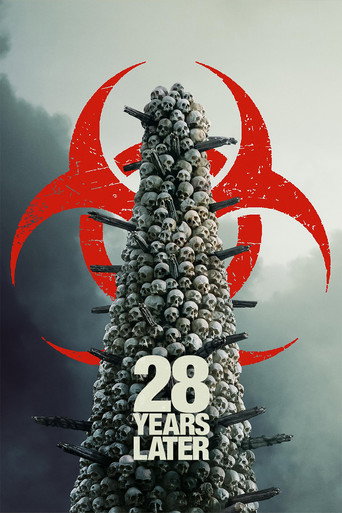
Not exactly 28 years later—closer to 23, if we’re counting—but Danny Boyle returns to the franchise he originated with 28 Days Later, the 2002 landmark that revitalized zombie cinema. That first film, a low-budget gamble shot on digital DV tapes, turned out to be wildly influential—its jittery camerawork, gritty immediacy, and terrifyingly fast “infected” helped define the genre for a new era. Without it, there’s little chance we’d have had Dawn of the Dead (2004), The Walking Dead, or the now-standard image of the sprinting undead. Now, the Trainspotting and Slumdog Millionaire director brings his kinetic energy, stylized flair, and deeply human storytelling back into a world infected with rage, delivering a third entry that’s a nightmare for the squeamish—and yet surprisingly tender underneath all the gore.
After an opening scene that essentially echoes the first sequel’s unforgettable introduction, 28 Years Later jumps to a version of the UK still haunted by the virus, where pockets of civilization cling together and the infected roam free. There’s no real continuation of storylines from the previous films—no returning characters, and the events of 28 Weeks Later are largely ignored. In fact, you could watch this one with no prior knowledge of the franchise.
The first hour delivers everything fans could hope for in a 28 Days Later sequel: unbearable tension, gruesome imagery, and genuinely terrifying infected. Boyle, a director who rarely stands still, updates what worked in the original and brings it into the modern age. If 28 Days Later redefined horror in the new millennium with its grainy, guerrilla-style immediacy, this new entry—shot largely on an iPhone 15 Pro Max, with longtime collaborator Anthony Dod Mantle behind the camera—takes it all to eleven. Dutch angles, chaotic edits, piercing sound design, and a score that blends orchestral swells with electronic distortion and layered source cues create a relentless sensory experience. It can be exhausting——pure Boyle through and through.
The film peaks around the midpoint with a masterfully edited sequence that crosscuts between a celebration and a frantic chase along a causeway—a moment that rivals the best the genre has to offer (only Train to Busan comes close). Yet Boyle and writer Alex Garland aren’t just interested in making another efficient zombie film; they use the opportunity to ask what’s left of us after the apocalypse becomes routine. With the market saturated over the past two decades, they seem intent on offering something that actually justifies its existence.
Once the more “traditional” survival horror portion wraps up, the film slows down significantly. The infected fade into the background. What emerges instead is a quieter, more intimate film—almost a Sundance drama embedded in a zombie apocalypse. A young boy, his ailing mother, and a landscape scarred by memory become the emotional center. Some viewers may find this turn frustrating. Characters introduced early on vanish without resolution. The pacing becomes meditative. But Boyle and Garland—far more effectively than The Last of Us series—ask what survival looks like when the world has moved past saving, and how someone young might piece together meaning from the ruins. It’s almost a coming-of-age film wrapped in survival horror.
Even as the momentum dips, the craftsmanship remains top-tier, and the performances keep it grounded. Ralph Fiennes brings gravitas to a small but pivotal role. Jodie Comer has a few powerful moments. And young newcomer Alfie Williams is a revelation—carrying much of the film’s emotional arc with a mix of vulnerability and resilience that feels entirely unforced. For all its structural shifts and unexpected introspection, 28 Years Later remains a sharp, bold return to the rage-infected world. It may not please everyone, especially those expecting a straight genre outing, but it earns its place in this ambitious trilogy. In a genre that often repeats itself, Boyle is still searching for something more.
Still courtesy of Sony Pictures Releasing Canada
- 1Sentimental Value
- 2Hamnet
- 3One Battle After Another
- 4Ne Zha 2
- 5Blue Moon
- 2528 Years Later#25 of 256
- Where to watch
 Crave
Crave- Where to watch
 Max
Max
 Play trailer


- Original title
- 28 Years Later
- Director
- Danny Boyle
- Genre
- Horror, Thriller, Science Fiction
- Cast
- Aaron Taylor-Johnson, Alfie Williams, Ralph Fiennes, Jodie Comer, Jack O'Connell, Chi Lewis-Parry, Edvin Ryding, Christopher Fulford
- Rated
- 14A
- Screenwriter
- Alex Garland
- Composer
- Alloysious Massaquoi, Kayus Bankole, 'G' Hastings
- Cinematography
- Anthony Dod Mantle, Stefan Ciupek
- Editor
- Jon Harris
- Country

- Language
- English
- Budget
- $60 million
- Box office
- $151.309 million
- Distributor (CA)
- Sony Pictures Releasing Canada