

OVERVIEW
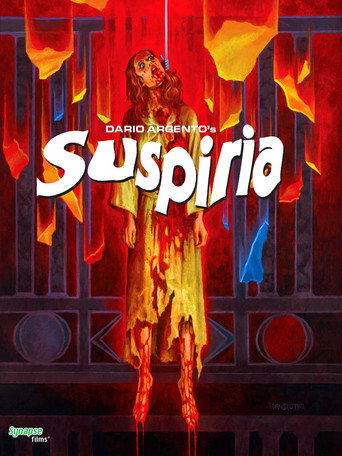
Suspiria offers further evidence that few places in cinema are more terrifying than a ballet academy. American dancer Suzy Bannion (Jessica Harper) arrives in Freiburg to attend the prestigious Tanz Dance Academy, stepping from the airport into a storm of violent colors, deafening music, and increasingly inexplicable events. A student fleeing the school is brutally murdered that same night, and after Suzy moves into the building, strange illnesses, sudden disappearances, and the secretive behavior of its staff gradually point to something sinister hiding within its walls.
BACKGROUND
Following the success of Deep Red (1975), Dario Argento moved beyond the giallo films that established his career, leaving behind mysteries ultimately explained by human violence for a supernatural world built around witchcraft and fairy-tale logic. Suspiria drew inspiration from Thomas De Quincey’s 1845 Suspiria de Profundis, and a story co-writer Daria Nicolodi told about her grandmother attending a music academy where the faculty practiced the occult. Argento originally envisioned the students as children, an idea rejected by producers but still reflected in the film’s oversized sets. Released in the United States by Fox in an edited version, Suspiria became one of the studio’s biggest rental successes of 1977 and has since become Argento’s most famous film and a defining work of Italian horror.
THE REVIEW
It is easy to be scared by a well-timed jump scare. It is easy to cling to your seat when you can see what is chasing the lead character. Finally, it is also easy to be disturbed by a brutal image, one that stays in your mind for hours or even days after watching it. Far harder is making you feel suffocated by what you cannot see, desperate to escape a place even as you remain hypnotized by it, as the lead character. You want to know more, but mainly you want to run away, without any certainty that it would be enough.
At its best, Suspiria achieves exactly that feeling, while still delivering its share of brutal murders, including one that has unquestionably become iconic. Yet its greatest achievement is how much Argento accomplishes with choices that seem simple on paper but together create a constant, suffocating unease.
Suspiria’s success can largely be summarized through three elements, all proudly unsubtle yet inarguably effective. First are the extreme colors. Red has rarely been as red as it is in Argento’s Suspiria. The striking result was achieved by Argento and cinematographer Luciano Tovoli through carefully controlled lighting and the film’s Technicolor printing process. It makes its striking first impression as Suzy arrives at the Tanz Academy, whose walls are dominated by the color, making the building seem downright demonic. Tovoli’s framing constantly heightens the effect, often reducing Suzy to a small figure against overwhelming colors and enormous sets that emphasize just how vulnerable she is within the academy.
That architecture is the second element. The Tanz Academy is a magnificent set, a maze of seemingly endless hallways, enormous rooms, and elaborate decorations that make every space feel slightly different from the last. The oversized sets, a remnant of Argento’s original plan to make the students children, work beautifully with this approach, and Argento gives us plenty of time to simply look at these architectural anomalies. We start to imagine what might be hidden there and what history these walls have already witnessed.
Finally, the last but most integral part of the film’s success is Goblin’s score, perhaps the least subtle element in the entire film, with its main 6-minute “Suspiria theme” played repeatedly throughout. Its central celesta and bell motif is deliberately repetitive, surrounded by pounding synths and creepy whispers that suggest the witches are always nearby, watching. It begins haunting Suzy the moment she arrives at the airport and practically refuses to give her peace.
The film’s best moments combine all three, especially the remarkable opening double murder, which culminates in a brutal image the film never quite matches. Unfortunately, Suspiria becomes considerably less interesting whenever its characters start explaining things. The narrative itself is remarkably thin, which would not be a problem if the characters simply spoke less. As Sara starts filling Suzy in, and later searches for more information about the academy, we are greeted with long stretches of terrible, expository, artificial dialogue, made even more distracting by the English dubbing (not from Jessica Harper, who looks the part and does a good job, but the rest of the cast). It is far more effective simply to watch Suzy wander through empty corridors than to hear another character explain why she should be afraid. The film could also have used another dance sequence or two, finding meaningful connections between its ballet world and its witches rather than using the academy primarily as an extraordinary setting.
FINAL THOUGHTS
Suspiria is a suffocating film where the tension comes much more from its well-constructed atmosphere than from anything in its screenplay, which gives the characters little depth and too often explains away the horror, making it less interesting the more we understand it. Yet Argento’s ability to bring color, architecture, framing, and music together can make those weaknesses briefly seem irrelevant. Over four decades later, Suspiria remains deeply influential, especially within films produced by A24, where the sense of dread often outweighs the actual source of fear.
- 1Sorcerer
- 2Annie Hall
- 3The Ascent
- 4Star Wars
- 5Close Encounters of the Third Kind
- 15Suspiria#15 of 40
- Where to watch
- Not available for streaming
- Where to watch
- Not available for streaming
 Play trailer


- Original title
- Suspiria
- Director
- Dario Argento
- Cast
- Jessica Harper, Stefania Casini, Flavio Bucci, Miguel Bosé, Barbara Magnolfi, Susanna Javicoli, Eva Axén, Rudolf Schündler
- Rated
- R
- Screenwriter
- Daria Nicolodi, Dario Argento
- Composer
- Dario Argento, Massimo Morante, Fabio Pignatelli, Agostino Marangolo, Claudio Simonetti
- Cinematography
- Luciano Tovoli
- Editor
- Franco Fraticelli
- Country

- Language
- Italian
- Box office
- $2.9 million