

OVERVIEW
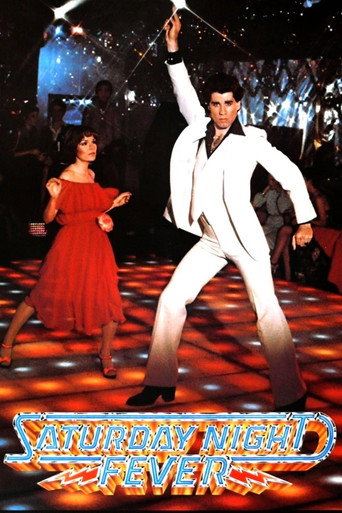
Saturday Night Fever is so iconic that it single-handedly cemented disco as the defining sound and image of the seventies. Yet for all the white suits, Bee Gees songs, and the sight of a young and dashing John Travolta pointing toward the ceiling, the film itself is far uglier than its reputation suggests. Its disco floor offers only a few hours of escape from a working-class Brooklyn defined by dead-end jobs, frustrated parents, casual racism, misogyny, violence, and young men with no idea of what life is there beyond another Saturday night.
Tony Manero (John Travolta) is 19 and works at a paint store, where a one-dollar raise represents about as much upward mobility as anyone expects from him. At home, his unemployed father belittles him while his mother remains preoccupied with the older son who became a priest. Outside, Tony goes everywhere with the same four friends, fooling around on the Verrazzano Bridge, picking fights with a rival Puerto Rican gang, and spending his weekends, and practically all his money, at 2001 Odyssey, the local discotheque where he temporarily becomes somebody. When a dance competition is announced, he initially agrees to enter with Annette (Donna Pescow), a neighborhood girl desperately interested in him, before abandoning her for Stephanie (Karen Lynn Gorney), a more experienced dancer whose Manhattan job and ambitions offer Tony a glimpse of life beyond Brooklyn. The closer he gets to her, the more limited his own life begins to seem.
BACKGROUND
The film originated with Nik Cohn’s 1976 New York magazine article “Tribal Rites of the New Saturday Night,” an apparent inside account of young working-class men in the Bay Ridge disco scene that Cohn later admitted was largely fabricated. Music mogul Robert Stigwood nevertheless saw a movie in it and built the project around John Travolta, already a television star but still largely untested as a film lead. Rocky director John G. Avildsen was initially hired, but disagreements over the direction of Tony and Norman Wexler’s gritty screenplay led Stigwood to fire him just as Avildsen received his Best Director nomination. He was replaced only weeks before filming by John Badham, a television director with little feature experience who nevertheless shared Stigwood’s commitment to preserving the rougher edges of the material.
Travolta spent months training as a dancer, working with choreographer Lester Wilson to develop Tony’s aggressive physicality, while filming took place around New York, including the real 2001 Odyssey in Bay Ridge. Much of the film had already been choreographed and shot to existing music by artists such as Stevie Wonder and Boz Scaggs before Stigwood approached the Bee Gees late in production. The group initially claimed they were too busy for a little indie film they knew almost nothing about, but thankfully for everyone involved, they were convinced and composed five songs that would come to define the group as much as disco itself. Aided by that immensely popular soundtrack, the film became one of 1977’s biggest hits and earned Travolta his first Academy Award nomination.
THE REVIEW
There is an irony to Avildsen’s departure, because the screenplay he fought hardest to change would ultimately become the film’s greatest weakness. Travolta later criticized his approach for trying to turn Tony into another Rocky Balboa, and the frustration is understandable. Softening Tony would have taken away from one of the script’s greatest achievements: its brave embrace of a deeply flawed protagonist and its challenge to the audience to follow him. But Avildsen was right that Wexler’s vision needed some restraint. Rocky was perhaps too nice, and even its gritty world can feel sanitized next to Saturday Night Fever, but it found immense transformation through small interactions. Wexler eventually needs five catastrophes in ten minutes just to give Tony a far less convincing transformation.
What we ultimately get is a great film held captive by a terribly misguided one. Instantly iconic scenes are stuck in a script that makes one scratch their head over exactly what it is going for. It pushes the gritty realism too far while asking us to leave hopeful for what is to come, ending up dishonest and deeply problematic, something Travolta would face again the following year in Grease. It is particularly frustrating because the film has so much potential, so many fantastic individual moments, and an Oscar-worthy performance by Travolta. With a few small but significant adjustments, it could have been, like Rocky, a film whose quality matches its iconic status.
The best scenes are all front-loaded, beginning with the fantastic opening that has Tony walking through Brooklyn to ‘Stayin’ Alive,’ eating pizza, checking out women, and behaving like an icon, only to contrast that confidence with his arrival at the paint store where he works. The conversations involving his brother are equally strong. Through these scenes, we get all we need to know about Tony, what drove him to become who he ultimately is, and how limited his life seems. Travolta obviously captures the cool, especially in the dance sequences, but is even better in the far quieter moments that truly challenge his character’s limited view of the world. During his conversations with his brother and later with Stephanie, the actor has a childlike, confused look, as if struggling to process this newly revealed information in real time, like a caveman being given an iPhone to play with. It is a completely rounded performance, one that elevates a problematic film into being somewhat worthwhile. But even he cannot save where the script ultimately takes the story.
The main problem is the film’s depiction of the toxic environment Tony lives in, and its inability to truly examine it as a serious study of what causes people to become this way, while still shoehorning in a forced redemption arc that hints at a happy ending. His friends are racist, misogynistic, homophobic, violent, and frequently repulsive, and while Tony is complicit in much of it, the film at least gives him enough dimension to understand where some of it comes from. Bobby is perhaps the only friend afforded the same treatment, with his desperation and vulnerability revealing what this environment can actually do to someone. The rest increasingly feel like one-dimensional monsters positioned around Tony to make his eventual escape seem inevitable.
If you squint hard, you can see what the film was going for, especially with Annette. She is trying far too hard to fit into a world where she ultimately isn’t wanted, accepting humiliation after humiliation just to remain part of the group. There is a parallel there that could have been made far more powerful by drawing on Tony’s own life, especially if the film had shown him genuinely attempting something outside his comfort zone rather than simply finding a dancer who was clearly already part of his world. Instead, Annette’s story is taken to its ugliest possible conclusion, and even her sexual assault ultimately becomes another terrible event contributing to Tony’s awakening rather than something the film seriously examines from her perspective.
We don’t get a proper analysis of prejudice either, and so much happens to Tony in such a short period of time that it becomes hard to tell what actually makes him change, if anything really does. He recognizes that the dance competition was rigged, attempts to sexually assault Stephanie, sees Annette assaulted by his friends, loses Bobby in a tragic death, watches the group fall apart, and runs away to Manhattan. The rigged competition alone already gives Tony a meaningful confrontation with prejudice, forcing him to recognize that the same racism he casually participates in can become a system that directly benefits him. Everything that follows takes the point further and further until the film seems to be yelling something it had already communicated.
On the other side of the spectrum, treating this as a dance competition film, which it also is, Tony’s final dance is completely underwhelming. The point is obviously that the competition is rigged and the Puerto Rican couple deserves to win, but after all the superior dances Tony and Stephanie perform throughout the film, having their big competition number be perhaps their least impressive makes one wonder how anyone in the room could believe they deserved first place at all.
FINAL THOUGHTS
Perhaps the most frustrating thing about Saturday Night Fever is how close it comes to being a great film. Strip away the silly clothes, and what’s underneath is a thoughtful and complex study of a young man trapped by his neighborhood’s racism, misogyny, and dead ends, alongside genuinely outstanding dance sequences and a career-defining Travolta performance. Every time the music kicks in, the songs, the choreography, the camera, all of it clicks with a confidence that explains, instantly, why these images became so iconic. But the film completely loses itself in its terrible third act, pushing everything too far and going for shock value that betrays the careful study that precedes it, all while incomprehensibly expecting us to forgive Tony and walk out hopeful. Saturday Night Fever’s greatest contradiction ultimately sits at its center: a film determined to destroy the myth of Tony Manero while equally determined to create the myth of John Travolta.
- Where to watch
 Buy or rent
 Buy or rent
 Play trailer


- Original title
- Saturday Night Fever
- Director
- John Badham
- Genre
- Drama
- Cast
- John Travolta, Karen Lynn Gorney, Barry Miller, Joseph Cali, Paul Pape, Donna Pescow, Bruce Ornstein, Julie Bovasso
- Rated
- R
- Screenwriter
- Norman Wexler, Nik Cohn
- Composer
- Maurice Gibb, Barry Gibb, Robin Gibb, David Shire
- Cinematography
- Ralf D. Bode
- Editor
- David Rawlins
- Country


- Language
- English
- Budget
- $3.5 million
- Box office
- $237.113 million
- Buy / rent (CA)
- Apple TV Store, Google Play Movies, YouTube, Amazon Video