
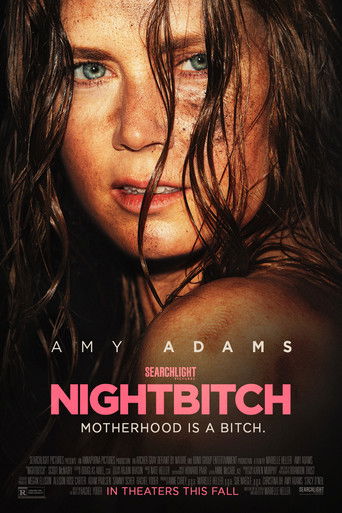
Nightbitch explores the challenges and frustrations of motherhood through the story of an unnamed artist turned stay-at-home mom, played by Amy Adams. Now a mother to a young boy, she feels her role as a caregiver is undervalued by her husband, who is frequently away on business trips. She then begins to experience strange, unmistakable signs that she’s turning into a dog.
Despite this bizarre concept, Nightbitch remains surprisingly accessible. For much of the runtime, it operates as a grounded exploration of daily life as a wife and mother, focusing on the exhaustion, frustration, and sacrifices inherent in caregiving while managing an often-absent spouse. Within the first five minutes, Adams delivers a poignant monologue that sets the tone and encapsulates the film’s message: how society continues to neglect and undervalue the work of motherhood.
As expected in a project of this nature, the film heavily relies on its lead performance, and fortunately, Amy Adams is fully committed and delivers an exceptional one. Her portrayal captures the relentless love, dedication, and quiet despair of a mother whose needs are overlooked. Adams brings warmth and charisma to the role, drawing the audience in even during lengthy monologues or when the script ventures into awkward territory, such as an over-the-top restaurant scene. Her grounded performance keeps even the most absurd moments from becoming outright ridiculous.
The film shines brightest in its smaller, relatable moments. Two standout scenes perfectly capture the emotional and physical demands of parenting: one where a simple painting activity spirals into a chaotic mess, and another where Adams’ character repeatedly attempts to nap on a couch, only to be interrupted time and again. The quick cuts in the latter scene are both nerve-wracking and hilariously accurate, perfectly illustrating the relentlessness of her new reality.
However, the depiction of marital dynamics feels underdeveloped. Key details about the couple’s relationship are introduced too late, and a pivotal third-act decision unfolds so abruptly that it lacks emotional weight. As a result, the husband (played effectively by Scoot McNairy) comes across as one-dimensional, despite hints of his loving nature.
The canine metaphor is where the film stumbles most. While the transformation scenes are well-executed, with Adams’ reactions to the changes being both humorous and unsettling, the symbolic connection feels muddled. Dogs are often symbols of freedom, but their associations with loyalty and affection clash with the film’s themes of self-discovery and undervalued labor. The film might have benefited from discarding this metaphor entirely, yet its gradual approach to the transformation keeps the surreal element grounded.
Though Nightbitch has its share of missteps, including some repetitive jokes in the group mom scenes, Amy Adams delivers a fantastic performance that elevates the film and makes it worth watching. Her ability to bring authenticity and emotional depth to even the most surreal moments ensures that Nightbitch stays engaging, even when its bark doesn’t fully match its bite.
- 1Dune: Part Two
- 2Conclave
- 3Better Man
- 4The Substance
- 5Challengers
- 49Nightbitch#49 of 110
- 1Conclave
- 2Better Man
- 3The Substance
- 4The Assessment
- 5Queer
- 24Nightbitch#24 of 50
- Where to watch
 Disney+
 Crave
Crave- Where to watch
- Disney+
 Play trailer


- Original title
- Nightbitch
- Director
- Marielle Heller
- Cast
- Amy Adams, Scoot McNairy, Arleigh Snowden, Emmett Snowden, Jessica Harper, Zoë Chao, Mary Holland, Archana Rajan
- Rated
- R
- Screenwriter
- Marielle Heller
- Composer
- Nate Heller
- Cinematography
- Brandon Trost
- Editor
- Anne McCabe
- Country

- Language
- English
- Budget
- $20 million
- Box office
- 170737