
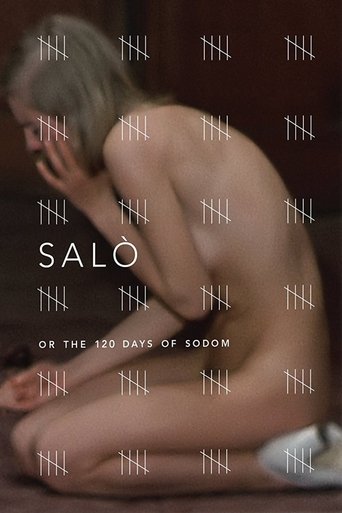
Salò, or the 120 Days of Sodom is a movie that forces itself into the viewer’s memory, delving into themes of power, control, and the dehumanizing brutality of fascism. It’s undeniably a film with “something to say,” reaching for political and philosophical importance. However, it also stands as proof that having a deeper meaning doesn’t necessarily make a film good, or even tolerable. There are many ways to show how fascism reduces people to objects or commodities, but Pasolini’s approach is blunt, sensational, and grotesque, often opting for visceral shock over nuanced exploration. Instead of delving into how power corrupts subtly or how ideologies degrade individuals, the film just throws it in your face, like having a fascist figure feed literal filth to their helpless victims.
The plot centers around four wealthy and corrupt libertines in Nazi-occupied Italy, who kidnap a group of young men and women, imprison them in a secluded villa, and subject them to horrific acts of abuse and degradation. These young people, mostly indifferent to the torture, become objects in the hands of the libertines, enduring ritualized humiliations that become more disturbing as the film progresses, from forced consumption of excrement to brutal acts like tongue-slicing. The brutality isn’t just physical; it’s psychological, presented as both a spectacle and a performance, with the adults’ complete disregard for the humanity of their victims underscoring a bleak message about the effects of unchecked power.
Contextually, Salò was Pasolini’s final film, created during a turbulent time in his life and just before his own tragic murder. He was known for his disdain for consumer culture and the way he saw it corrupting society. Inspired by the Marquis de Sade’s novel The 120 Days of Sodom, Pasolini set his adaptation in Fascist Italy to show the horrors of authoritarianism taken to its extreme. The movie is often discussed as an allegory for the ways fascism and capitalism reduce people to mere tools for pleasure, stripping them of their humanity and dignity. The setting, the rituals, and the rigid structure of the libertines’ acts all serve to illustrate how cruelty and power intertwine, creating a closed system where empathy is erased in favor of control and subjugation.
But despite its complex themes, Salò is a blunt, exhausting experience. The film’s core message, about the horrors of fascist power, is apparent within the first 30 minutes, after which the rest of its runtime devolves into a repetitive parade of grotesque acts. The cold, expressionless performances, the elaborate yet detached production design, and the sense of rigid ritual all make sense in the context of the film’s themes, but the result feels oppressively redundant. Yes, Pasolini’s choices have reasons behind them, but his insistence on repeating the same scenes of degradation leaves the viewer feeling battered rather than enlightened. Does the film open one’s eyes to the cruelty of fascism? Or does it merely beat the audience over the head with its point, sacrificing subtlety and depth in favor of shock value?
One final troubling aspect of Salò is the unsettling irony of its production. Pasolini sought to expose the horrors of dehumanization and exploitation, yet in doing so, he subjected his young cast to disturbing scenes and experiences. The film condemns fascists for treating people as disposable objects, yet Pasolini’s treatment of his actors raises uncomfortable questions about the boundaries of art and ethics. Watching such young people act in these scenes carries an unsettling weight; it’s tragic and deeply sad, as if Pasolini has, in some ways, replicated the very exploitation he condemns.
In the end, Salò, or the 120 Days of Sodom is a heavy-handed, bleak, and profoundly uncomfortable film. Does it stay with you? Certainly, but not in a way that feels meaningful or revelatory. It lives more as a shock piece than a true critique of fascist horror.
- 1Rocky
- 2Taxi Driver
- 3Assault on Precinct 13
- 4Kings of the Road
- 5All the President's Men
- 49Salò, or the 120 Days of Sodom#49 of 51
- Where to watch
- Not available for streaming
- Where to watch
- Not available for streaming
 Play trailer


- Original title
- Salò o le 120 giornate di Sodoma
- Director
- Pier Paolo Pasolini
- Cast
- Paolo Bonacelli, Giorgio Cataldi, Uberto Paolo Quintavalle, Aldo Valletti, Caterina Boratto, Elsa De Giorgi, Hélène Surgère, Sonia Saviange
- Screenwriter
- Pupi Avati, Sergio Citti, Pier Paolo Pasolini
- Cinematography
- Tonino Delli Colli
- Editor
- Nino Baragli
- Country

- Language
- Italian
- Budget
- 800000
- Box office
- $1.8 million