OVERVIEW
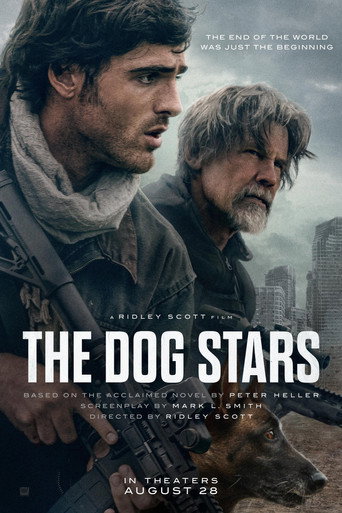
Nearly a decade after his last science fiction film, Ridley Scott returns to the genre with a subdued story about a man searching for a reason to keep living after the end of the world. Years after a pandemic has wiped out most of humanity, Hig (Jacob Elordi) lives at an abandoned Colorado airfield with his dog Jasper and Bangley (Josh Brolin), a heavily armed and paranoid former Marine. Hig spends his days flying a small plane over the surrounding wilderness and the house he once shared with his late wife, until a faint radio transmission suggests there may be other survivors beyond the world he knows.
BACKGROUND
The Dog Stars is based on Peter Heller’s acclaimed debut novel, a post-apocalyptic story that was deemed extremely cinematic upon its release but only made its way to the screen over a decade later, when The Revenant screenwriter Mark L. Smith brought the project to Ridley Scott. Paul Mescal was initially set to play Hig but had to step down because of scheduling conflicts, resulting in popular sad boy number two, Jacob Elordi, taking over the role alongside Josh Brolin and Margaret Qualley. Despite the story’s Colorado setting, Scott filmed largely across Italy, using its forests and mountainous landscapes to recreate the American wilderness. As is common with the director, filming moved quickly, often using several cameras and very few takes, while the actors were given unusual freedom to shape the material. Elordi and Qualley even spent their weekends reworking scenes and personalizing their dialogue, with some of those additions ultimately surviving into the finished film.

THE REVIEW
It takes a while to decipher what possibly drew Ridley Scott to the material, or anyone, for that matter. Its post-apocalyptic world feels assembled from ideas that have become increasingly familiar over the past decade: isolated survivors, dangerous outsiders, another community somewhere beyond the horizon, and the inevitable reminder that humanity remains the greatest threat even after civilization has collapsed. Perhaps this material felt fresher when Peter Heller’s novel was published, but after The Walking Dead, The Last of Us, Fallout, and countless variations on the same premise, there is little immediately appealing about watching another survivor approach another tribe, pray they happen to be good people, and mourn everything they have lost along the way.
The film requires patience, especially in its opening act, where Harry Gregson-Williams, Scott’s most frequent musical collaborator, accompanies Hig’s isolation with sparse guitar solos and minimal strings that recall the similarly restrained sound of The Last of Us. Combined with Erik Messerschmidt’s desaturated photography and the deliberately slow pace, The Dog Stars sometimes seems determined to lull you to sleep. At the center of all this restraint is Jacob Elordi, hardly the companion I would choose for the apocalypse, even if he is noticeably more emotive here than in something like On Swift Horses, occasionally allowing him small laughs and glimpses of warmth. For the most part, however, his performance remains so heavily internalized that it falls into the worst tendencies of these subdued, perpetually dour performances. They drain the charisma that such sparse stories desperately need without communicating the enormous grief underneath, leaving Hig clearly sad and broken but, for much of the film, simply not compelling company.
Elordi is hardly helped by a screenplay that struggles to give those emotions convincing expression. The dialogue can be painfully blunt, including Hig’s laugh-inducing reminiscence, “I used to be a mechanic. I fixed things.” The film frequently tells us what these people have lost without effectively making us feel it, particularly in Hig’s relationship with Bangley (Josh Brolin). Their opposing instincts, with Bangley determined to protect what remains and Hig still curious enough to look beyond it, should create an interesting tension, but neither their conflict nor the affection underneath it ever feels fully developed.
The Dog Stars becomes much better once Hig finally boards his plane and follows the mysterious voice he has been hearing on the radio. His journey takes him to a farm occupied by Cima (Margaret Qualley) and her father, Pops (Guy Pearce). Scott avoids dragging out developments we have already seen countless times in stories like this, with Hig and Cima’s eventual conversation about what they have lost working precisely because their pain is not treated as some enormous revelation waiting to be dramatically uncovered.
While Hig’s time with Cima gives the film some of its most natural and emotional material, other encounters feel less at home, including a bizarre diversion involving Allison Janney, whose overblown performance would sit better in Snowpiercer or Fallout. Even with the occasional tonal clash, Scott remains remarkably good at taking questionable material and making an individual sequence work. He never pretends the strangers Hig encounters might be trustworthy, making the danger apparent almost immediately and building tension around when the situation will finally erupt. What follows is several wonderfully uncomfortable minutes capped by a satisfying, if narratively convenient, payoff.
Better still are two action sequences involving a group of Indigenous people, one centered around a plane taking off and another unfolding through nightmarish imagery in the darkness. Both are fantastic, containing some of the year’s best isolated pieces of action staging. Much like Disclosure Day, they are reminders of what older and wiser masters can still pull off, with individual sequences thrilling enough to work almost independently of the films surrounding them. Unfortunately, that is also part of the problem. Scott can make practically any five minutes of The Dog Stars exciting when he wants to, but the screenplay rarely makes those minutes feel like an organic consequence of everything preceding them. Encounters arrive, generate tension, resolve, and give way to the next one, creating an episodic rhythm that keeps even the best sequences from building much cumulative momentum.
And yet, somewhere inside this derivative story, awkward dialogue, uneven pacing, and a protagonist hard to connect with, Scott eventually finds a justification for the whole thing. The Dog Stars gradually becomes less interested in whether Hig can survive this world than whether surviving it means anything if he has nobody with whom to share it. Approaching 90, Scott looks at a desolate landscape populated by people who have every reason to abandon hope and arrives at a surprisingly optimistic conclusion. Even Bangley, the character most committed to isolation and suspicion, ultimately reveals a desire for connection. The screenplay has done little to earn the emotional force of that conclusion, but somehow Scott gets there.
FINAL THOUGHTS
The Dog Stars works despite itself, a film which frequently frustrates but whose final destination makes the journey worthwhile. In a genre that has spent years telling us that other people are the greatest danger after the world ends, it is unquestionably affecting to see an old filmmaker arrive at the opposite conclusion: our desire to find and help one another may be the only reason surviving it matters.
Still courtesy of Walt Disney Studios Motion Pictures Canada
- 1Everytime
- 2Hadestown: The Musical
- 3Tuner
- 4Minotaur
- 5You Can See Everything
- 118The Dog Stars#118 of 219
- Where to watch
- Out of Theaters
- Where to watch
- Out of Theaters
 Play trailer


- Original title
- The Dog Stars
- Director
- Ridley Scott
- Cast
- Jacob Elordi, Margaret Qualley, Josh Brolin, Guy Pearce, Allison Janney, Benedict Wong, Ewen Bremner, James Craze
- Rated
- 14A
- Screenwriter
- Mark L. Smith
- Composer
- Harry Gregson-Williams
- Cinematography
- Erik Messerschmidt
- Editor
- Claire Simpson, Sam Restivo
- Country

- Language
- English
- Budget
- $110 million
- Box office
- $37.417 million
- Distributor (CA)
- Walt Disney Studios Motion Pictures Canada