

OVERVIEW
By 1943, France’s resistance to the Nazi occupation was scattered across dozens of small networks that distrusted one another and often did not even know of each other. Jean Moulin (Gilles Lellouche), a former prefect parachuted into the country on Charles de Gaulle’s orders, was the man tasked with pulling them into a single command. Moulin follows the work of that mission and the days that begin with his arrest by the Gestapo in June 1943, when he is taken to Lyon and placed in the hands of Klaus Barbie (Lars Eidinger), the head of the Gestapo in the city.
BACKGROUND
After Son of Saul surprised the Cannes crowd in 2015, first by being granted a Competition slot at all (a slot Cannes almost never grants to a feature debut, routing first features through Un Certain Regard or the parallel sidebars instead), and then by losing the Palme to Audiard’s Dheepan in a room that had openly decided Nemes’ film was the stronger work, the Hungarian director had a tough time returning to the Croisette. The two features he made in between, Sunset and Orphan, both struggled to extend the radical formal grammar of the debut, 4:3 Academy ratio glued to one face, and both premiered at Venice to muted receptions that have since faded from the conversation. To return, he had to do the opposite of what earned him his first slot, trading the radical for the classical and swapping an unknown lead for a bankable French star above the title, while focusing on a central figure of French history. Jean Moulin had been the subject of two French television adaptations but no theatrical production, and the opportunity to present the first major biographical film about one of France’s most revered national figures was an opportunity the committee would not pass up.
THE REVIEW
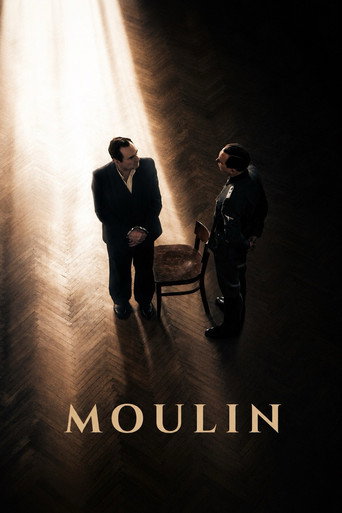
The result is a movie far closer to another Oscar-nominated work from 2015: Spielberg’s Bridge of Spies. Like that film, Moulin is a respectable, well-mounted classical narrative, well shot, well acted, and ultimately effective at telling its story. Mátyás Erdély shoots on 35mm in true anamorphic CinemaScope, with a storybook use of colors: muted yellows for the daylight scenes before prison, deep shadows for the night-time spy activities, muted grays once Moulin is in Gestapo custody. Compositions are precise, and the editing keeps the story tense, especially in the first half, as it moves determinedly through each of its pivotal moments.
The spy scenes thrill with secret encounters, code names, and easy-to-follow abbreviations, and the second half, which sees Moulin tortured for information, finds its tension in the games Barbie plays while Moulin refuses to break. It all looks good and is brought together by Lellouche, whose posture and controlled face convince us of a man exceptionally good at hiding and lying, while keeping his growing fear always visible. Eidinger is menacing and intelligent in equal measure, which makes every scene between the two great cat-and-mouse cinema.
It is classical cinema that, through its craft, becomes a respectable piece of filmmaking, informing us about the historical event while engaging us in the narrative. At the same time, the cost of following such a traditional path is the loss of Nemes’ voice, and what remains is a film that, although accomplished, could have been made by anyone. His distinctive style is gone, and the film has little point of view beyond convincing us of how committed Moulin was to keeping his secrets. That facet is impressive, and we come away knowing of this man’s important work to get France’s Resistance acting as one command, without ever fully delving into why all of that work mattered.
FINAL THOUGHTS
Moulin is, in the end, the trade Nemes had to make to come back. A respectable national biopic that gets the craft right and the showcase right, easy to admire on every technical level. It is worth it for the work Lellouche and Eidinger do across the table from each other, and for the historical curiosity of seeing France’s most revered Resistance figure finally given a theatrical frame. Whether the director of Son of Saul could have made a stranger, more inhabited film, while making the torture feel more visceral, is something we will never know.
- 1Everytime
- 2Hadestown: The Musical
- 3Tuner
- 4Minotaur
- 5You Can See Everything
- 69Moulin#69 of 219
- 1Minotaur
- 2Hope
- 3The Man I Love
- 4The Unknown
- 5La Gradiva
- 19Moulin#19 of 34
- Where to watch
- Coming soon
- Where to watch
- Coming soon
 Play trailer


- Original title
- Moulin
- Director
- László Nemes
- Cast
- Gilles Lellouche, Lars Eidinger, Louise Bourgoin, Marcin Czarnik, Max Warburton, Félix Lefebvre, Hortense de Gromard, Théo Costa-Marini
- Screenwriter
- Olivier Demangel
- Composer
- Laëtitia Pansanel-Garric
- Cinematography
- Mátyás Erdély, Eszter Csepeli
- Editor
- Péter Politzer
- Country


- Language
- French