
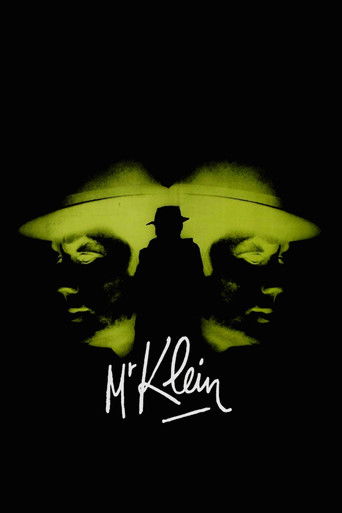

Mr. Klein opens with a woman being examined like livestock. Her nose is measured, her posture judged, her features analyzed under cold fluorescent light. The purpose? To determine if she “looks Jewish.” If so, she’ll be detained, and, absurdly, she has to pay for the exam. Set in Nazi-occupied Paris in 1942, the film wastes no time revealing its central idea: the occupation and persecution of Jews was never really about ideology or economics. It was about erasure, a system designed to dehumanize, to “purify” society based on appearance, ancestry, or rumor.
That’s why Robert Klein never thought to worry.
He’s a wealthy Parisian art dealer (played by Alain Delon, in full Le Samouraï mode) who’s been profiting off the very people being targeted, buying valuable artworks from Jewish families desperate to flee. He’s detached, smug, confident in his safety. But then a Jewish newspaper arrives at his home, addressed to a “Mr. Klein.” Not him, supposedly, but someone else with the same name. And this other Mr. Klein is wanted by the authorities.
From there, the film leans into a slow-burning paranoia. Klein is followed, interrogated, and watched. He tries to solve the situation like a legal puzzle, thinking the right papers or clever explanations will restore order. But the more he tries to untangle it, the more powerless he becomes. And the more we begin to wonder if the “other” Klein is real, or just a projection of a man unraveling under the weight of a system that no longer recognizes him.
The cinematography, by Gerry Fisher, is one of the film’s more memorable elements. The palette is muted, drained of life, with shadows pressing in from the edges. It gives the impression that the world is quietly disappearing around Klein, and he’s the last one to notice. The atmosphere is thick with dread, and Joseph Losey’s direction smartly avoids easy exposition. Like Klein, we’re left grasping for answers that never come.
What sticks most, though, is how Klein sees himself as separate from those being arrested. He’s not like them. He’s cultured. He’s French. He’s safe. The film’s quiet brilliance lies in watching that certainty fall apart. He can’t imagine being mistaken for a Jew, because in his mind, there’s a firm line between “him” and “them.” The story slowly, methodically erases that line.
But then we reach the third act, and here’s where the film loses some of its power. On paper, the ending is devastating. It’s stark, morally loaded, and tragically inevitable. But Delon’s performance never fully breaks. He stays composed, almost passive. There’s no moment of collapse. No flicker of realization. It’s as if he walks quietly into the nightmare without ever acknowledging it. That may be the point, but emotionally, it lands frustratingly soft.
Mr. Klein is a cold, cerebral mystery about identity, complicity, and how quickly privilege disappears when the system turns. It’s elegantly crafted, thematically rich, and deeply unsettling. But it holds back just enough in its final moments to keep it from being truly great. It stays in your head, but never quite makes it to your gut.
- 1Rocky
- 2Taxi Driver
- 3Assault on Precinct 13
- 4Kings of the Road
- 5All the President's Men
- 19Mr. Klein#19 of 51
- Where to watch
 Criterion Channel
- Where to watch
- Not available for streaming
 Play trailer


- Original title
- Mr. Klein
- Director
- Joseph Losey
- Cast
- Alain Delon, Jeanne Moreau, Francine Bergé, Juliet Berto, Jean Bouise, Suzanne Flon, Massimo Girotti, Michael Lonsdale
- Rated
- PG
- Screenwriter
- Franco Solinas, Fernando Morandi, Costa-Gavras
- Composer
- Egisto Macchi, Pierre Porte
- Cinematography
- Gerry Fisher
- Editor
- Marie Castro, Henri Lanoë, Michèle Neny
- Country


- Language
- French