
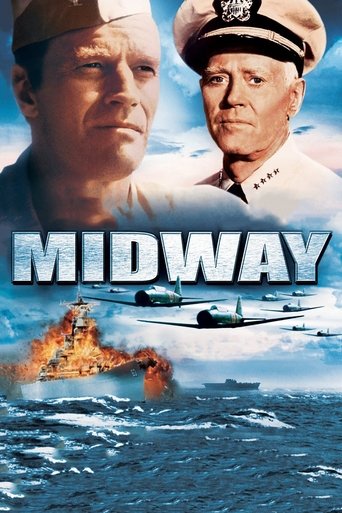

For anyone needing a refresher on their WWII history, the Battle of Midway was a pivotal naval confrontation in June 1942 that effectively halted Japanese expansion in the Pacific and served as a decisive response to the attack on Pearl Harbor. Jack Smight’s 1976 film sets out to dramatize this turning point through an all-star ensemble, a cross-cultural romance, and a dual perspective that includes both the American and Japanese sides of the conflict. The intent is noble. The execution, regrettably, is another matter.
Much like Universal’s The Hindenburg from the prior year, Midway leans on archival combat footage to lend authenticity where special effects of the time fell short. But while The Hindenburg used this approach sparingly, reserving it for its climactic payoff, Midway builds its entire second half around a patchwork of grainy newsreel clips, awkwardly edited with the filmed action. The transitions are clunky, and the differences in lighting, film quality, and staging make it painfully obvious when the film is cutting between old footage and new scenes.
Adding to the disjointedness are frequent title cards used to identify characters mid-scene, a distracting and inelegant device that suggests a lack of confidence in either the writing or the audience’s ability to follow. Combined with the already confusing back-and-forth between dramatized sequences and historical footage, the film flattens any tension it tries to build and renders its battle scenes inert.
The cast, stacked with Hollywood heavyweights like Charlton Heston, Henry Fonda, Glenn Ford, and James Coburn, gives the production the veneer of prestige. But these actors are given little to do beyond wear uniforms and deliver exposition. Characterization is surface-level at best. Heston brings a sturdy presence as a fictional naval officer, but his performance is stiff and his family subplot, meant to humanize the conflict, feels barely sketched. Fonda brings quiet authority, but spends most of his time staring at maps in war rooms that feel more stagey than urgent.
Efforts to depict the Japanese perspective are, in theory, a step toward nuance, but in practice, they fall flat. The Japanese officers are treated with a lack of depth, their dialogue awkwardly dubbed and devoid of character detail. It’s a superficial parallel to the American narrative, and without any significant casting or cultural consultation, the result comes off as tokenistic rather than balanced.
The romantic subplot, between Heston’s son and a Japanese-American woman whose family is interned, could have added emotional resonance, especially given the historical implications. Instead, it’s treated as an afterthought. The two characters share minimal screen time, and their relationship is never convincingly established. Rather than deepening the drama, the subplot interrupts the main narrative without ever justifying its presence.
And then there’s the score by John Williams, arguably the film’s most disappointing element. Written the same year as The Missouri Breaks and The Family Plot, this effort stands as one of the composer’s weakest. While the music may function on its own terms, its placement within the film actively works against the intended tone. The rousing, militaristic marches clash with the film’s attempts at realism, and in some moments, the score swells so triumphantly over archival footage that it borders on the inappropriate, turning scenes of real-life carnage into something uncomfortably close to a recruitment reel.
Even setting aside its excessive and awkward reliance on archival footage, Midway feels less like a gripping war epic and more like a dramatized history lesson, the kind that leaves students zoning out to the drone of a monotone lecture. It aims to educate, entertain, and move, but can’t execute any of them well. The story it tells is undeniably important, but importance alone can’t carry a film. Burdened by its overused footage, fragmented storytelling, and a mismatched musical tone, Midway ultimately collapses under the weight of its own ambitions.
- 1Rocky
- 2Taxi Driver
- 3Assault on Precinct 13
- 4Kings of the Road
- 5All the President's Men
- 51Midway#51 of 51
- Where to watch
- Rent or buy at Apple TV Store, YouTube, Amazon Video
- Where to watch
- Rent or buy at Apple TV Store, Amazon Video, Claro video
 Play trailer


- Original title
- Midway
- Director
- Jack Smight
- Cast
- Charlton Heston, Henry Fonda, James Coburn, Glenn Ford, Hal Holbrook, Robert Mitchum, Toshirō Mifune, Cliff Robertson
- Rated
- PG
- Screenwriter
- Donald S. Sanford
- Composer
- John Williams
- Cinematography
- Harry Stradling Jr.
- Editor
- Robert Swink, Frank J. Urioste
- Country
- Language
- English
- Budget
- $4 million
- Box office
- $100 million