
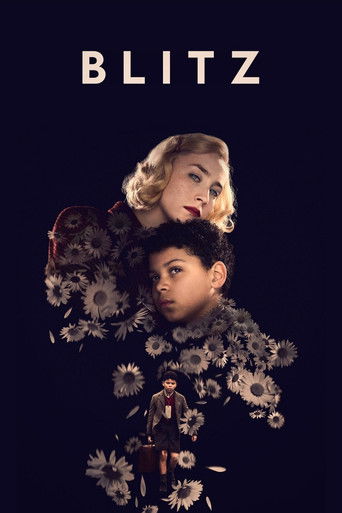
In Blitz, Steve McQueen attempts to explore the trauma and heartbreak of families separated during the Blitz, the devastating bombing campaign carried out by Nazi Germany against London in World War II. While films like Empire of the Sun, An American Tail, Atonement, and The Impossible succeed in conveying the emotional stakes of families torn apart by various circumstances, capturing the desperation of families facing the fear of never being reunited, Blitz struggles to evoke the same depth. McQueen, known for his complex explorations of power and human suffering in films like 12 Years a Slave and Shame, doesn’t achieve anything close to that. His signature style doesn’t align with the needs of this more conventional narrative, and while his visuals and tense atmosphere are on display, they never quite connect with what the story truly needs.
There’s a common misconception that straightforward, plot-driven narratives are somehow easier or less deserving of praise than more cerebral, thought-provoking works. Blitz probably taught McQueen otherwise. He struggles to sell the complex human emotions in its simplicity. The film’s linear approach demands a level of emotional engagement that McQueen’s techniques can’t fully deliver.
On the technical side, Blitz is a treat and features a phenomenal production design. Every frame meticulously reconstructs war-torn London, from the eerie rubble-strewn streets to the bomb shelters echoing with the tension of people just trying to survive. The sound work also deserves special mention, sirens, explosions, and the hum of anxious crowds are expertly rendered to pull the audience into the urgency of the moment. Hans Zimmer’s intense score adds another layer of suspense, though it often feels overwhelming, forcing tension in scenes that might have benefited from quieter, more personal moments. McQueen seems unable to use them to achieve their intended goal: generating empathy or interest in the characters.
The plot centers on young George and his mother, Rita (Saoirse Ronan). In the midst of the London Blitz, Rita sends George away on a train to protect him. Overcome with longing for his mother, George jumps off the train and embarks on a dangerous journey through war-torn England, hoping to reunite with her.
The treatment of young George is one of the film’s major issues. While the intent is clear, to show him as distant and traumatized, the choice to have him leave the train in a petulant, childish manner makes it hard to empathize with him. Rather than a heart-wrenching moment of isolation, it feels like a plot device that weakens the emotional impact. This decision, coupled with George’s lack of personality, turns him into a blank slate, leaving viewers with little to latch onto emotionally. Also, it doesn’t help that nothing particularly interesting happens in his journey. The ‘episode’ with Stephen Graham is the worst.
Ronan, too, is hampered by a script that doesn’t fully explore her character’s grief. While she skillfully portrays the complex emotions of a mother separated from her son, these feelings don’t come across with the intensity they deserve. At times, her distress over sending George away feels genuine, but in quieter moments between, that grief fades, making her concern feel forced. The film fails to capture these subtle emotional shifts, robbing the story of its emotional weight.
By the final act, when the film should be delivering a climax charged with catharsis and heartbreak, it instead feels empty. McQueen’s style and vision have crafted an aesthetically powerful experience, but without the heart and depth to back it up, Blitz becomes a beautifully constructed film that leaves little lasting impact. It’s technically accomplished, but its emotional void ultimately makes it a well-made film that evokes nothing.
- Where to watch

 Apple TV
 Apple TV
 Play trailer


- Original title
- Blitz
- Director
- Steve McQueen
- Cast
- Elliott Heffernan, Saoirse Ronan, Benjamin Clementine, Paul Weller, Stephen Graham, Harris Dickinson, Kathy Burke, Leigh Gill
- Rated
- PG-13
- Screenwriter
- Steve McQueen
- Composer
- Hans Zimmer
- Cinematography
- Yorick Le Saux, James France
- Editor
- Peter Sciberras
- Country


- Language
- English
- Budget
- $15.775 million
- Box office
- $15.8 million
- Streaming (CA)
- Apple TV