
OVERVIEW
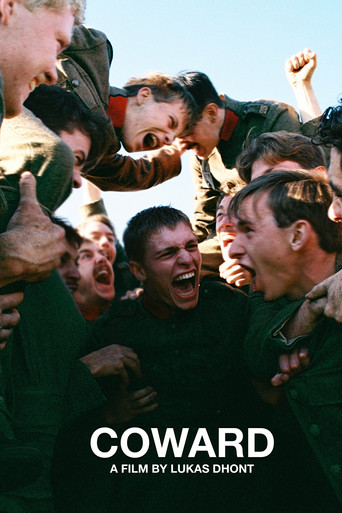
Being gay in 1916 was no easy feat, and for Pierre (Emmanuel Macchia), a timid young farmer turned soldier, acting on his desires was not even in the realm of possibilities. He spends his early days in camp working hard to fit in with his battalion, men who mock the enemy prisoners with the cruelty that rules such places. Then he meets Francis (Valentin Campagne), a former tailor who runs the battalion’s theater troupe, and decides to go against his better judgment. While the rest of the men go to battle, Pierre injures himself so he can stay behind and spend more time with Francis.
BACKGROUND
The idea behind the film came from a black-and-white photograph Dhont saw in a Paris bookshop, of a soldier in a sandbag skirt performing behind the front lines. Intrigued, he consulted historians, who told him these revues were a recurring practice where men turning the tools of war into theater to entertain the troops between deployments. Dhont uses that history as a backdrop for his usual subject, the courage it takes to love someone you are not allowed to love. Doubts were raised over whether he would have the film ready for the 2026 Cannes Film Festival, where trade rumors briefly had him slipping to 2027, but he finished it close to the wire. It premiered during the most openly queer Competition in the festival’s history and left with a shared Best Actor prize for its two newcomers, won in a field that included Javier Bardem and Rami Malek.

THE REVIEW
Coward continues Dhont’s exploration of the conflict between desire and shame, leaning on many of his usual traits: close-range shots of faces, hands building intimacy between its characters, the central romance rendered as gentle and tender as possible.
If that approach worked well in Close, where he explored the forbidden closeness of two young teenagers, it now sits at odds with a setting far more ambitious. For one moment, you are watching a very small, intimate scene about two boys embracing for the first time, and for the next, you are asked to set that against the horror of war.
Being fair to Dhont, he pushes his approach to its limit, with fantastic use of sound that tries to immerse the audience more than the visuals manage to. He shows again that he casts for presence over technique, finding unknowns and building the film around their faces, the way Eden Dambrine defined Close. The non-professional quality of the two leads does a lot of work, and the Cannes jury agreed, handing the pair a shared Best Actor.
Seeing what should be far heavier and more complex themes stripped down to their bare minimum makes the whole experience feel rather weightless. When a character tells Pierre he is a coward for staying outside the conflict, the accusation carries far less force than it should. Are these people proud of their country? Why is Francis so off the hook for not going while Pierre is crucified for it? And how much of Pierre not wanting to fight is down to his attraction to Francis versus the trauma of watching men die next to him? Playing it out this way, the film comes close to trivializing war trauma. All you need is to find the love of your life.
The film reaches for a second idea, that outsiders find refuge in art, and it is a good one. The theater troupe gives Francis and his band of rejects a place to exist that the real world denies them, a stage where a man in a parachute dress is applauded by the same soldiers who would beat him for it anywhere else. That is a genuinely strange and moving arrangement, and Coward sets it up with care. Then it more or less leaves it there. The Black Ball, which premiered the same day, touches on similar matters and lets it deepen and complicate over its runtime; Dhont raises it, stages a few numbers, and returns to the romance. The same thing happens with the irony at the film’s center: these men are freer to be themselves at the front than in their own homes. It is the kind of tension a whole film could be built on. Dhont is content to state it and trust that stating it is enough.
Instead, the film repeats itself for much of its middle, developing the romance slowly and with little conflict around it. When conflict does arrive, it appears only in isolated scenes, such as Pierre standing to protect Francis (even though Francis handled the moment far more cleverly and never needed protection), or in the closing scenes. A late sequence has the army singing together, clearly meant as one of the film’s emotional high points, but it plays less like men who lost their souls to the war and more like a band of misfits finally coming together in a Disney movie. The film keeps returning to its sparse central romance, which, tender as it is, feels far too slight for everything around it.
FINAL THOUGHTS
I am genuinely glad the two leads won Best Actor at Cannes, but I sit in the minority that did not think the film belonged in Competition at all. Its central ideas run too close to The Black Ball, which premiered the same day and overshadowed it, and on its own terms, Coward is too slight to leave a mark. There were more daring titles in the sidebars that could have used the slot. Dhont keeps everything small and close and trusts the intimacy to carry it, but for me, keeping it tender is not enough, especially for a film that sets out to be about courage, desertion, and fear in war.
Still courtesy of MUBI
- 1Everytime
- 2Hadestown: The Musical
- 3Tuner
- 4Minotaur
- 5You Can See Everything
- 164Coward#164 of 219
- 1Minotaur
- 2Wild Horse Nine
- 3The Man I Love
- 4The Unknown
- 5La Gradiva
- 41Coward#41 of 52
- 1Minotaur
- 2Hope
- 3The Man I Love
- 4The Unknown
- 5La Gradiva
- 30Coward#30 of 34
- Where to watch
- Coming soonDec 25, 2026
- Where to watch
- Coming soonDec 31, 2026
 Play trailer


- Original title
- Coward
- Director
- Lukas Dhont
- Cast
- Emmanuel Macchia, Valentin Campagne, Jef Jacobs, Willem De Schryver, Liam Jacqmin, Mistral Guidotti, Jonas Wertz, Boris Bouchat
- Screenwriter
- Lukas Dhont, Angelo Tijssens
- Composer
- Valentin Hadjadj
- Cinematography
- Frank van den Eeden
- Editor
- Alain Dessauvage
- Country


- Language
- French
- Distributor (CA)
- MUBI