
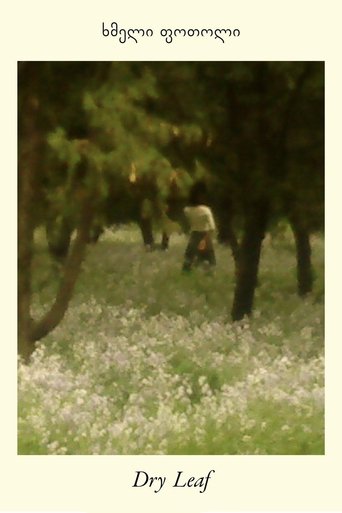
A dry leaf is fragile, its surface breaking apart with the smallest touch. The wind carries it aimlessly, a simple reminder that time moves only forward. In Alexandre Koberidze’s Dry Leaf, it carries all these meanings, but most of all it reflects a life that once thrived and has now quietly faded.
The story begins with Irakli, played by the director’s own father, who receives a letter from his daughter Lisa, a sports photographer a, aouncing she is stepping away from her work. Disturbed by the news, he sets out to retrace her last assignments. Joined by Levan, Lisa’s close friend, he moves from one rural football field to another, asking the same questions about each field’s location and whether anyone has seen the woman in Lisa’s photograph. Each place he reaches is a neglected, half-abandoned space, watched over by stray animals that seem more present than the people he approaches. Lisa herself is never there.
Told at an unhurried pace, Dry Leaf unfolds like a dreamlike, poetic road trip. On the surface, the repetition of Irakli’s encounters feels narratively aimless. Variations are slight, but as the cycles stretch on, frustration begins to seep in for him and for us. We feel the weight of going in circles, of chasing meaning where it never appears. This is not simply a search for a daughter, but a meditation on what has already slipped away, a man resisting the void that loss leaves behind. He cannot understand why Lisa would leave, since clinging to routine is the only way he knows to keep going. He never explodes, and the changes are gradual, but you can feel what the journey is doing to him.
Koberidze makes a truly bold and unconventional choices to underscore this journey. The entire film is shot on an old Sony Ericsson phone, giving us pixelated and foggy images that blur detail and make the world seem half-remembered. They call to mind the early days of mobile photography, when we were finally able to record our memories with ease, even if the result was often clumsy. Here the low fidelity becomes an aesthetic, a metaphor for memory itself, fragile and indistinct. Just as striking is the decision to render certain characters invisible, including Levan, who travels with Irakli and converses freely with him, yet never appears on screen. Together these choices, along with the film’s patient rhythm and a score that often feels repetitive and overbearing, make for a challenging experience, but one that carries a quiet power.
In truth, the film’s main character is the world itself. Every city Irakli passes through tells its own story of life lost and change creeping in. Abandoned football fields are torn down to make way for new condos. Children still find ways to play, but now in tighter and diminished spaces. The film mourns that loss. Its animals, watching from a distance, indifferent yet enduring, underline the idea that the world continues whether or not we notice what is disappearing.
And then, in its final moments, Dry Leaf brings its ideas together with startling clarity. The journey has not been about finding Lisa but about recognizing that despite the fragility of memory, the inevitability of change, and the traces we leave behind, there can be calm in that recognition. Like the dry leaf of its title, human lives, communities, and traditions are carried by forces beyond their control. They may appear small and easily overlooked, yet they matter deeply, and once they fall into our hands they remind us of everything that has already passed.
Still courtesy of TIFF.
- 1. Sentimental Value
- 2. Hamnet
- 3. Blue Moon
- 4. Sirāt
- 5. The Testament of Ann Lee
- 31. Dry Leaf
- Where to watch
- Out of Theaters
- Where to watch
- Out of Theaters
 Play trailer


- Original title
- ხმელი ფოთოლი
- Director
- Alexandre Koberidze
- Cast
- David Koberidze, Irina Chelidze, Giorgi Bochorishvili, Otar Nijaradze, Vakhtang Panchulidze, Manu Tavadze, Giorgi Lazrishvilli, Natalia Gelashvili
- Rated
- NR
- Screenwriter
- Alexandre Koberidze
- Composer
- Giorgi Koberidze
- Cinematography
- Alexandre Koberidze
- Editor
- Alexandre Koberidze
- Country
- Language
- Georgian