
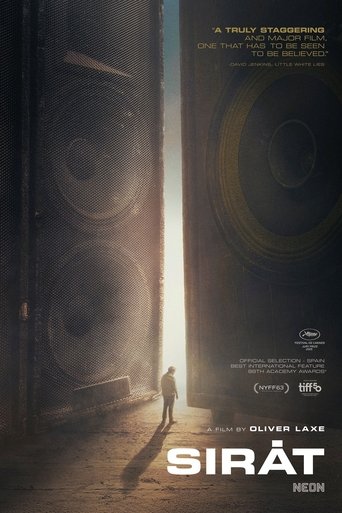
One of the greatest pleasures of film festivals is the uncertainty of choice, of taking a seat with no idea what awaits, and of being part of the first audience to discover a film. Dozens of titles arrive all at once, and it is often impossible to read between the lines and know which ones will truly stand out. That uncertainty can just as often lead to disappointment, with prestigious premieres turning into letdowns and, in hindsight, a waste of precious festival time. Yet the gamble is worth it when the opposite happens, when you suddenly realize you are among the first in the world to encounter something special. At Cannes 2025, Sirât was that film for me.
The fourth feature by Spanish director Óliver Laxe continues a career that has unfolded like a staircase through Cannes’ parallel programs. From Directors’ Fortnight to Critics’ Week and then Un Certain Regard, he won prizes at every stage while steadily refining his voice. That determination finally earned him a place in the Official Competition, where Sirât was awarded the Jury Prize. As the next progression, Laxe had spoken of wanting to make his work more accessible, even jokingly calling this film closer to “popcorn cinema,” admitting the inaccessibility of his earlier work and hoping to reach a larger audience without losing his identity. The finished film shows he not only managed that balance but advanced it further.
The title Sirât refers, in Islamic belief, to the narrow bridge every soul must cross over fire on Judgment Day. Laxe uses this image as a metaphor for the story of a father and son traveling across the desert in search of a missing daughter and sister. Their journey takes them from rave to rave, showing her photo and asking strangers if she has been seen, while clinging to the fragile hope of finding her and slowly confronting the possibility that they never will. The road itself becomes a spiritual passage, raising the question of why move forward when the destination may no longer exist. Every mile feels like an attempt to stitch something broken back together.
Shot on Super 16, Sirât is strikingly immersive. The format gives the film a tactile texture, making you feel the heat of the desert rising from the screen. The sound design is equally powerful, and Kangding Ray’s score can shake the walls of a theater or a living room. The early stretches unfold through long rave sequences that define the environment and immerse us in its world. At first, these passages feel alienating, and I admit it took me some time to connect with the film through them, but the distance narrows as the characters emerge. In these gatherings, strangers begin to mirror the protagonists’ own search, and the film draws us closer.
Much of the film follows the father and son as they join one particular group on the road to yet another rave, trekking together across the desert. The journey recalls Friedkin’s Sorcerer in its tense desert-road sequences, while the ragged convoys, battered vehicles, and even the otherworldly look of its characters bring George Miller’s Mad Max to mind. Two remarkable sequences reshape the story: one midway leaves the audience stunned, and another near the end is, quite literally, dynamite. These shifts keep the film unpredictable and engaging, giving it a rhythm that is never repetitive and always alive.
The strength of Sirât also lies in the community it builds. The ravers are shaped by rejection and loss, and the film lets us sense their histories without spelling them out. They are all running from something, or maybe toward something, and that shared movement creates a bond stronger than ideology. They carry pain but transform it into kindness, extending a generosity they may not have received themselves. This comes through in a scene where part of the group studies the photo of the daughter, their genuine desire to find her becoming evident. Small gestures accumulate, reminding us that empathy often binds people more firmly than ideology.
Piece by piece, Sirât becomes an exploration of life itself. Grief moves to the center, dialogue grows sparse, and Laxe trusts silence and glances to carry meaning. We never fully learn the backstories of the travelers, yet we come to feel that we know them. The third act does struggle with its pace as the physical search gives way to an odyssey of grief and reckoning, but it still culminates in a final sequence of rare force. Sirât is both intimate and overwhelming, a film that once seen will not be forgotten.
- 1Sentimental Value
- 2Hamnet
- 3One Battle After Another
- 4Ne Zha 2
- 5Blue Moon
- 6Sirāt#6 of 256
- 1Sentimental Value
- 2Hamnet
- 3Blue Moon
- 4Sirāt#4 of 73
- 5Tuner
- 1Sentimental Value
- 2Sirāt#2 of 27
- 3The Plague
- 4Arco
- 5Resurrection
- Where to watch
 Mubi
Mubi- Where to watch
- Telecine
 Play trailer


- Original title
- Sirāt
- Director
- Oliver Laxe
- Cast
- Sergi López, Bruno Núñez, Stefania Gadda, Joshua Liam Henderson, Richard Bellamy, Tonin Janvier, Jade Oukid, Ahmed Abbou
- Rated
- 14A
- Screenwriter
- Oliver Laxe, Santiago Fillol
- Composer
- Kangding Ray
- Cinematography
- Mauro Herce
- Editor
- Cristóbal Fernández
- Country


- Language
- Spanish
- Budget
- $7 million
- Box office
- $10.445 million