
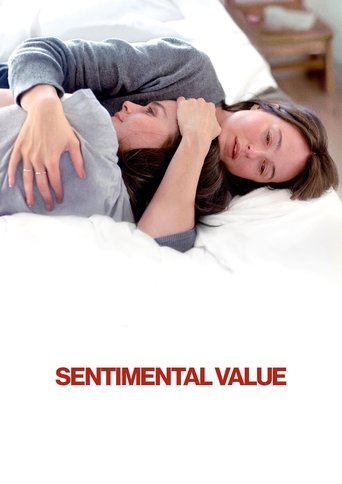
Originally drafted as part of Reviews On Reels Cannes 2025 coverage, this review has been expanded and refined after a second watch.
Joachim Trier has admitted that he sees himself more as an anthropologist than a filmmaker. He approaches cinema as a study of human behavior with the same care a scholar might bring to ritual or tradition. His films are less about narrative propulsion than about documenting gestures, contradictions, and insecurities, crafting portraits that feel achingly authentic. At their best, they work like mirrors. We recognize patterns from our own lives in characters who may live nothing like us, and in that recognition comes discovery, confrontation, and sometimes even transformation.
Like Mike Leigh or Richard Linklater, the Norwegian director finds beauty in the mundane and significance in imperfection, portraying characters who are ordinary yet endlessly captivating. What sets him apart, and in my view places him above those names, is the way he bridges their strengths, the empathy for the flawed from Leigh and the optimism from Linklater, with a tone that is uniquely his own. He never loses sight of creating human characters, but he surrounds them with imagination, stylistic flourishes, and humor that elevate his films beyond exercises in realism. By layering in these inventions, he transforms what might otherwise be despairing studies of human weakness into experiences that feel hopeful. Even in stories steeped in pain, he leaves us with the conviction that people can do better, and we leave inspired to try, which may be the most enduring gift cinema can offer.
If The Worst Person in the World was the culmination of these ideas, Sentimental Value takes each of them further. Here Trier turns from romantic entanglements to family bonds, focusing on the wounds left by fathers who fail again and again. At the same time he peers into the lives of artists, those who surrender fragments of their soul to nourish others and are left to live with what remains.
Not strictly autobiographical, but personal enough to feel confessional, Sentimental Value finds Trier turning the camera inward. Drawing from his own experience of becoming a parent, he tells the story of Gustav Borg (Stellan Skarsgård), a once-revered director whose life and legacy are tangled up with the scars he has left on his daughters. Nora (Renate Reinsve), now a stage actress, carries her father’s absence like an open wound, while her younger sister Agnes (Inga Ibsdotter Lilleaas) has learned to cope in quieter, warmer ways. When Gustav returns with a script based on the tragedies of his own mother, a resistance fighter tortured during the war who later died by suicide, old fractures resurface. Offering Nora the role is both an attempt to reconnect and a recognition that only she could embody a character shaped by trauma that he himself inflicted.
This is deep, fertile material, studied with care in a remarkable script. All of Trier’s strengths are on display, and the characters he draws are endlessly compelling. His exploration of filmmaking itself, representing the artist’s soul as both gift and burden, is layered with meaning. Equally strong is the theme of trauma as inheritance, passed down and reshaped across generations. It is moving to see how Nora and Agnes have developed different ways of living with sadness, and how Agnes found strength in having her sister as a guide. There is also the fascinating presence of Rachel Kemp, a young actress played beautifully by Elle Fanning, who tries to replicate the pathos of this family’s grief but finds herself frustrated by her own lack of lived experience. The production becomes less about the film itself than about these emotional collisions, and since every interaction feels lived in and is delivered with devastating precision by the cast, it becomes one of the most compelling character studies Trier has made.
The cast is uniformly excellent. Renate Reinsve, so unforgettable in The Worst Person in the World, delivers another layered performance, capturing Nora’s exhaustion and inner depression with subtle shifts in breath and glance. Elle Fanning finally has a role worthy of her talent, playing Rachel with a mixture of ambition and fragility that hints at wounds of her own. Stellan Skarsgård is magnetic as Gustav, embodying both the charisma and the cruelty of a man impossible to pin down, while Inga Ibsdotter Lilleaas brings quiet force to the third act with moments that leave a lasting ache.
Yet Sentimental Value shines not only through its cast but through how candidly it treats trauma. Pain is never a single rupture but something absorbed, reshaped, and passed on. Gustav’s mother may be gone, yet her anguish lingers in him and in his daughters. Trier captures this most hauntingly in a visual flourish where three generations of faces blend together, a stark image of suffering as legacy. Still, he never lets the film become oppressive. With Eskil Vogt co-writing, the script leaves space for humor, while Hania Rani’s score and Kasper Tuxen’s cinematography soften the darkness without diluting its weight. Editing is handled with precision, making the passage of time feel effortless and choosing just the right moments to withhold or reveal information.
The film is full of singular, unforgettable scenes: a quiet reckoning between Gustav and his longtime cinematographer, a sly callback to a moment from The Worst Person in the World, and a closing sequence, a film within a film, that left me weeping. In the end, Sentimental Value is an extraordinary study of human behavior. It peels away layers of fractured families, inherited trauma, and the cost of creating art. It is devastating and tender, precise and imaginative, and it leaves us with the rarest of feelings, the desire to understand others more deeply and to be better ourselves.
- 1Sentimental Value#1 of 256
- 2Hamnet
- 3One Battle After Another
- 4Ne Zha 2
- 5Blue Moon
- 1Sentimental Value#1 of 73
- 2Hamnet
- 3Blue Moon
- 4Sirāt
- 5Tuner
- 1Sentimental Value#1 of 27
- 2Sirāt
- 3The Plague
- 4Arco
- 5Resurrection
- Where to watch
 Prime Video
- Where to watch
 Mubi
Mubi
 Play trailer


- Original title
- Affeksjonsverdi
- Director
- Joachim Trier
- Cast
- Renate Reinsve, Stellan Skarsgård, Inga Ibsdotter Lilleaas, Elle Fanning, Anders Danielsen Lie, Jesper Christensen, Lena Endre, Cory Michael Smith
- Rated
- PG
- Screenwriter
- Eskil Vogt, Joachim Trier, Joe Serwah André
- Composer
- Hania Rani
- Cinematography
- Kasper Tuxen
- Editor
- Olivier Bugge Coutté
- Country




- Language
- Norwegian
- Budget
- $7.8 million
- Box office
- $23.884 million