
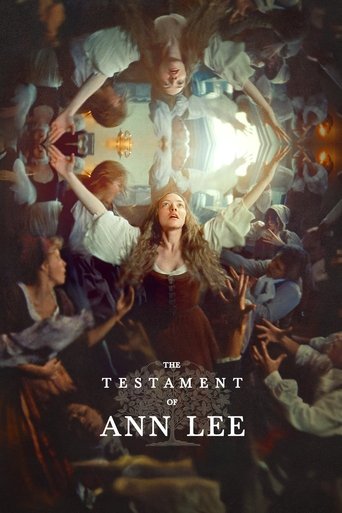
Sharing her husband’s taste for monumental storytelling, Mona Fastvold, wife of Brady Corbet (director of The Brutalist), shapes The Testament of Ann Lee around another outsider who turns trauma into creation. In Ann Lee’s case, grief and loss become a doctrine of celibacy and community. Given how closely the couple collaborates, there are even more points in common between their films, from themes that ask whether devotion is a form of liberation or another kind of imprisonment to a presentation that transforms a modest budget into a grand epic.
The film is a speculative retelling of the life of Ann Lee, founder of the Shakers, a group that grew to nearly six thousand members in the 1840s. Ann Lee was born into poverty in 18th-century England, endured the loss of all four of her children, and claimed to have visions that stressed celibacy, confession of sins, and communal living. Her conviction made her a formidable leader and appealed to working-class men and women, textile workers whose arduous lives made them open to spiritual movements that promised new beginnings. Persecution in England pushed the group to emigrate to the United States, where their message at first resonated with pacifism and allowed people from humble backgrounds to hold positions of influence. That, and directly challenging the central institutions of American society, made the group feel threatening, especially to landowners. Years later, the group would be remembered for their ecstatic worship, which involved dancing and “shaking” (hence the name), as for their rejection of violence and property.
Fastvold approaches the material as both a historical reconstruction and a study of Ann Lee herself. She became interested in the story of the Shakers after researching for a song for another project, but was hooked on Ann Lee’s leadership and the devotion of her followers. The film presents Ann as a female religious figure whose rejection of violence is balanced by an unshakable conviction, one that leans more on shared emotion than on force to keep her community together. It also suggests the double edge of prophecy, with charisma that inspires as much as it manipulates. There are thematic echoes of The Master and Saint Maud, with fragile followers caught between faith and delusion, while Ann herself, shaped by trauma, and finding in celibacy a way to cope with the loss of her children as well as with the memory of witnessing intimacy at a young age.
Fastvold’s execution includes striking musical and choreographed sequences, moments mounted with such care and precision that impress and transport, capturing the ethereal beauty and appeal of the group. The Shaker hymns, sung in unison and carried into Daniel Blumberg’s score, which also introduces electric guitars and modern tones that make the movement feel timeless, create something otherworldly. Their non ornamented, modal repetition recalls Howard Shore’s Elvish choral passages in The Lord of the Rings, floating and unmoored from familiar liturgy.
Truly making the film work is Amanda Seyfried, delivering one of her finest performances. She captures not only Ann Lee’s soft, entrancing voice but also the manipulative authority beneath it. Making great use of her expressive eyes, she convinces as a figure others might mistake for divine, while herself walking a fine line between conviction and trauma. The scenes that caused her trauma are extremely intense but also affecting.
Not all of Fastvold’s choices land. Like her husband, there are times when her hand feels too heavy, especially with voiceovers that while works in the films bookends, it also is too constant in the film itself, explaining what the film is already showing us. This becomes most distracting in Ann Lee’s pivotal tragedy, which loses its power, distancing us from her pain. The film’s third act also meanders, circling around its themes instead of confronting them, as if reluctant to resolve its ambiguity. Still, The Testament of Ann Lee is worth seeing for Seyfried alone, as well as for its entrancing musical passages. Together, they may leave you tempted to become a Shaker yourself.
This is part of Reviews On Reels TIFF 2025 Coverage. Due to the hectic rhythm of a film festival, it may be tweaked in the future. Still courtesy of TIFF.
- 1Sentimental Value
- 2Hamnet
- 3One Battle After Another
- 4Ne Zha 2
- 5Blue Moon
- 7The Testament of Ann Lee#7 of 256
- 1Sentimental Value
- 2Hamnet
- 3Blue Moon
- 4Sirāt
- 5Tuner
- 6The Testament of Ann Lee#6 of 74
- Where to watch
 Disney+
- Where to watch
- Disney+
 Play trailer


- Original title
- The Testament of Ann Lee
- Director
- Mona Fastvold
- Cast
- Amanda Seyfried, Lewis Pullman, Thomasin McKenzie, Matthew Beard, Christopher Abbott, Viola Prettejohn, David Cale, Stacy Martin
- Rated
- R
- Screenwriter
- Mona Fastvold, Brady Corbet
- Composer
- Daniel Blumberg
- Cinematography
- William Rexer, Sam Ellison
- Editor
- Sofía Subercaseaux
- Country




- Language
- English
- Budget
- $10 million
- Box office
- $4.197 million