
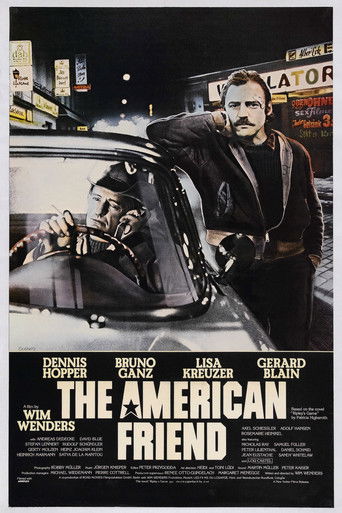

After three soulful road movies — culminating in the fantastic Kings of the Road — Wim Wenders was ready for a change. Craving a tighter narrative structure, he turned to Patricia Highsmith’s world of deception and violence. The idea of a filmmaker known for life-affirming, loosely plotted works like Kings of the Road and Perfect Days tackling a tense thriller was exciting—and while The American Friend doesn’t quite rank among Wenders’ very best, it’s a fascinating and stylish foray outside his usual comfort zone.
Wenders shows great command of cinematic language here, crafting tense sequences—especially the two major murder setpieces, both masterclasses in building suspense. Combined with Robby Müller’s stunning cinematography, Jürgen Knieper’s atmospheric score used with precision, and restrained yet incredibly sharp performances, the result is a film that looks and feels like gold.
Similarly to how he captures landscapes in his road movies, Wenders’ vision of Germany—particularly Hamburg—is striking: rain-slicked streets, sterile corridors, graffiti-tagged subways. Cityscapes are rendered as quietly decaying, empty spaces where life feels adrift. Germany isn’t shown as vibrant or bustling, but as a place of disappointment and unfulfilled promises, mirroring the emotional state of its characters.
Yet for all the strength in its visuals and moment-to-moment tension, the story itself doesn’t fully rise to the same level.
The screenplay works best when dissecting its two main characters. Dennis Hopper’s Ripley is very different from the more overtly evil portrayals by Matt Damon and Andrew Scott—and feels like a natural evolution of the character. After years of conning, lying, and destroying personal connections, Wenders’ Ripley is hollow, desperate to fill the emptiness inside him. Hopper brings a lot of nuance and unpredictability to the role (partly fueled by his real-life struggles with addiction during filming), but his greatest achievement is how convincingly he captures Ripley’s sadness. His ego, once his weapon, has become a fragile wound—so fragile that even a casual slight makes him lash out in ruinous ways.
Jonathan Zimmermann, played by Bruno Ganz, is just as complex. The script and Wenders’ direction carefully portray Zimmermann’s conflicted nature, even as his actions feel somewhat inevitable. (Like Walter White: was he really doing it all for his family, or was part of him chasing a life he feels he never truly lived? A theory that Wenders subtly confirms by showing Jonathan ‘trapped’ within frames early in the film—something you can see highlighted in the review’s featured image.) Ganz brings extraordinary discipline and quiet internal conflict to his performance, and between these two actors—and these two contrasting characters—the relationship that forms between them becomes the film’s most fascinating aspect.
Yet, much like the main plot, that relationship never quite leads anywhere profoundly hurtful or unexpected. The murders happen, there’s some fallout, but not enough to create the suffocating sense of doom that powers the best Ripley adaptations. Nor does the film land with a tragic gut-punch—the ending, especially, doesn’t hit as hard as it should.
Still, the film has aged beautifully. When a movie looks this good, and when every scene offers something to unpack, the experience becomes more powerful than the plot itself. Wenders’ thriller (which even features cameos from American cult directors portraying gangsters) might not deliver the crushing tension or tragic catharsis of the very best Ripley stories, but it becomes something rarer when filtered through Wenders’ usual themes: a beautifully crafted, quietly haunting study of loneliness, ego, and the need for real connection.
- 1Sorcerer
- 2Annie Hall
- 3The Ascent
- 4Star Wars
- 5Close Encounters of the Third Kind
- 7The American Friend#7 of 40
- Where to watch
- Rent or buy at Apple TV Store
- Where to watch
- Not available for streaming
 Play trailer


- Original title
- Der amerikanische Freund
- Director
- Wim Wenders
- Cast
- Dennis Hopper, Bruno Ganz, Lisa Kreuzer, Gérard Blain, Nicholas Ray, Samuel Fuller, Peter Lilienthal, Daniel Schmid
- Rated
- NR
- Screenwriter
- Wim Wenders
- Composer
- Jürgen Knieper
- Cinematography
- Robby Müller
- Editor
- Peter Przygodda
- Country



- Language
- German