
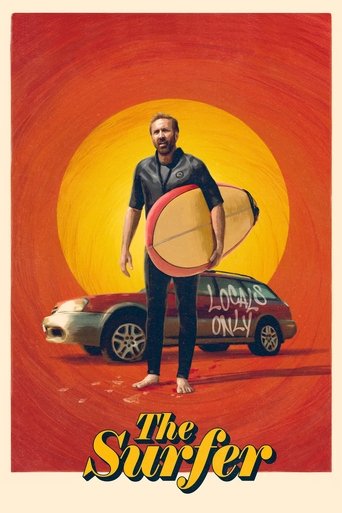
After years of appearing in one terrible movie after another, largely due to his need to pay off debts, Nicolas Cage started finding his groove again around 2013, when he began starring in and delivering some truly great performances in a sub-genre I like to call “Nicolas Cage has been done wrong and now needs to do something about it.” Whether it’s going on a violent spree (Mandy), meditating on grief (Pig), or becoming a decent father figure to a teenage boy with an abusive, alcoholic father (the underappreciated Joe), these one-word-titled films have used Cage better than anything in years. Cage, who is always committed — no matter how bad the material he’s working with — somehow gives even more of himself (as if that were possible) and brings unexpected depth to these roles.
The Surfer barely makes it into that category. It tells the story of a man (referred to only as “the Surfer”) who returns to his childhood beach with his son, intending to buy back his old family home, only to be turned away by a hostile group of locals who have unofficially taken over the area. As he insists on staying, his life and mental state begin to spiral. Unlike the previous films, where one major event sets things off, here it’s death by a thousand humiliations — refusing him the right to surf, stealing his board, messing with his car, and so on.
These build-up events, which take up about 70% of the movie, combined with dreamy, beautiful cinematography and an almost Twin Peaks-like score, keep hinting at one big, violent Nicolas Cage explosion that, unfortunately, never comes. It’s unfair, maybe, but sometimes a movie disappoints simply because it doesn’t take the story where we expect it will go. Here, the build-up is so efficient, the escalation so slow and careful, and the movie demands so much patience from the viewer, that it’s hard not to feel let down when, instead of a cathartic over-the-top spree, we get an ambiguous, confusing mixture of visions, reality, and a subdued descent into madness. The film gestures at bigger ideas — past parental trauma, the idea of tying self-worth to possessions like a house or even the simple right to surf — but it isn’t focused enough to really explore them. It ends up merely repeating those ideas rather than saying anything substantial about them.
It’s impossible not to feel disappointed by the final 15 minutes, especially since the best moment comes just before that, when the Surfer stuffs a dead rat into one of the gang members’ mouths and yells, “Eat the rat!” — a classic Nicolas Cage moment that is by far the movie’s most memorable and entertaining scene.
Still, Cage himself, the way he’s photographed, the score, the subtle production design that captures the grossness of a public beach, and the portrayal of his unraveling madness keep The Surfer extremely captivating for a big chunk of the runtime. And while those other films (Pig, Mandy, Joe) are better overall, his performance here might even beat them — finding the perfect balance between Cage’s signature mannerisms and true humanity. It’s just a shame the film doesn’t build to the kind of powerful payoff that Cage’s performance deserves.
- 1. Sinners
- 2. Shepherds (Bergers)
- 3. The Ballad of Wallis Island
- 4. Kiss of the Spider Woman
- 5. One of Them Days
- 34. The Surfer
- Where to watch
 Crave
Crave- Where to watch
- Not available for streaming
 Play trailer


- Original title
- The Surfer
- Director
- Lorcan Finnegan
- Cast
- Nicolas Cage, Julian McMahon, Justin Rosniak, Alexander Bertrand, Rahel Romahn, Nicholas Cassim, Finn Little, Charlotte Maggi
- Rated
- R
- Screenwriter
- Xavier Irvine, Jason Groarke, Thomas Martin
- Composer
- François Tétaz
- Cinematography
- Radek Ładczuk
- Editor
- Tony Cranstoun
- Country




- Language
- English