

When I was a kid, I hated long drives. A four-hour trip to the beach with my family felt like ten, and I was constantly asking “Are we there yet?” like the Donkey in Shrek 2. I’d get bored even with music playing. But as I grew older, time on the road began to pass differently. I don’t own a car (living in downtown Toronto, who really needs one?), so when I do drive, it’s usually for vacations or weekend getaways to clear my head. And I’ve come to realize that the time spent in the car, whether quietly watching the scenery, singing along to songs, or talking, often ends up being the most restful and reviving part of the trip.
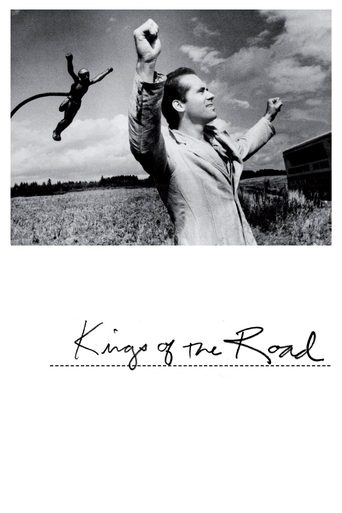
In Kings of the Road, Wim Wenders, closing out his “Road Trilogy”, aims to capture that reflective rhythm travel can bring. Inspired by his own road trips across Germany, the film follows two men: Bruno Winter (Rüdiger Vogler), a film projector repairman traveling between small-town cinemas, and Robert (Hanns Zischler), a recently divorced man who meets Bruno by chance and decides to tag along.
The film doesn’t follow a traditional plot, things happen, but the focus is on how the road itself becomes a kind of therapy. Like in most road movies, they meet people along the way, each encounter adding a little something to their journey. And many of those characters, like the main duo, could probably use a long, quiet drive themselves.
At nearly three hours, the movie can feel like the experience it’s portraying. Its slow pace might test your patience if you’re not in the mood, but the striking black-and-white cinematography helps pull you in, even during stretches of silence. What keeps it grounded is the dynamic between the two leads. Their growing connection feels authentic, built gradually through small gestures and late-night conversations. They’re learning from each other, not through big speeches, but just by being in each other’s presence.
Still, the film won’t be for everyone. If you’re not tuned into its wavelength, it may feel meandering. It’s the kind of film you might watch in sections. And that’s fine, it welcomes that kind of engagement.
Underneath it all, Kings of the Road is about taking time to reflect and figure yourself out. As the pair visits decaying movie theaters, the film quietly mourns the fading place of cinema in post-war German culture. In one case, a theater remains shuttered, lovingly maintained for a reopening that may never come. The film reflects on cultural shifts in post, World War II Germany, and in that sense, it still feels timely today, shaped by a pandemic that brought changes we may never fully reverse. The original German title, Im Lauf der Zeit (“In the Course of Time”), is a quietly poetic phrase, evoking the idea of slow transformation and the subtle erosion brought by time. It’s about what life gradually takes from us, and how stepping away from the noise might help us come to terms with it.
Like those long drives I used to dread, Kings of the Road unfolds slowly, but with time, reveals itself as something quietly restorative.
- Where to watch
 Criterion Channel
- Where to watch
- Not available for streaming


- Original title
- Im Lauf der Zeit
- Director
- Wim Wenders
- Genre
- Drama
- Cast
- Rüdiger Vogler, Hanns Zischler, Lisa Kreuzer, Rudolf Schündler, Marquard Bohm, Hans Dieter Trayer, Franziska Stömmer, Patric Kreuzer
- Screenwriter
- Wim Wenders
- Composer
- Axel Linstädt
- Cinematography
- Robby Müller
- Editor
- Peter Przygodda
- Country

- Language
- German