

OVERVIEW
Look Back is a very gentle film, which is hardly surprising given its director, Hirokazu Kore-eda. Few filmmakers capture the warmth of lonely children finding companionship quite like him, or convey how precious a friendship can feel at that age. That sensitivity makes him an especially natural fit to translate Tatsuki Fujimoto’s manga into live action, following an already successful anime adaptation. Fujino is a confident young artist who takes pride in being the best illustrator at her school, until the reclusive Kyomoto starts submitting drawings from home and completely outclasses her. Their shared obsession with drawing brings them together, first as unlikely friends and later as creative partners, as the film follows their relationship across thirteen years.
BACKGROUND
Fujimoto originally published Look Back as a one-shot manga in 2021. It found immediate success in both its original form and through Kiyotaka Oshiyama’s animated adaptation in 2024. Kore-eda, however, had already discovered the manga years earlier. Returning from Kyoto during the pandemic, he was drawn to the cover at Shinagawa Station and read the whole thing in one sitting. He approached the film with unusual patience, shooting on 35mm across an entire year in Fujimoto’s hometown of Nikaho so the story could naturally move through winter, spring, summer, and autumn. It is also Kore-eda’s second feature of 2026, arriving only a few months after Sheep in the Box premiered at Cannes. Fortunately, this represents a return to form after that fiasco.
THE REVIEW
Kore-eda strikes a great balance, keeping Look Back extremely faithful to the manga and anime framings while also making it feel grounded and populated by real people. It has double the runtime of the latter, mostly by giving scenes considerably more room to breathe and capturing the characters’ lives and introspection through stillness and music. At times, an exaggerated movement or reaction from the girls clearly tries to recreate an image from the original, which can clash with Kore-eda’s more naturalistic style. But overall, it is a meditative and patient film, taking its time through their drawing process and times together (wouldn’t be a Kore-eda film if we didn’t also see them running together!), all while scored to warm piano and strings by Yuta Bandoh, which does not use the themes from Haruka Nakamura’s music in the 2024 anime.
The director’s most impressive feat, however, is how naturally he moves through the story’s thirteen years, seamlessly changing actresses and ultimately achieving something close to the Boyhood effect as we watch Fujino and Kyomoto grow before our eyes. Fujino helps the introverted Kyomoto leave her room and find some comfort in the world outside, while Kyomoto becomes the person who understands Fujino’s obsession with drawing better than anyone. That comfort, however, starts to hinder Kyomoto, and one of the film’s most touching moments comes when she, after spending so much of her life looking toward Fujino and drawing behind her, decides that she needs to go elsewhere and discover what she can do on her own.
In that way, the direction the story takes afterward feels slightly contradictory, and perhaps unnecessarily extreme. This is more due to Fujimoto than Kore-eda, as Kyomoto finally pushes herself outside that comfort zone and chooses to discover who she can become without Fujino, only for the story to answer that independence with tragedy. Would she have been better off simply staying where she was? The film encourages us not to dwell on those what-ifs (the manga even hides an Easter egg that adds to the title and forms Don’t Look Back in Anger), but the source itself makes that question difficult to avoid. The tragedy gives the story its most devastating material, yet also feels like an easy way to generate tears when the separation of these two girls was already interesting on its own. At least it gives Kore-eda another compelling theme to explore: the emptiness left by losing someone who became not only a friend, but also a creative partner, and once, part of the everyday routine.
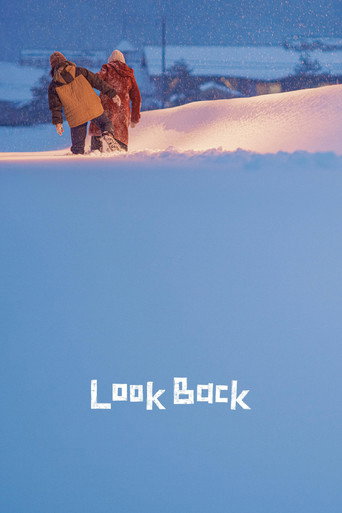
Despite its darker detour inherited from the source material, Kore-eda keeps the ordeal remarkably cozy, with unhurried editing that allows shots to linger on the scenery, especially the snow, and softly lit cinematography that gives the changing seasons a gentle, lived-in texture while making it all feel like a dreamy memory. The aforementioned score is equally lovely, with a flowing theme that manages to feel melancholy and uplifting at the same time. In that sense, the nearly doubled runtime compared with the anime also turns Look Back into a lovely palate cleanser from the outside world, giving Kore-eda more time to simply stay with these characters. His empathy is felt throughout, leaving us, even if only for a short while, in a simpler and gentler world where even tragedy is eventually looked back on with affection.
FINAL THOUGHTS
Look Back feels both like a highly faithful recreation of the manga and unmistakably a Kore-eda film, allowing him to once again bring his empathy for lonely children to a friendship built around artistic partnership and followed across many years. Some exaggerated behavior inherited from the manga occasionally clashes with his naturalistic approach, and the direction the story takes feels needlessly dark considering its themes. Yet even at its gloomiest, the film remains so warm in the way it watches these girls grow, create, and depend on one another that its saddest moments can still feel weirdly warm and uplifting. After the disappointment of Sheep in the Box, this is Kore-eda very much back in his element.
- 1Hadestown: The Musical
- 2Tuner
- 3The Weight
- 4Wicker
- 5Minotaur
- 54Look Back#54 of 191
- 1Minotaur
- 2Wild Horse Nine
- 3The Man I Love
- 4Club Kid
- 5The Unknown
- 15Look Back#15 of 42
- Where to watch
- Coming soon
- Where to watch
- Coming soon
 Play trailer


- Original title
- ルックバック
- Director
- Hirokazu Kore-eda
- Genre
- Drama
- Cast
- Natsuki Deguchi, Aju Makita, Fuuri Nanase, Rokka Okada, Masaki Suda, Kankuro Kudo, Kayo Noro, Ryo Ikeda
- Rated
- PG
- Screenwriter
- Tatsuki Fujimoto, Hirokazu Kore-eda
- Composer
- Yuta Bandoh
- Cinematography
- Senzo Ueno
- Editor
- Hirokazu Kore-eda
- Country

- Language
- Japanese
- Box office
- $929,800