

OVERVIEW
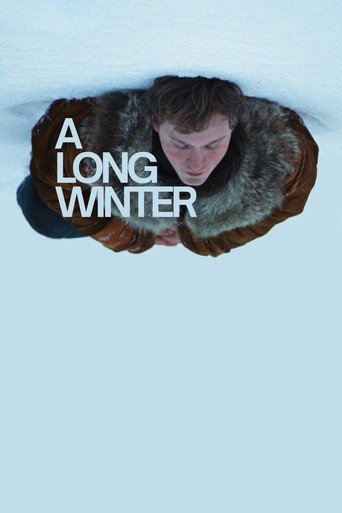
Isolation and loss continue to fascinate Andrew Haigh. Whether inside a long marriage, a brief romance, or a son’s relationship with his dead parents, the director repeatedly looks at people who crave connection but struggle to communicate what they actually feel. A Long Winter brings those same themes to a young man searching for his missing mother during an arduous winter in the Colorado mountains. Set in 1951, the film follows Mike (Fred Hechinger), who has returned home just as his younger brother Tommy (Kit Connor) is preparing to leave for the Korean War. He finds his father Lester (Ebon Moss-Bachrach) and mother Louise (Caitríona Balfe) already carrying tensions of their own, while Mike himself seems perfectly comfortable with the family’s isolated life. After an argument with Lester, Louise walks away from the house just as a snowstorm arrives, leaving Mike searching the mountains for her while slowly realizing how little he understood about his mother, his father, and ultimately himself.
BACKGROUND
A Long Winter is adapted from Colm Tóibín’s story of the same name, originally published as the closing piece in his 2006 collection Mothers and Sons. Haigh secured the rights before he had even made his first feature, after writing directly to Tóibín and spending several days walking through the Pyrenees with him, but struggled for 18 years to get the film financed. He eventually relocated the story from the Spanish Pyrenees to 1950s Colorado and finally secured backing from MUBI and Film4. The production itself required similar patience. Haigh delayed filming a full year when the project wasn’t ready in time for the winter conditions he needed, eventually shooting in Alberta, with the Canadian Rockies standing in for Colorado. The director and part of the cast also lived together during the shoot, which brought its own challenges once the heavy snow and winds arrived, conditions Haigh jokingly described as his own, considerably more delicate version of The Revenant.
THE REVIEW
It is not uncommon for a director, after spending years trying to bring one particular project to life, to borrow elements of that material for other films, only for the original project to finally become a reality and feel strangely derivative of everything that came before it. Something similar happened with Martin Scorsese and Gangs of New York, and now, with Haigh in A Long Winter. Just like that Scorsese disappointment, A Long Winter suffers from feeling derivative of the work it technically predates, inviting comparisons that don’t work in its favor.
It certainly offers Haigh a different challenge in terms of scope. The mountains, cabins, and nearby town are all surrounded by a sense of decay that, on paper, makes for a great setting for his usual themes of loneliness. Where his previous work often leaned on silence, here the wind constantly haunts the characters, reminding them that they are not only isolated, but also prisoners of that long winter. André Turpin films the mountains with enormous scale, frequently making the already short Fred Hechinger look even smaller against them, while the initial snowstorm gives Haigh one of the most ambitious sequences of his career, and one he handles remarkably well.
Yet A Long Winter is so restrained that the sadness and anxiety surrounding Louise’s disappearance, which should suffocate Mike and weigh over every scene, are kept so quiet that they become almost imperceptible. It all feels too subdued, especially against the grandeur of the scenery. The actors do what they can with what they’re asked, but they never quite fit together as a family or with the material. Hechinger unfortunately lacks the intensity the role requires, especially compared with Andrew Scott in All of Us Strangers, who played a similarly timid and quiet character with far more expressiveness. Hechinger always looks like a very nice guy, but not one with a lot going on in his mind, which fits well with his roles in Gladiator II and The White Lotus, but not a tortured young man struggling to discover who he is. Ebon Moss-Bachrach feels equally miscast, working much better as a drunk and volatile presence in a broader show like The Bear than in this kind of slow-burn period drama. His performance here is loud, but shallow, rarely capturing what truly drove his wife away. Caitríona Balfe is very good in her limited scenes but leaves the film far too early, while Martin Freeman and Kit Connor fare well on their short cameos.
Without much engagement with the characters, what remains feels like a far milder reheat of ideas about masculinity and guilt that Haigh has explored more effectively before, particularly in All of Us Strangers. The cinematography keeps it interesting, and it is great to see Haigh working on a larger scale, with the initial snowstorm alone proving how well he can handle technically challenging scenes. It eventually arrives at a mild conclusion that, while well acted, never lands with the impact it should.
FINAL THOUGHTS
A Long Winter unfortunately marks a step backward for Haigh, especially coming off three strong films. All his usual themes are here, from loneliness and unspoken desire to guilt and complicated family relationships, but they lack the emotional intensity that made his previous work so affecting. André Turpin’s beautiful photography and the larger scale give Haigh something new to work with, and there are individual sequences where that ambition pays off. Yet the characters remain strangely distant, the performances don’t connect with one another, and the extreme restraint keeps even its most dramatic moments at arm’s length. It is thoughtful and often beautiful to look at, but after two hours of waiting for those emotions to break through, A Long Winter leaves us stranded in the cold.
- Where to watch
- Coming soon
- Where to watch
- Coming soon


- Original title
- A Long Winter
- Director
- Andrew Haigh
- Genre
- Drama
- Cast
- Fred Hechinger, Caitríona Balfe, D'Pharaoh Woon-A-Tai, Kit Connor, Ebon Moss-Bachrach, Manuel Garcia-Rulfo, David Furr, Susan Serrao
- Screenwriter
- Andrew Haigh, Colm Tóibín
- Composer
- Paul Haslinger
- Cinematography
- André Turpin
- Editor
- Jonathan Alberts
- Country


- Language
- English
- Distributor (CA)
- Films We Like