

OVERVIEW
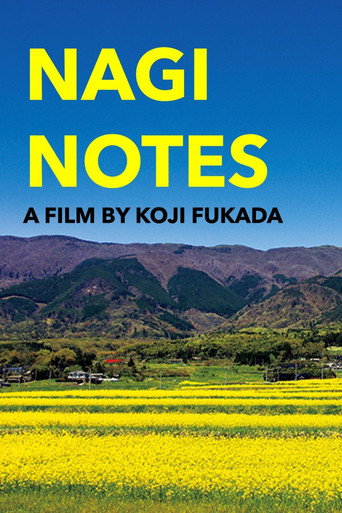
Nagi sits about 630 kilometers west of Tokyo, a town of roughly 5,000 in Okayama Prefecture, with a Self-Defense Forces base whose live-shell drills serve as background noise for the whole area and a contemporary art museum built as compensation for hosting it. The national railway does not serve the town, and the trip from Tokyo runs close to seven hours. Sculptor Yoriko (Takako Matsu) has lived there for years, working in wood and carrying a private grief. When her former sister-in-law Yuri (Shizuka Ishibashi), a newly divorced Tokyo architect, arrives to sit as her model, the two women begin to circle the things they have never said to each other.
BACKGROUND
Fukada built his reputation on harrowing family dramas, Harmonium winning the Un Certain Regard Jury Prize in 2016, Love Life at Venice in 2022, Love on Trial in Cannes Premiere in 2025. Nagi Notes is finally his promotion to the main competition, where he joins Hirokazu Kore-eda (Sheep in the Box) and Ryûsuke Hamaguchi (All of a Sudden) on the Palme d’Or shortlist. It is the first time three Japanese filmmakers have competed for the prize in the same edition since 2001. What drew Fukada to Nagi was the contradiction at the town’s center, a contemporary art museum sitting beside a Self-Defense Forces base whose live-shell drills shake the surrounding hills. He spent close to ten months there as an artist-in-residence, interviewing locals, including beef ranchers whose livelihoods have been squeezed by the war in Ukraine. The project uses Hirata’s 1994 Tokyo Notes as a base, with Fukada rewriting nearly all of it to fit the new setting.
THE REVIEW
Perhaps in an attempt to capture the life of such an isolated town, or to honor a play that is a landmark of the “quiet theater” movement, the film is a tranquil, gentle one, developing its characters in subtle ways that are easy to miss on a first watch. Fukada’s approach to capturing real life pays off, giving every character a lived-in quality and, as a result, nothing feels written.
Yoriko and Yuri’s conversations are sandwiched between detours into the lives of other residents, mainly two young boys, Keita and Haruki, whose friendship is about to end as one of their fathers is being relocated. Other than that, there are small interludes Fukada uses to capture more of the town, like the escaping cows (Nagi is a center for beef in Japan), and a visit to the museum. We don’t see much of the base, but the film uses it well as an insistent background presence, which lands particularly well in showing how neglected one of the boys feels by his father.
While the boys deal with their inevitable farewell, Yuri and Yoriko have conversations in which they slowly open up about themselves, perhaps for the first time. The film doesn’t stage long dialogue scenes; it uses the passage of time instead, letting the two women’s relationship grow closer through repetition and proximity. At the same time, the film draws out their differences. Yuri is the one who has just admitted to herself that she has been living far too much for others, neglecting her own choices, and the carefree way Yoriko has built a life away from societal judgment is precisely what Yuri seems to be reaching for during her stay.
The conversations between Yoriko and Yuri are the film’s high points, well-written and acted. Their differences should have been the bigger focus, since what surrounds them is far less interesting. Yoriko meets a widower (Kenichi Matsuyama) who takes a special interest in her, and the film spends far too much time on this subplot, which adds little to the development of the two main characters. Nagi itself is captured with warmth, and Yuri’s gradual exploration of the town plays almost like a commercial for the place.
The town is the perfect setting for the film’s premise of two women in different stages of their fight against the repression that has shaped their adult lives. In Fukada’s hands, the material stays too subtle to truly captivate. It works for a while, especially in how Yuri keeps choosing to stay at first until Yoriko herself engineers reasons for Yuri to stay longer. These moments land, but the film’s pivotal scene, with Yuri yelling from a moving car, lacks the impact that the build-up was preparing us for. Everything remains far too pleasant, and ultimately too twee, to achieve what the premise was reaching for.
- 1Everytime
- 2Hadestown: The Musical
- 3Tuner
- 4Minotaur
- 5You Can See Everything
- 160Nagi Notes#160 of 219
- 1Minotaur
- 2Hope
- 3The Man I Love
- 4The Unknown
- 5La Gradiva
- 28Nagi Notes#28 of 34
- Where to watch
- Coming soon
- Where to watch
- Coming soon
 Play trailer


- Original title
- ナギダイアリー
- Director
- Koji Fukada
- Genre
- Drama
- Cast
- Takako Matsu, Shizuka Ishibashi, Kenichi Matsuyama, Kawaguchi Waku, Kiyora Fujiwara, Sawako Fujima, Ron Mizuma, Shin Seo-gye
- Rated
- PG
- Screenwriter
- Koji Fukada
- Cinematography
- Hidetoshi Shinomiya
- Editor
- Sylvie Lager
- Country




- Language
- Japanese