

OVERVIEW
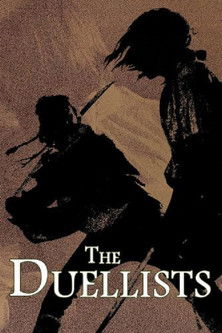
The Duellists is Ridley Scott’s debut feature, adapted from Joseph Conrad’s 1908 short story “The Duel.” It follows two French officers whose petty conflict escalates into a grudge lasting nearly 20 years during the Napoleonic era. Gabriel Féraud (Harvey Keitel) is the hot-blooded, obsessive one, while Armand d’Hubert (Keith Carradine) is the more restrained officer who uses a “code of honor” to conceal his own impulses and pride. The film explores toxic masculinity, the futility of violence, and obsession.
BACKGROUND & LEGACY
Prior to becoming a major, mainstream auteur, Scott was a commercials director who spent years trying to break into features. After founding Ridley Scott Associates (RSA), he claimed he directed over 2,000 commercials, which became his calling card.
It paid off. As Paramount sought new voices, following the unexpected success of Bugsy Malone, a producer introduced Scott to them based on his commercial work, and he embraced the opportunity. He committed to a period drama spanning years on a minimal $900,000 budget, and pulled it off with striking assurance. The film went on to win Cannes’ Best First Work/Best Debut Film prize and earned two BAFTA nominations, but made little impact at the box office. Still, it signaled that Scott was ready for larger projects, which helped secure his next gig, Alien (1979).
THE REVIEW
Ridley Scott’s confidence is clear from the opening duel, filmed from afar so the landscape makes the conflict feel grand while leaving the men isolated and oddly insignificant, a visual approach that draws bold comparisons to Barry Lyndon. For the first hour, he keeps pushing against the film’s low budget without ever letting the seams show. It never plays like a debut, but like the work of a director already in control of the craft, especially in how he reveals character through pacing and action rather than explanation.
He uses sets and cinematography intelligently, going intimate in the large camp scenes so the focus stays on character, while the framing makes the world feel fuller than the production likely was. His ability to convey scale is unmatchable, something he would later prove in historical epics like the two Gladiator films and Kingdom of Heaven, yet The Duellists shows he does not need an enormous budget to get there. It is not only the framing but also the way people move and speak, like the General’s weary manner when dealing with d’Hubert’s feud, treating it with the smallness it deserves against everything else happening around them. Even as the duels stay personal, the film makes space and time feel lived-in, with years passing in a way you can feel on the characters.
It is, as the name suggests, a movie with a lot of fencing, sword fighting, and action set pieces, yet they always support the story and deepen the characters rather than taking the forefront as the main attraction. A lot of care went into the choreography, impressive in its grounded, period-minded approach. More importantly, what you get from the fights is the dynamic between the characters themselves, which makes them far more tense.
Scott also proves an apt storyteller, giving the duels’ build-up as much weight as the fights themselves. If the first clash has Armand hesitating and being slowly lured in, the second feels much more inevitable, with Armand no longer pretending he wants to avoid it, and by the third, we do not even see the lead-up at all, cutting straight to them mid-fight, already tired.
Add the well-spotted score, which uses oboe and flute to convey the isolation that the obsession brings to Armand, and the production and costume design, which, like the candlelit cinematography for interiors, is once again Barry Lyndon-inspired, and it is easy to tell this is the work of a capital-F filmmaker.
What holds The Duellists back is something Scott has a habit of: a drop in energy once the film shifts from charged set pieces to more connective, character-focused material. After a very strong first hour, in which the escalating tension between the two rivals is conveyed through their fights, the film spends time on d’Hubert’s private life, settling into a sluggish middle as he builds a family, a stretch meant to underline the personal cost of the feud. It is harder to invest there because the scenes feel more literal and less charged than what came before. The main problem is that little of this stretch adds new depth to what the film has already expressed through and between the duels, so we do not gain a clearer understanding of what this commitment is doing to d’Hubert beyond what the first hour already made vivid. The film eventually regains momentum, but it takes its time getting back to the final duel.
There is also the matter of casting. Harvey Keitel is a significantly stronger actor than Keith Carradine, who was far more effective as the smooth-talking folk singer Tom Frank in Nashville than as the tortured Armand d’Hubert. We are meant to watch this man repeatedly lose a battle against impulses that he, and everyone around him, knows are foolish, yet that duality is not conveyed with enough force to make the character’s restraint compelling. Much like Kubrick’s feature, we end up with the lead character being the least interesting aspect of the film.
On the other hand, Keitel is magnetic and appropriately infuriating as Gabriel Féraud, and the moment later in the film when he is asked what started it all is extremely funny, even hinting at tragedy, as the actor allows the character a brief blink-and-you’ll-miss-it moment of internal conflict. It is a shame he does not have a scene partner who can challenge his energy.
The film also has a few intriguing women at the edges of both characters’ lives, and a greater focus on them might have sharpened the sense of what the feud is taking from them. The film still concludes in a satisfying manner, even if its middle stretch keeps it from landing as hard as it should.
FINAL THOUGHTS
Overall, The Duellists is a very solid debut feature for Ridley Scott, with an impressive first hour followed by a sluggish middle stretch that wastes too much time on domestic beats without deepening the conflict. Scott shows great command of filmmaking, making a low-budget production feel epic in scale and announcing himself as a major visual stylist, even as the film also foreshadows a familiar Scott weakness: a dip in momentum when the drama shifts away from set-piece tension into more straightforward character logistics.
- 1Sorcerer
- 2Annie Hall
- 3The Ascent
- 4Star Wars
- 5Close Encounters of the Third Kind
- 12The Duellists#12 of 40
- Where to watch
- Rent or buy at Apple TV Store, Google Play Movies, YouTube, Amazon Video
- Where to watch
- Not available for streaming
 Play trailer


- Original title
- The Duellists
- Director
- Ridley Scott
- Cast
- Keith Carradine, Harvey Keitel, Albert Finney, Edward Fox, Cristina Raines, Robert Stephens, Tom Conti, John McEnery
- Rated
- PG
- Screenwriter
- Gerald Vaughan-Hughes, Joseph Conrad
- Composer
- Howard Blake
- Cinematography
- Frank Tidy
- Editor
- Pamela Power
- Country


- Language
- English
- Budget
- 900000