
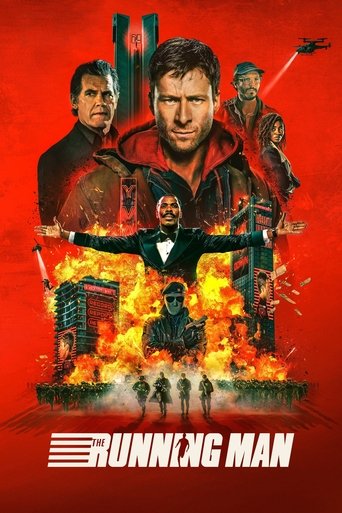
It is hard to admit, but Edgar Wright’s The Running Man is a poorly directed film. It marks the second time in a row that one of cinema’s most precise and playful stylists, the filmmaker who once gave us meticulous, tightly crafted, and extremely fun work like Shaun of the Dead and Hot Fuzz, feels completely lost. As in Last Night in Soho, Wright cannot quite reconcile his visual style with the ideas he is exploring, leaving the film at war with itself.
Stephen King’s 1982 novel, written under the name Richard Bachman, was already adapted to the screen once, by Paul Michael Glaser in 1987 with Arnold Schwarzenegger in the lead. That version, though later embraced as a cult favorite, was poorly received at the time, and King himself said it barely resembled his story. Instead of a confident framed ex-cop cracking one-liners, the novel was about Ben Richards, a desperate, morally conflicted man entering a deadly contest, where he must survive thirty days in the city while being hunted by professional hunters, to save his sick daughter. Wright has said in interviews that he wanted his version to be very faithful to the novel and desired to lean into its darker, more grounded tone.
That decision is at the root of many of the film’s problems. Everything the movie wants to say about capitalism, media manipulation, spectacle culture, and the commodification of violence has been said, often better, many times since Death Race 2000 fifty years ago. Hearing the same message repeated almost verbatim feels tired and predictable, even dated. The film’s commentary, already blunt in its first ten minutes, only grows more heavy-handed by the weak conclusion. The film tries to modernize its message by bringing a discussion about deep fakes and generative AI, and how that does not replace the real thing, but it goes as deep as I went as I wrote this sentence.
It approaches all these conversations with a self-important tone, draining the fun and the spark you would expect from a $110 million Edgar Wright production, especially in its first and last twenty minutes. Some flashes of the Wright we know and love occasionally appear through stylish transitions, clever geographic cuts, playful camera moves and a few satisfying music cues. Yet they arrive too late, only once the game begins, and feel disconnected, drawing attention to themselves instead of blending naturally into the film. Nothing here comes remotely close to the opening chase of Baby Driver, despite having nearly triple that film’s budget.
The tonal confusion also carries into the performances. Josh Brolin and Emilia Jones seem to think they are in a much grittier film, while Michael Cera and Lee Pace act like they have come from a cartoon. Glen Powell never convinces as the scarred protagonist, with his emotions feeling very manufactured. The actor, who was terrific in Hit Man last year, looks comfortable here only when reprising that performance, in the moments when his character uses disguises and gives him the chance to recycle some of his funny, silly voices. Yet this man is meant to be broken by hardship, motivated by his sick daughter, someone worn down by the system, and that is never felt. Instead, Powell’s clean-cut, Ken-like appearance constantly yells someone who would love to be filmed. As another critic once said about Christy, this movie would have worked far better if the Anyone But You star had swapped places with Katy O’Brien, who is once again criminally misused. She and Colman Domingo supply an impressive amount of energy in their very short minutes of screen time.
Plenty else breaks immersion such as the small-looking sets in the film’s first act that resemble a cheaper episode of Black Mirror, the confusing explanation of the game’s rules (I understood way more from the game Ben watches on TV before), and the silly disguises. At one point, William H. Macy appears and hands him new “identities” consisting of glasses and a glued-on mustache, which Ben loses the very next day. Could he not grow a beard or shave his head during the fifteen days he is supposedly on the run, or make any effort to not look like himself?
For a while, you might go along with it, enjoying the premise and the 80s throwback energy, even if there is not a single memorable action sequence. But the third act pushes the film’s self-seriousness to its limit. The writing grows clumsy with conveniences, like characters waiting for commercials or the protagonist suddenly gaining leverage by pretending to have a bomb. At that point, it becomes extremely hard to care about any of it.
An unconvincing protagonist, uneven effects, misplaced solemnity, and stylistic flashes that clash with everything around them… The Running Man ends up having far more in common with the 2012 Total Recall remake than I ever expected. Maybe it is time for Wright, Pegg, and Frost to reunite and give us another entry in their Cornetto series. Now those were fun films.
- 1Sentimental Value
- 2Hamnet
- 3One Battle After Another
- 4Ne Zha 2
- 5Blue Moon
- 204The Running Man#204 of 256
- Where to watch
- Rent or buy at Apple TV Store, Amazon Video
- Where to watch
- Rent or buy at Apple TV Store, Amazon Video
 Play trailer


- Original title
- The Running Man
- Director
- Edgar Wright
- Genre
- Action, Thriller, Science Fiction
- Cast
- Glen Powell, Colman Domingo, Lee Pace, Josh Brolin, William H. Macy, Michael Cera, Emilia Jones, Daniel Ezra
- Rated
- 14A
- Screenwriter
- Michael Bacall, Edgar Wright
- Composer
- Steven Price
- Cinematography
- Chung Chung-hoon, Carlos De Carvalho
- Editor
- Paul Machliss
- Country


- Language
- English
- Budget
- $110 million
- Box office
- $69 million