

OVERVIEW
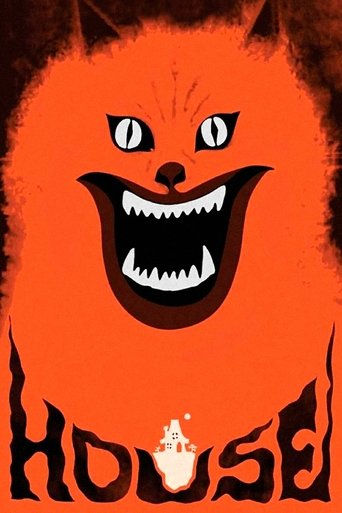
Soap opera melodrama, sugary pop songs, and a demonic cat meet in this uniquely strange summer vacation film. Distraught that her widowed father has returned from a long trip abroad with a new wife, a Tokyo teenager known to her friends as Gorgeous, abandons her family’s holiday plans for a visit to her aunt’s isolated country house. She brings along six classmates, each defined by a single trait: Melody plays the piano, Kung Fu kicks, Mac has an insatiable appetite, and so on. The aunt is gracious but frail, and inseparable from her white cat, and she has been waiting a very long time for young visitors. The house, it turns out, is hungry, and begins devouring the girls one by one through mirrors, futons, pianos, wells, and other impossible traps, all brought to life by Nobuhiko Obayashi through matte paintings, hand-drawn animation, primitive chroma key, and an endless stream of visual tricks.
BACKGROUND
By the mid 1970s, Toho, one of Japan’s biggest studios and the home of the Godzilla films, was struggling to produce a major hit. Inspired by the runaway success of Jaws, executives approached one of the country’s best-known commercial directors, Nobuhiko Obayashi, to develop ideas for a successful blockbuster of their. Obayashi accepted, but instead of borrowing from Hollywood, he asked his eleven-year-old daughter to contribute ideas based on the things that frightened her.
The resulting screenplay was considered so bizarre that every director at Toho refused to touch it, convinced it would end their careers. After two years stuck in limbo, Obayashi finally persuaded the studio to let him direct it himself. The result could hardly have been further removed from Jaws. Critics dismissed it, but young audiences embraced its dreamlike absurdity, turning it into an unexpected commercial success. After fading from international conversation for decades, the film was rediscovered through Janus Films’ restoration, sold-out screenings at the 2009 New York Asian Film Festival, and the Criterion Collection’s celebrated 2010 release, cementing its reputation as one of cinema’s great cult classics.
THE REVIEW
House is, without question, one of the most original and strange films ever made. Drawing on his long experience in commercials, Nobuhiko Obayashi rejects nearly every filmmaking convention, challenging the timing of events and reactions, embracing artificiality over realism and surprise over coherence. Painted backgrounds, animated flourishes, impossible transitions, exaggerated performances, and abrupt tonal shifts collide into something that often feels like a child’s nightmare. It is hard to say how much of this is deliberate and how much is happy accident, or whether the thing in front of you is a great and daring film or a hot mess that turns fascinating in spite of itself. I land somewhere in the middle, my jaw on the floor again and again, yet unable to have the fun the film kept begging me to have.
That unconventionality shines brightest in the killings. One by one, the girls are devoured by pianos, clocks, mirrors, futons, and wells, an escalating series of elaborate deaths that somehow become more violent and more playful at once. The famous piano sequence remains the undeniable highlight, evolving within seconds into one of horror’s most unexpectedly gruesome set pieces. From there, the film unleashes rivers of blood, flying severed limbs, and impossible transformations with relentless confidence. Just when you think it has exhausted its imagination, Obayashi finds another outrageous idea.
The refusal to adhere to conventions becomes the film’s biggest strength, but also its greatest weakness. Every scene introduces another visual trick, another tonal shift, another outrageous image before the previous one has had time to register. At first, the constant one-upmanship is exhilarating. Eventually, however, surprise itself begins to lose its impact. There is only so much a brain can absorb before even the impossible starts feeling routine. By the final act, the highly original murders become strangely weightless, not because they are less inventive, but because the film never stops trying to outdo itself. Even with such unforgettable imagery, there is little room for suspense, fear, or uncertainty to accumulate.
Beneath the laser-shooting cat and the floating severed head lies a story about generational grief. The aunt has spent decades waiting for a fiancé who never returned from the war, while Gorgeous carries a similar version of that loss after her mother’s death. Many viewers understandably embrace the film’s emotional distance as part of its dream logic, and that reading makes perfect sense. Even so, the symbolism never translated into genuine feeling for me, especially around Gorgeous, whose arc is too confusing to land. What should ground the circus remains too abstract, leaving the tragedy of both women and the fate of the girls caught between them emotionally inert.
Definitely not inert is the film’s score, which has the same two themes, the soap-opera ‘longing’ theme and the funky cue that plays in Kung Fu scenes of defiance, played so many times that it is enough to make one lose their mind. I think I might have.
FINAL THOUGHTS
There is no denying the extraordinary achievement House is. Nearly fifty years later, its visual imagination has rarely been matched on the big screen, and its practical ingenuity continues to outshine films made with infinitely greater resources. It is easy to see why so many viewers consider it a masterpiece of surreal horror, impressed by how the film keeps defying expectations. Whether one sees it as visionary or completely unhinged, House remains unlike anything else ever made. I found myself constantly impressed by its imagination, yet frustratingly detached from the experience itself. A rare film that works better in dopamine-inducing reel format than as a whole presentation.
- 1Sorcerer
- 2Annie Hall
- 3The Ascent
- 4Star Wars
- 5Close Encounters of the Third Kind
- 27House#27 of 40
- Where to watch
 Crave
Crave- Where to watch
- Not available for streaming
 Play trailer


- Original title
- ハウス
- Director
- Nobuhiko Obayashi
- Cast
- Kimiko Ikegami, Kumiko Ohba, Ai Matsubara, Miki Jinbo, Eriko Tanaka, Masayo Miyako, Mieko Satoh, Yōko Minamida
- Rated
- NR
- Screenwriter
- Chigumi Ôbayashi, Chiho Katsura
- Composer
- Asei Kobayashi, Mickie Yoshino
- Cinematography
- Yoshitaka Sakamoto
- Editor
- Nobuo Ogawa
- Country

- Language
- Japanese