
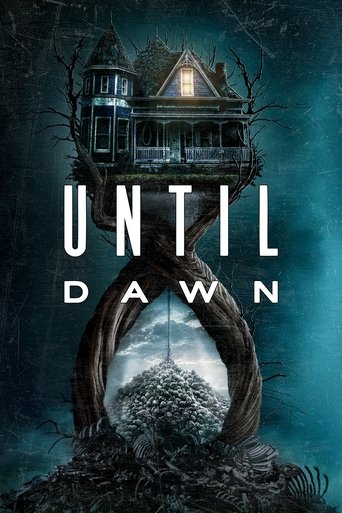
Adding to the pile of disappointing video game adaptations, Until Dawn reimagines the familiar “group of friends in a cabin” setup with a time loop gimmick—meant to mimic the game’s branching outcome system, where player choices shape the story. In theory, this should be a clever way to translate interactivity into film. In practice, it mostly feels like narrative stalling.
The group of six friends fits the usual horror movie mold, but to the film’s credit, the first loop does a good job establishing their relationships. They come across as people who genuinely care for each other, which makes those early scenes more engaging than expected. That opening loop is also the film at its most compelling—there’s a clever idea involving how the area’s weather behaves, and the discovery of photos of missing people adds just the right amount of eerie mystery.
As a fan of time loop stories, I was on board for a while—until the film started unraveling its larger mythology. The explanation behind the loop is both confusing and disappointingly unoriginal, framing everything as some kind of experiment on fear. Once that layer is revealed, the movie starts to lose steam. There’s a complete lack of urgency, and the actual stakes are only clarified far too late.
Instead, you mostly watch the characters die in increasingly absurd—if occasionally creative—ways (the standout deaths involve people literally blowing up). But because the loop resets without any clear logic or rising tension, it all starts to feel hollow. Despite the film’s attempts to suggest otherwise, there’s no real sense of consequence or momentum—just repetition for its own sake.
By the time the third act rolls in—after a bizarre scene where the characters watch phone footage of some of the movie’s deleted death scenes (in a moment that recalls, in the worst way, the infamous laptop scene from Batman v Superman)—you feel just as trapped as they are. And like them, you’re more than ready to get out of the cabin.
- 1Sentimental Value
- 2Hamnet
- 3One Battle After Another
- 4Ne Zha 2
- 5Blue Moon
- 239Until Dawn#239 of 256
- Where to watch
 Crave
Crave- Where to watch
 Max
Max
 Play trailer


- Original title
- Until Dawn
- Director
- David F. Sandberg
- Cast
- Ella Rubin, Michael Cimino, Odessa A'zion, Ji-young Yoo, Belmont Cameli, Maia Mitchell, Peter Stormare, Tibor Szauerwein
- Rated
- R
- Screenwriter
- Blair Butler, Gary Dauberman
- Composer
- Benjamin Wallfisch
- Cinematography
- Maxime Alexandre
- Editor
- Michel Aller
- Country

- Language
- English
- Budget
- $15 million
- Box office
- $54.105 million