
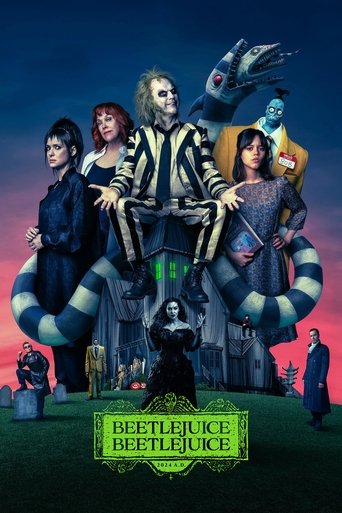
When Beetlejuice hit theaters in 1988, few expected that Tim Burton’s second feature, a quirky, low-budget gamble, would not only become a box office hit but also evolve into a pop culture phenomenon and cult classic. Now, over three decades later, with plenty of hits and misses in between, Burton has found his way back into the spotlight thanks to his recent success with Netflix’s Wednesday. Winona Ryder has also enjoyed a resurgence with Stranger Things, and Michael Keaton remains a fan favorite (specially after becoming a part of the MCU), making a Beetlejuice sequel a much safer bet for Warner Bros. this time around. In an era where original ideas are scarce, it’s hard to blame them, after all, a new original Burton film likely wouldn’t achieve the same level of success as Wednesday or this sequel did.
Alongside Burton, Ryder, and Keaton, Beetlejuice Beetlejuice brings back familiar faces like Catherine O’Hara and composer Danny Elfman, along with the iconic “Day-O (The Banana Boat Song).” The sequel also adds Jenna Ortega from Wednesday, with the show’s scriptwriters Alfred Gough and Miles Millar onboard. Thankfully, Jeffrey Jones and Alec Baldwin are absent from this installment.
Set thirty-six years after the original, the film follows Lydia Deetz (Winona Ryder), now a famous host of a supernatural talk show, as she returns to Winter River with her mother and daughter for a funeral. When Lydia’s daughter Astrid accidentally opens a portal to the afterlife, Lydia faces a difficult choice: strike a deal with the resurrected demon Betelgeuse or risk losing her daughter forever.
It’s a serviceable plot that doesn’t merely recycle the original, but the film falters by overcomplicating things with a barrage of unnecessary subplots and characters. Monica Bellucci and Willem Dafoe’s roles, for example, add little to the story, and their removal would not only streamline the narrative but also allow Betelgeuse to reclaim his position as the central villain.The two romantic subplots also feel dispensable and uninspiring.
While the original Beetlejuice touched on deeper themes like death and purpose, those ideas are mostly abandoned here. Despite the presence of strong actresses like Ryder, O’Hara, and Ortega, the film misses opportunities to explore rich themes, such as mother-daughter relationships and the sacrifices of motherhood. Even Betelgeuse himself, despite being the film’s namesake, remains a secondary figure who doesn’t drive the plot as much as you’d expect.
That said, the film is a visual marvel. Burton expands on the whimsical, eerie aesthetic that made the first film so memorable, crafting inventive new sets in the afterlife. The character designs are fantastic, with delightfully grotesque touches like a character that died bitten by a shark and another who walks around with fish perpetually gnawing on his skin. The R rating is well-earned, with some impressively creepy effects, such as a heads popping up, souls being sucked out, and plenty of goo. The makeup is always impressive, while Elfman’s score fades into the background after the opening titles. The film also strikes a decent balance with its references to the original, using callbacks like the reprise of “Day-O (The Banana Boat Song)” without going overboard.
The final act leans heavily into Wednesday territory, especially with a dance sequence that feels tailor-made for TikTok. While Beetlejuice Beetlejuice is certainly entertaining, its cluttered narrative and overstuffed subplots leave it feeling frustratingly uneven.
Still courtesy of Warner Bros. Pictures Canada
- 1Dune: Part Two
- 2Conclave
- 3Better Man
- 4The Substance
- 5Challengers
- 68Beetlejuice Beetlejuice#68 of 110
- Where to watch
- Rent or buy at Apple TV Store, YouTube, Amazon Video
- Where to watch
 Netflix
 Max
Max
 Play trailer


- Original title
- Beetlejuice Beetlejuice
- Director
- Tim Burton
- Cast
- Michael Keaton, Winona Ryder, Catherine O'Hara, Jenna Ortega, Justin Theroux, Willem Dafoe, Monica Bellucci, Arthur Conti
- Rated
- 14A
- Screenwriter
- Alfred Gough, Miles Millar, Seth Grahame-Smith
- Composer
- Danny Elfman
- Cinematography
- Haris Zambarloukos
- Editor
- Jay Prychidny
- Country

- Language
- English
- Budget
- $99 million
- Box office
- $452 million
- Distributor (CA)
- Warner Bros. Pictures Canada