
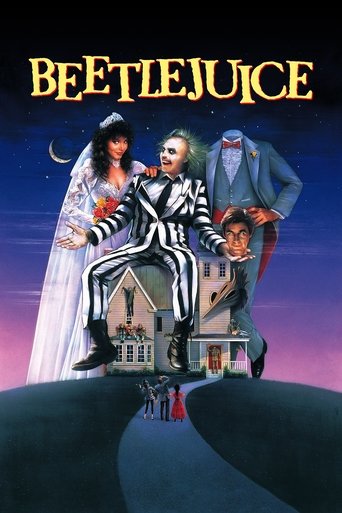
Fresh off the success of Pee-wee’s Big Adventure (1985), Tim Burton was selective about his next project, turning down numerous offers until the script for Beetlejuice landed in his lap. In hindsight, it’s surprising the concept didn’t originate with him, as it embodies everything we associate with classic Burton, dark fantasy, horror, and comedy blended with boundless creativity.
The film follows a recently deceased couple, Barbara and Adam Maitland (Geena Davis and Alec Baldwin), who find themselves trapped in their home as ghosts. When an eccentric new family moves in, they enlist the help of Betelgeuse (Michael Keaton), a rogue “bio-exorcist” who specializes in scaring away the living. But as their plan spirals out of control, they form an unlikely bond with Lydia (Winona Ryder), the goth-leaning daughter of the new owners, and soon realize Betelgeuse is far more unpredictable than they expected.
Like Burton’s best late-’80s and ’90s work, Beetlejuice thrives on its creative design, from the undead bureaucracy to the surreal transformations of the Maitlands’ home. Every frame bursts with personality, whether it’s Bo Welch’s imaginative production design, the stop-motion sandworms, or the striking makeup work by Steve La Porte, Ve Neill, and Robert Short, who won an Oscar for their efforts. Danny Elfman’s score, particularly the playful yet eerie main theme, sets the perfect tone, with its distinctive trombone motif and haunting choir arrangements.
But while the film dazzles visually, its storytelling struggles beneath the surface, revealing a director who hadn’t yet mastered narrative cohesion. Characters quickly shift from being central to becoming afterthoughts, making it unclear where our emotional focus should lie, especially after an abrupt time skip in the first act. The Maitlands’ storyline is sidelined, turning their arc into a footnote, while Lydia, played with effortless charm by Winona Ryder, is underutilized (a flaw the Broadway musical adaptation would later correct). Betelgeuse himself, despite being the titular character, often feels more like a chaotic detour than a driving force in the story. Michael Keaton is undeniably energetic, but his portrayal lacks the depth or charisma that later interpretations, like Alex Brightman’s in the 2018 musical, brought to the role. Nowhere is Burton’s struggle to create emotional engagement more evident than in a scene where the Maitlands face a supposed life-or-death threat, yet the moment feels oddly weightless, much like the rest of the film.
For all its inventive visuals and memorable musical moments, Beetlejuice is an entertaining but uneven experience, more of a creative showcase than a fully realized story. The musical adaptation offers a more polished and cohesive take, but the film remains a cult favorite, if only for the sheer force of its imagination.
Still courtesy of Warner Bros.
- Where to watch
 Netflix
 Crave
Crave- Where to watch
 Max
Max
 Play trailer


- Original title
- Beetlejuice
- Director
- Tim Burton
- Cast
- Alec Baldwin, Geena Davis, Winona Ryder, Catherine O'Hara, Jeffrey Jones, Michael Keaton, Glenn Shadix, Sylvia Sidney
- Rated
- PG
- Screenwriter
- Michael McDowell, Larry Wilson, Warren Skaaren
- Composer
- Danny Elfman
- Cinematography
- Thomas E. Ackerman
- Editor
- Jane Kurson
- Country

- Language
- English
- Budget
- $15 million
- Box office
- $84.554 million
- Distributor (CA)
- Warner Bros.