
OVERVIEW
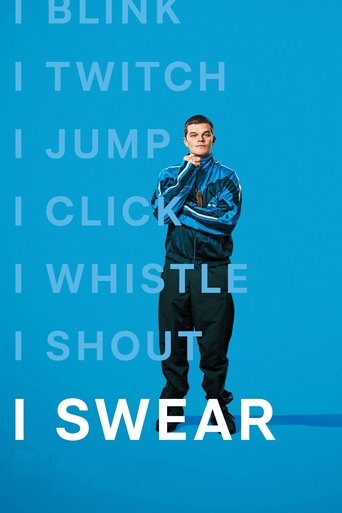
A condition tragically caricatured and misunderstood, Tourette syndrome forces those who have it to live with involuntary tics and outbursts, and in some cases, constant swearing. I Swear tells the story of John Davidson (Robert Aramayo), a Scottish activist who, after years of struggling with the condition, transformed his own experience into advocacy for others. The film follows him from his early childhood diagnosis to the MBE he eventually received for his work in helping the public understand what living with Tourette’s actually looks like.
BACKGROUND
Arriving in theaters the same weekend as Lionsgate’s $200 million biopic Michael, which carefully overlooked crucial aspects of a complex man’s life to deliver the safest possible outcome, I Swear had director Kirk Jones selling his family home to keep the film as respectful as possible to its subject. The sacrifice was the only way to cast an actor he believed could carry the role and to retain the level of profanity the subject matter required. Jones also handed full narrative control to Davidson himself, sending the script in twenty-page increments for his approval, with the stated goal of making the activist proud. The film opened in the UK in October 2025 to an extraordinary critical and commercial reception, and pulled off one of the great BAFTA upsets in February 2026 with Aramayo’s Best Actor win. The ceremony itself became a painful proof of concept for the film’s mission when Davidson, attending as a guest, involuntarily shouted a racial slur during a live presentation that the BBC failed to remove from the broadcast.
THE REVIEW
The film takes on the format of British biographical dramas like The Theory of Everything, Philomena, Mr. Turner, Pride, and, more recently, The Choral, among many others. The lead performance carries the complexities of its difficult, necessary topic, while everything around it remains as easily digestible as possible. Affable humor, lovable supporting characters you want to hug, and wearing every intention on its sleeve all work in the film’s favor as much as they keep it from truly capturing what such a condition deserves.
There is a strange contradiction in saying that the film likely to win the “most cursewords” prize of the year can also be described as a gentle one. Very quickly, from its portrait of Davidson’s earlier years, Jones makes it clear his intention is to keep everything easily graspable and warm, even when the character takes a beating or gets into trouble. The efficiency of that approach, especially in the moments where Dottie and Tommy show Davidson the kind of unconditional support he has never received, encourages and uplifts him in ways that may bring a tear or two.
It all works because of Robert Aramayo’s studied, precise performance, not only in the physicality of the outbursts and impulses themselves, but in the way he layers the emotional aftermath of each one, the visible sequence of anger, sadness, and resignation that runs across his face when his body and voice betray him in public. Even when the script will not commit to the darkest layers in the story, like Davidson’s early suicide tendencies, which are abandoned after the time jump, Aramayo never forgets that baggage and suggests, in the way he is always expecting the worst, that the thought has not gone anywhere even decades later. Mullan and Peake are easy to love around him, and the three performances are what carry I Swear even when it is at its most formulaic.
For most of its length, the film is structured around mini episodes where Davidson tries something new with a new character or in a new setting, while the audience waits to see whether he will manage to hold a tic in a pivotal moment or, more commonly, how the bystander will react to it. By the eighth or ninth time, that beat begins to feel like a structural crutch. The film is also respectful to Tourette’s even when it is essentially using it for laughs, and there is one moment in particular, when Davidson meets a girl who also has the condition and the film cuts to her parents observing the two cursing at each other from outside the car, where the framing pushes the comedy a beat too far for what the moment is actually about.
The supporting characters land mostly in extremes, either as saints willing to drop their lives for Davidson or as caricatures of cruelty and ignorance. Even when the film tries for someone in between, like the mother, it oversimplifies, painting her as unlikable before her son is even diagnosed and later having her claim selfishly that she wants Davidson around once everyone else in the family has left, which sidesteps any real reckoning with what carers actually sacrifice. We see the diagnoses and the breakthroughs, but rarely the texture of the in-between, the daily friction of trying to hold a job or build a relationship that is bound to fail. Those are mentioned in dialogue, never the focus.
FINAL THOUGHTS
I Swear is a film that wants to inform and to uplift, and on those terms, it certainly works. Aramayo’s performance, the topic, and the warmth Jones brings to the material together produce a film that will earn its tears honestly. But for a story this specific, about a condition this misunderstood, a willingness to sit longer in the difficulty would have given the inspiration somewhere harder to land. Davidson’s life has the weight to hold a tougher film, and Aramayo’s performance suggests one was possible.
- 1Sentimental Value
- 2Hamnet
- 3One Battle After Another
- 4Ne Zha 2
- 5Blue Moon
- 72I Swear#72 of 256
- Where to watch
- Rent or buy at Apple TV Store, Amazon Video
- Where to watch
- Not available for streaming
 Play trailer


- Original title
- I Swear
- Director
- Kirk Jones
- Cast
- Robert Aramayo, Maxine Peake, Peter Mullan, Shirley Henderson, Scott Ellis Watson, David Carlyle, Francesco Piacentini-Smith, Somerled Campbell
- Rated
- 14A
- Screenwriter
- Kirk Jones
- Composer
- Stephen Rennicks
- Cinematography
- James Blann
- Editor
- Sam Sneade
- Country

- Language
- English
- Budget
- $3.73 million
- Box office
- $15.564 million