
Overview
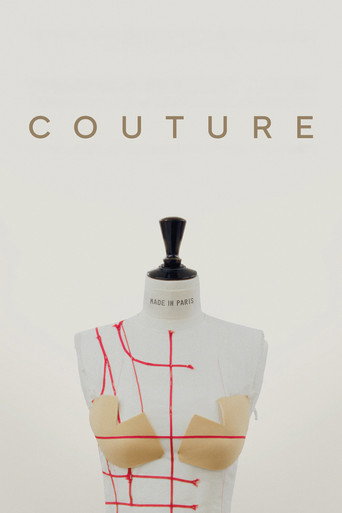
During the frenzy of Paris Fashion Week, three women cross paths around a single haute couture show. Maxine (Angelina Jolie), an American filmmaker shooting a short film for the runway, gets the news mid-production that she has breast cancer. Ada, a young model newly arrived from South Sudan, is walking her first season, still unsure if that is what she wants to do with her life. Angèle, a makeup artist working backstage, wants a different life as a writer. Couture follows their separate days as they cross, three women trying to keep their footing while the ground shifts under them.
Background
The film is autobiographical for writer-director Alice Winocour, a breast cancer survivor whose idea came one day when she walked out of the hospital during her treatment, straight into the crowds and cameras of Fashion Week happening right outside. She cast Angelina Jolie, who tested positive for the BRCA1 mutation, had a preventive double mastectomy in 2013 after losing her mother to cancer at 56, and has spent years as a public advocate for women’s health, here in her first French-speaking role. For the other storylines, Winocour wanted to explore different moments in a woman’s life, all inspired by her 18-month research into the fashion industry. Couture is also remarkably the first fiction film granted permission to shoot inside Chanel.

The Review
One of the intertwined storylines concerns Angèle, a makeup artist working inside the fashion industry, who does models’ makeup while writing novels on the side. At one point she gets a call in which the publisher first dismisses her work as lacking veracity, then lands on the sharper point: being rooted in real experience does not automatically make it interesting. It is not hard to imagine the scene is shaped by similar notes Winocour has gotten from producers and distributors. However, what Angèle, and by extension Winocour, fails to recognize is that the publisher’s point is valid, and good intentions and authenticity only get you halfway there. Couture undoubtedly comes from a real place, but across the multiple storylines, it feels like Winocour is prioritizing quantity over depth, and we are never quite pulled into any of it.
Characters will appear, the film will spend ten minutes with them at a time, and they will say, whether in a phone call or in expository dialogue, exactly what they are feeling. It is not helped by the dialogue itself, filled with stiff, blunt lines that never make these women feel like real people in real situations, and it goes against much of the empathetic portrayal Winocour strives for. For instance, Maxine’s reaction to her cancer diagnosis features some of Jolie’s most compelling facial acting, yet all the emotional impact is undone the second she questions the doctor’s diagnosis out loud, to make sure the whole audience got it. She comes across as clueless and unable to put two and two together. Did she really not suspect she had cancer after her American doctor arranged an urgent appointment in Paris?
Maxine’s arc is still the most effective one, mostly thanks to Jolie, whose performance makes the character’s confusion and conflict affecting even when the writing gives her more of an idea than a person. It is unfortunate that she doesn’t get a single compelling supporting character. Everyone around her, from the doctor to her assistant director, exists only to support her, so she never has a truly deep interaction with any of them. The better scenes are the ones where Jolie is alone in the frame, like walking through the hospital processing the news she just heard, or how free she feels when she takes the first step onto her hotel’s balcony. The arc culminates in a touching scene between Maxine and her daughter, despite again fighting some unconvincing lines.
The other arcs, however, don’t have the same screen time focus and never go beyond the surface level. What connects them, beyond the uplifting empowerment of these women, is that each would have worked much better with far less dialogue, letting the audience reach the conclusions the characters keep spelling out for them.
Final Thoughts
Couture is a frustrating ensemble film in which good intentions are evident throughout, but the flow never fully clicks. The stories stay surface-level, never digging deeper into the fashion industry or the lives of these characters. Jolie has a few strong moments and is the reason to see it, but prepare to be frustrated by a script that holds her, and everything around her, back.
Still courtesy of Game Theory Films
- Original title
- Coutures
- Director
- Alice Winocour
- Genre
- Drama
- Where to watch
- Rent or buy at Apple TV Store, Amazon Video
- Where to watch
 Telecine
- Cast
- Angelina Jolie, Anyier Anei, Ella Rumpf, Louis Garrel, Vincent Lindon, Garance Marillier, Grégoire Colin, Aurore Clément
Crew and more details
- Screenwriter
- Alice Winocour
- Composer
- Filip Leyman, Anna von Hausswolff
- Cinematography
- André Chemetoff
- Editor
- Julien Lacheray
- Country


- Language
- French
- Distributor (CA)
- Game Theory Films
 Play trailer
- 1Everytime
- 2Hadestown: The Musical
- 3Minotaur
- 4You Can See Everything
- 5Hope
- 189Couture#189 of 231


