
OVERVIEW
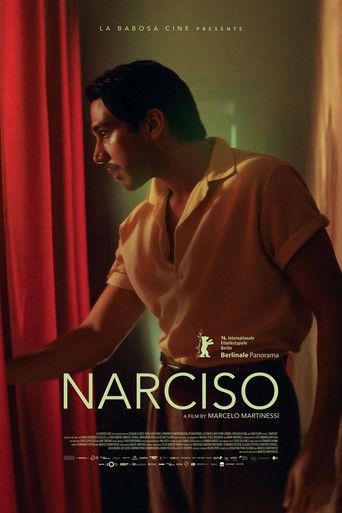
Set in 1959 Paraguay, Narciso follows the rise and abrupt death of a young singer who returns after years in Buenos Aires and shocks a conservative radio station by bringing rock and roll on-air. With pure charisma and a knack for bending rules, he becomes wildly popular and a symbol of freedom, drawing attention from everyone around him.
BACKGROUND
The film is adapted from a novel inspired by the real case of Bernardo Aranda, a young Paraguayan radio announcer and programmer who became linked in public memory to the early local spread of rock and roll. After his murder, the case was seized as a pretext for a sweeping moral panic, one that helped legitimize new forms of repression. Martinessi, who writes and directs, is returning to Berlin after Las Herederas won major Silver Bears at the Berlinale in 2018, with clear historical goals. He wanted to reconstruct a 1950s Paraguay that left remarkably little behind on film, and to revisit a story he sees as a social turning point, one that helped set the stage for the long military dictatorship that followed.
THE REVIEW
In a society where a radio program can be criticized for its radio version of Dracula being too scary, it is easy to see why someone like Narciso, unbothered but quietly confident, would feel like a problem waiting to happen. Like Baz Luhrmann’s Elvis, the titular singer is an introvert, but his agency is always clear. The film portrays him as smarter than he lets on, yet he doesn’t think every fight is worth the trouble. Diro Romero plays him with effortless self-possession, with natural good looks and a loose way of walking and talking. Other interesting character traits, like the way he licks the plate after eating or how his eyes light up when he talks about music, are essential to making the character feel rounded, even when unspoken.
He knows how people look at him, especially when there is a homoerotic charge, as there is in Lulu’s gaze. Lulu, played by Manuel Cuenca, becomes the film’s most important character and the one with the clearer arc, pulled between the rules he must enforce and what he actually wants. His arc can feel a little too legible, as the film reveals the essence of his conflict a bit early, but it remains compelling to watch him wrestle with it, especially when he feels out of control. Weak people are indeed the most dangerous.
The dynamic between these two, and their ripple effect on the secondary cast, captures much of what Martinessi is aiming for. As someone unfamiliar with Paraguayan history, I found the film illuminating, especially in how it portrays a society that is easily manipulated and the media’s role in it.
FINAL THOUGHTS
Similar to The Secret Agent, Narciso uses an intimate and human approach as a backdrop to a pivotal moment in the country’s history. It is not as rich as that film, even if its reconstruction and attention to detail are solid. And in narrative terms, I will always protest a story that spoils itself early with a frustrating device. Still, the performances and nostalgic sepia-toned cinematography made me wish I could stay in this world a bit longer.
- 1Everytime
- 2Hadestown: The Musical
- 3Tuner
- 4Minotaur
- 5You Can See Everything
- 89Narciso#89 of 219
- Where to watch
- Coming soon
- Where to watch
- Coming soon
 Play trailer


- Original title
- Narciso
- Director
- Marcelo Martinessi
- Cast
- Diro Romero, Manuel Cuenca, Margarita Irún, Arturo Fleitas, Nahuel Pérez Biscayart, Mona Martínez, Aníbal Ortíz, Natalia Cálcena
- Screenwriter
- Marcelo Martinessi
- Composer
- Zeltia Montes
- Cinematography
- Luis Armando Arteaga
- Editor
- Fernando Epstein
- Country




- Language
- Spanish