
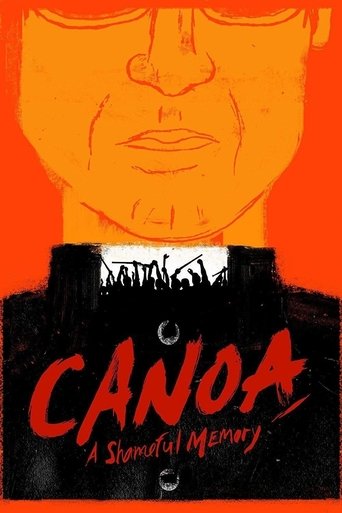

Canoa: A Shameful Memory recounts the real-life events that took place in the late 1960s, following five young university employees from Puebla who set out to hike La Malinche volcano. Due to a storm, they were forced to seek shelter in the small and religiously fanatical Mexican town of Canoa. There, in a community heavily influenced by the Church, the local priest, an outspoken supporter of anti-communist agendas, accused them of being political agitators. His words, whether intentionally or not, put their lives in grave danger. Fueled by paranoia, the townspeople formed a violent mob, attacking the visitors and leaving some of them dead.
It was a gut-wrenching event that exposed how an entire population can be manipulated by religious authority and fear, stripping them of any sense of humanity and turning them into mindless creatures. Director Felipe Cazals recognized the power of this true story and felt it was one that needed to be told, and known by the world. With that, he chose to depict it as a kind of reenacted documentary.
This approach works well as an informative piece, but it also keeps the audience at a distance. The characters often feel caught between being real people recounting their experiences and dramatic figures we’re meant to emotionally invest in. In the first act, they address the camera directly to provide background on the town, an efficient way to deliver context, but one that creates emotional detachment. In terms of tone and structure, this technique is also inconsistent, as it’s largely abandoned once the film shifts into a more conventional narrative in the second act.
The more conventional elements aren’t as effective. The acting is uneven, and the five central characters remain indistinct, making it difficult to truly connect with their journey or plea. Though the mob violence is horrifying, the scenes leading up to it lack the necessary tension or psychological build-up. Without a stronger sense of suspense or deeper insight into the villagers’ descent into violence, the brutality comes across as shocking but somewhat distant.
Still, Canoa is a powerful and necessary film, largely due to the impact of the real events it portrays. What it lacks in cinematic polish, it makes up for in moral urgency. It stands as a damning portrayal of how manipulation, fear, and religious hypocrisy can twist a community into justifying the unforgivable. Decades later, its depiction of collective hysteria and blind obedience still resonates, offering a chilling reminder of how dangerously easy it is to lose our humanity when we stop thinking for ourselves.
- Where to watch
 Criterion Channel
- Where to watch
- Not available for streaming
 Play trailer


- Original title
- Canoa: memoria de un hecho vergonzoso
- Director
- Felipe Cazals
- Cast
- Salvador Sánchez, Ernesto Gómez Cruz, Enrique Lucero, Arturo Alegro, Roberto Sosa Sr., Carlos Chávez, Gerardo Vigil, Jaime Garza
- Screenwriter
- Tomás Pérez Turrent
- Cinematography
- Álex Phillips Jr.
- Editor
- Rafael Ceballos
- Country
- Language
- Spanish