
OVERVIEW
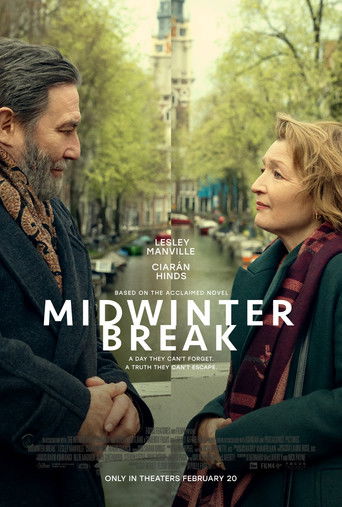
Married for more than 40 years, Stella and Gerry have more than settled into their routines. Stella goes to church and prays every night before bed, while Gerry reads, drinks, and often falls asleep in his recliner. They are the classic “alone together,” living side by side but emotionally disconnected, until Stella, feeling drained and increasingly hollow, plans a trip to Amsterdam for the two of them. A few days in, after their rituals begin repeating in a different city, she brings up the idea of separation, to his surprise.
BACKGROUND
Based on Bernard MacLaverty’s 2017 novel, Midwinter Break marks the feature debut of director Polly Findlay after an established career in theatre. She was brought onto the project in part because of her experience directing intimate two-handers, and has spoken about being drawn to the contradictions in long relationships, especially the regrets and unrealized versions of ourselves that become sharper with age.
THE REVIEW
Her approach is very theater-like, giving the two lead actors room to live inside the script. As often happens when theater directors move into film, there is a strong focus on silence, pauses, and the smallest shifts in expression. The good news is that she has two excellent actors at the center. Lesley Manville and Ciarán Hinds, both theater veterans and always reliable, cross that line where it stops feeling like performance and starts feeling like we are simply watching a real married couple.
They are tender together, and they effortlessly sell the length of this marriage. In one moment, Gerry forgets where he put his medicine, and Stella calmly walks straight to it, as if she has done this a thousand times before. The film is full of small details like that, which make the relationship feel lived-in and the resentment feel like something that has been quietly building for years. When they argue, it feels like they have had versions of these conversations many times before, yet Stella, especially, is finally putting certain emotions into words for the first time.
The problem is that, no matter how true-to-life it feels, the film’s everyday texture rarely becomes interesting. In other words, it is a boring film. It is clearly aiming for a subdued, intimate register, without big confrontations or cathartic scenes, and that approach can absolutely work. But here, between the gray Amsterdam setting, the sparse score, and the lack of humor or warmth, the film starts to feel heavy in the wrong way. Dour instead of tragic. There is a moment when Stella’s face lights up, and she says, “Let’s have some fun,” and they go for a walk through the red-light district, but it lasts only seconds before the film returns to their unpleasant bickering.
That would still be fine if the central conflict landed with more force. Great relationship films built around conversation, memory, and routine, like Linklater’s Before trilogy, 45 Years, or Amour, can make even the smallest moments feel loaded with tension and meaning without anyone raising their voice. Here, the film stays so muted that the crisis never gains real stakes. Despite how much time it gives Stella to think, it never feels like she has truly thought things through. The film also introduces a traumatic event meant to explain why the two see the world so differently, but that subplot, which the film treats like a major revelation, does not really land. In the end, their crisis feels too easily resolvable, not revealing, and not especially deep, and while the film is tender and faintly hopeful, it never becomes moving enough to justify its quiet, restrained tone.
FINAL THOUGHTS
By the end, you are not truly invested in their marriage, and you are mostly ready for their Amsterdam trip to end. Manville and Hinds are predictably fantastic, and they create a mature couple whose shared life could have been genuinely illuminating to watch. They just needed a better film around them, one that knew how to turn their authenticity into dramatic meaning.
- Where to watch

 Prime Video
 Buy or rent
 Play trailer


- Original title
- Midwinter Break
- Director
- Polly Findlay
- Genre
- Drama
- Cast
- Lesley Manville, Ciarán Hinds, Niamh Cusack, Julie Lamberton, Ed Sayer, Leila Laaraj, Tim Licata, Marco Horta Lopes
- Rated
- 14A
- Screenwriter
- Nick Payne, Bernard MacLaverty
- Composer
- Hannah Peel
- Cinematography
- Laurie Rose
- Editor
- Lucia Zucchetti
- Country


- Language
- English
- Budget
- $4 million
- Box office
- $1.003 million
- Streaming (CA)
- Amazon Prime Video
- Buy / rent (CA)
- Apple TV Store, Amazon Video