
OVERVIEW
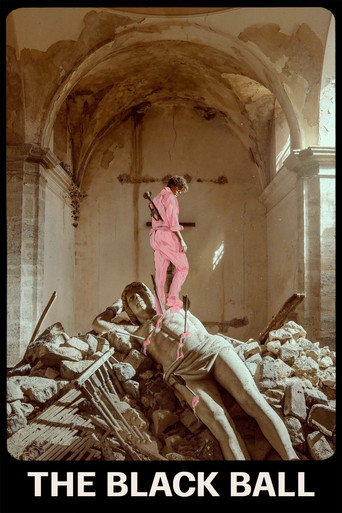
Three timelines run in parallel in La bola negra, all connected by an unfinished Lorca work that explored desire and identity in a fractured Spain. In 1932, a wealthy young man waits on a vote that will decide whether his social club accepts him. In 1937, a military bandsman (Guitarricadelafuente) falls for a Republican prisoner (Miguel Bernardeau). In 2017, an estranged historian (Carlos González) inherits a manuscript from the grandfather he assumed was long dead. Kind of like The Hours meets Cloud Atlas, the film slowly reveals the thread connecting the timelines, and how the past keeps shaping the present.
BACKGROUND
Javier Calvo and Javier Ambrossi established themselves through television and the 2017 musical Holy Camp!, followed by the series La Mesías, which became a critical and awards juggernaut at home. That success never left Spain, so the jump to a slot in the 79th Cannes Film Festival was a surprise for many. The project began when Calvo read Alberto Conejero’s play La piedra oscura and was deeply moved from its first page. That same day, he and Ambrossi expanded the idea into the three-timeline structure that combines Conejero’s play with Lorca’s unfinished work and a new present-day timeline. The film received a twenty-minute ovation, one of the longest of the festival, and shared the Best Director prize with Pawel Pawlikowski, despite many predicting a possible Palme d’Or, including Netflix, which beat A24, Mubi, and Neon for the US rights in a five-million-dollar deal and is reportedly planning an awards campaign in the mold of Emilia Pérez.

THE REVIEW
Don’t worry if that last comparison throws you off. Despite sharing with Emilia Pérez a theme of queer people finding their identity, and a real shot at contending for as many Oscar nominations, La bola negra is far more crowd-pleasing and will be way less controversial on release.
It has the grandeur of the epic films that dominated Oscar season in the late 1990s and early 2000s (Cold Mountain, Frida, The English Patient, the aforementioned The Hours), with an ambition rarely seen in modern cinema. It jumps from timeline to timeline with a complex yet fluid rhythm and impeccable production values, making it a fully immersive experience that catches you and doesn’t let go. Like those films, its grand presentation makes it either an engaging watch or a long, unending one, depending on your mood and how much you’re willing to sink into grandiose storytelling (I should know, having watched it twice during the festival at different times of day).
What can’t be denied is the talent of its directors, who, in a nice irony, shared the Best Director award with Pawlikowski, whose Fatherland, an austere black-and-white chamber piece, sits at the complete opposite end. Where Pawlikowski uses every second to convey his characters and his country’s decay, counting on the audience to fill the blanks with what he doesn’t show, La bola negra throws everything at the viewer: flashy dance sequences, epic war moments, parallel editing, even a Glenn Close cameo (speaking Spanish no less!), so that you rarely have time to think of anything beyond the moment in front of you.
Throwing everything at the viewer becomes both its strength and its weakness. As the separate timelines begin intersecting and their connection grows clearer, you follow along as if it were one combined storyline. The fluidity between them, aided by the fantastic editing of Alberto Gutiérrez, will undoubtedly make it a strong Oscar contender. When the story hits its climax, its force is so uncontestable that you cry without quite understanding why, such is the power of its presentation.
For all that spectacle, it isn’t a film that offers much food for thought, and its central theme is disappointingly simplistic (basically, that contemporary queer dissatisfaction should be corrected by looking back at the suffering of previous generations). Much of the fault lies with the present-day storyline, by far the weakest of the three, and unfortunately the one meant to give the film its meaning, tying the themes together and delivering their statement. Its central character is set on a journey he cares little about, and it fails to land what should have been the heart of the film: the relationship between Alberto and his partner, played by Julio Torres. The scenes between Alberto and his mother are also meant to land as an emotional climax, yet they don’t hit as hard because both characters are written to be unlikable. That unlikability, along with Alberto’s disinterest in his own journey, is by design and feeds the film’s themes, but knowing that doesn’t make those passages easier to sit through. It leaves the movie, for all its spectacle, with a hollow core.
Much better are the other two storylines. Even if Carlos’s is the shortest, and purposely vague and inconclusive, it still captures the hidden struggles and tortured mind of the young boy, with a very affecting scene between him and his mother, and another memorable moment that has Carlos dancing out his frustrations to a song of a mother grieving her lost son. Yet the film’s best moments are all in Guitarricadelafuente’s Sebastián storyline. The tender relationship between him and Miguel Bernardeau’s Rafael is extremely captivating, and the romance is well-constructed.
Despite not having sweeping romantic scenes, their connection acquires depth with surprising economy. A lot of this is thanks to the actors, who share great chemistry and convey their characters’ conflicting thoughts well. Yet what really makes it work is how well the script builds it. Rafael notices Sebastián’s attraction right away and plays with it at first, knowing he has something to gain. He lets Sebastián watch him as the nurses bathe him (some gratuitous frontal nudity in this segment, by the way), and later leans on his shoulder for support. Once he sees he has no escape (and perhaps only because of that), he opens himself to Sebastián, not unlike the central dynamic in Kiss of the Spider Woman.
Another highlight is Penélope Cruz, who steals the film despite her limited screen time. The Spanish actress has a larger-than-life presence that fills any room, and gives the film much-needed energy in her two cabaret numbers. She also gets a pivotal moment, looking at Sebastián with a genuine empathy that may be the first time in his life anyone has regarded him that way, before delivering a monologue that ties the tragedy of war to a society that forces people to live a second life.
The film also has a very memorable score. At times, it draws on the energy of acoustic guitars, much like Elliot Goldenthal’s work on Frida, just as eclectic and as rooted in its own culture. At others, it reaches for the sweeping orchestral writing of Gabriel Yared or James Horner, though never with their sophistication. Its main theme is simple yet memorable enough that you leave the theater humming it (can you imagine that in 2026?). The musical highlight comes in a scene on a snowy mountain, built around a lovely (and, as it seems, original) song that reminds me of “Dos Oruguitas” from Encanto. It almost hides how blatant the metaphor it is accompanying actually is.
FINAL THOUGHTS
It is easy to see the overwhelming response to the film, an ambitious drama with an epic presentation that certainly stands out against the much drier titles of the competition. It will also play well in Netflix. Yet, I can’t help but compare it to The Brutalist, and how that film impressed with its presentation and modernized traits not seen in cinema for many years, while leaving a feeling that something important is missing. As with that film, two of its three thirds succeed completely, while the third drags the whole thing down, resulting in a film of considerable visual power that remains, somehow, emotionally incomplete.
Still courtesy of Netflix
- 1Everytime
- 2Hadestown: The Musical
- 3Tuner
- 4Minotaur
- 5You Can See Everything
- 44La Bola Negra#44 of 219
- 1Minotaur
- 2Wild Horse Nine
- 3The Man I Love
- 4The Unknown
- 5La Gradiva
- 13La Bola Negra#13 of 52
- 1Minotaur
- 2Hope
- 3The Man I Love
- 4The Unknown
- 5La Gradiva
- 12La Bola Negra#12 of 34
- Where to watch
- Coming soonDec 2, 2026
- Where to watch
- Coming soonFeb 18, 2027
 Play trailer


- Original title
- La bola negra
- Director
- Javier Ambrossi, Javier Calvo
- Cast
- Guitarricadelafuente, Miguel Bernardeau, Carlos González, Milo Quifes, Lola Dueñas, Penélope Cruz, Glenn Close, Antonio de la Torre
- Rated
- 14A
- Screenwriter
- Javier Ambrossi, Javier Calvo, Alberto Conejero
- Composer
- Raül Refree
- Cinematography
- Gris Jordana
- Editor
- Alberto Gutiérrez
- Country


- Language
- Spanish
- Budget
- $11.1 million
- Box office
- $255
- Distributor (CA)
- Netflix