
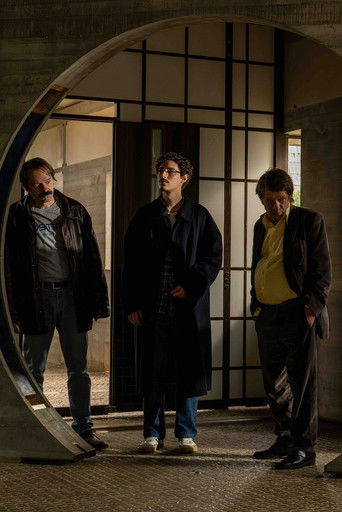
Based on a real life experience from director Francesco Sossai, who one night in Venice got drunk with a friend and met an architecture student, The Last One for the Road evolves the friends-on-the-road and drinking-buddy format by placing a shy younger character alongside two older men in a “one last drink” cycle. Inspired by commedia all’italiana, the film carves out its own spin on the formula by making this younger man the anchor of the adventure and setting the journey against the backdrop of modern day Veneto’s ruins.
The pair of older men are Carlobianchi (Sergio Romano) and Doriano (Pierpaolo Capovilla), members of a so-called “Lost Generation.” Born in the 1970s and raised in prosperity, they were derailed by the 2008 crisis and have since become regular patrons of every bar in sight. Sossai draws heavily from the traditions of the genre for their dynamic. Their supposed mission is to recover cash left behind by an old friend, Genio, before he fled the country, but in practice that means wandering from bar to bar, drinking heavily, trading bad advice, and recycling rituals of self destruction and tiresome philosophical rambling. Along the way they encounter workers, bartenders, local characters, and old acquaintances, as is typical of the genre, pulling the young architect into their journey.
That architect is Giulio (Filippo Scotti), who quickly emerges as the most compelling figure in the film. While Carlobianchi and Doriano devolve into obnoxious loudmouths who crack jokes only they find funny and radiate an exhausting energy, Giulio is composed, introspective, and cautious. He is the kind of student who would rather get some sleep to protect his academic responsibilities, even if it means sacrificing time with a crush. It is interesting how the film introduces him as if he were a background character that will appear in only a couple of scenes, yet he grows increasingly central as the story unfolds. To the older men, he is a change of pace, and corrupting him is a fun little side-mission, while they remain trapped in their own cycles. To Giulio, however, these ‘Lost Generation’ is a warning. He watches their rituals and regrets, imagines what his life could be, while learning what not to become. The film uses that to study of which traditions are worth passing on, what could genuinely enrich Giulio’s life (as he indeed grows throughout the ‘adventure’), and what should be left behind.
The journey itself, despite its stated goal, drifts into the expected meandering of the genre. If that structure is not to your taste, the film can feel unpleasant or tiring. Yet Giulio’s development keeps it grounded, giving it a thread of genuine interest. In the end, it may not be essential cinema, but it stands as a regionally rooted entry in the drinking-buddy subgenre and a distinctive presence in TIFF’s 2025 lineup.
This is part of Reviews On Reels TIFF 2025 Coverage. Due to the hectic rhythm of a film festival, it may be tweaked in the future. Still courtesy of TIFF.
- 1Sentimental Value
- 2Hamnet
- 3One Battle After Another
- 4Ne Zha 2
- 5Blue Moon
- 95The Last One for the Road#95 of 256
- 1Sentimental Value
- 2Hamnet
- 3Blue Moon
- 4Sirāt
- 5Tuner
- 36The Last One for the Road#36 of 74
- Where to watch
- Rent or buy at Apple TV Store, Amazon Video
- Where to watch
- Not available for streaming
 Play trailer


- Original title
- Le città di pianura
- Director
- Francesco Sossai
- Genre
- Comedy
- Cast
- Filippo Scotti, Sergio Romano, Pierpaolo Capovilla, Roberto Citran, Andrea Pennacchi, Giuseppe Messina, Denis Fasolo, Tommaso Gianesini
- Rated
- NR
- Screenwriter
- Francesco Sossai, Adriano Candiago
- Composer
- Krano
- Cinematography
- Massimiliano Kuveiller
- Editor
- Paolo Cottignola
- Country


- Language
- Italian