

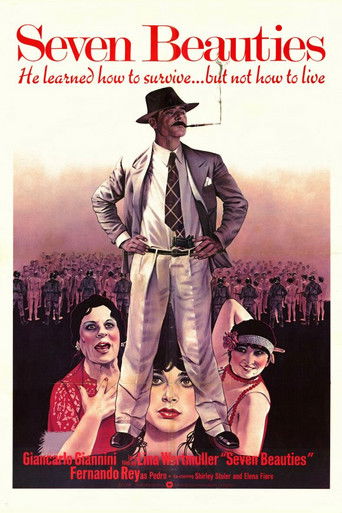

Seven Beauties is a daring and deeply uncomfortable analysis of how far people will go to protect themselves—their pride, their image, the way they’re seen by others—and what they’re willing to sacrifice along the way. Lina Wertmüller doesn’t deliver this message through heroism or clear moral lessons, but through Pasqualino Frafuso, a delusional Neapolitan thug who lives his life projecting the image of a ladies’ man while embodying cowardice and self-interest. Every move he makes—from killing a man to protect his family’s “honor,” to faking insanity, joining the army, deserting, and finally manipulating his way through a Nazi concentration camp—is driven by the same instinct: to preserve his own standing, no matter the cost to others, and even to himself.
Placing such an unlikable and pitiful character at the center turns out to be the film’s greatest strength. Pasqualino isn’t some antihero to root for—he’s a mirror held up to the worst parts of human nature. Are we really that different from him, chasing our own ambitions or desires at any cost? Or are we just more socially acceptable versions of the same kind of rot?
The film smartly builds its critique through irony, especially when Pasqualino confesses to murder with pride—as if it were a badge of honor, killing for his sister’s dignity—only to then be forced to pretend he’s insane to avoid execution, completely undoing the “Monster of Naples” image he had proudly built up for about a minute. He keeps sabotaging himself in a desperate attempt to control the narrative, never realizing how little control he truly has. The irony here is rich, and Giancarlo Giannini plays it brilliantly. His performance anchors the film’s extreme tonal shifts—switching effortlessly from pathetic victim to something monstrous, often within the same scene.
But the true MVP of Seven Beauties is director Lina Wertmüller. Having worked with Fellini as an assistant director on 8½, she brings a similar eye for visual exaggeration and tonal contradiction to Pasqualino’s descent. The film constantly mixes tones—its political critique, bleak survival elements, and dark humor often happen all at once. It’s funny in moments that should feel tragic, and tragic in ways that still feel absurd. This film made history, earning the first Best Director Oscar nomination ever given to a woman—and it’s a well-deserved one, given Wertmüller’s control over the film’s tone and how she manages to balance it all.
The score, especially the memorable main theme, helps set the film’s tone—a mix of humor and tragedy. That lingering sadness underneath all the absurdity really sticks with you. And the Fellini-style imagery and loose rhythm give it that transportive quality that makes Italian cinema from this era so distinctive.
Despite all this, the script doesn’t always land its punches as forcefully as it could. The subtleties are often brilliant—like the opening montage set to a funky “Oh yeah” track while bombs fall on civilians, underlining our indifference to suffering outside our immediate world. The final scene, too, is conceptually strong: Pasqualino returns broken, hollowed out by his choices, a man disgusted by what he’s become. But emotionally, it doesn’t quite hit as hard as it should. The film’s refusal to offer emotional signposts or clearer moral perspective is bold, but it also makes its commentary harder to absorb. The ideas are there—about survival, complicity, and the hollow nature of masculine pride—but they aren’t always given room to breathe. So the themes are there intellectually, but they don’t always resonate viscerally.
The film’s most pivotal moment—what should be Pasqualino’s most devastating moral compromise—feels rushed. Wertmüller does what she can to stage the aftermath with poetic imagery, but she undercuts the tragedy seconds earlier with a heavy-handed visual (one that uncomfortably echoes Salo), and the friend Pasqualino betrays shows little resistance, which softens the impact. It’s the one moment where the film could’ve shattered us—and instead, it pulls back.
By the end, Pasqualino has clearly changed. The final shot captures him as a man who has survived—but lost any sense of dignity in the process. And while we understand his exhaustion, I’m not sure we feel it as deeply as we should. He starts pathetic and ends pathetic. To make his arc truly haunting, we needed to see him cross a line so terrible that we feel implicated too. Instead, the film keeps us at just enough of a distance to stay safe.
Still, Seven Beauties remains a bold, provocative film. It’s messy by design, intentionally discomforting, and laced with a biting cynicism about human nature. It asks: who do we become to achieve our selfish goals and feed our pride? And maybe more importantly—were we always that person to begin with?
- Original title
- Pasqualino Settebellezze
- Director
- Lina Wertmüller
- Where to watch
- Rent or buy at Apple TV Store, YouTube
- Where to watch
- Not available for streaming
- Cast
- Giancarlo Giannini, Fernando Rey, Shirley Stoler, Elena Fiore, Roberto Herlitzka, Piero Di Iorio, Enzo Vitale, Ermalinda De Felice
- Rated
- R
Crew and more details
- Screenwriter
- Lina Wertmüller
- Composer
- Enzo Jannacci
- Cinematography
- Tonino Delli Colli
- Editor
- Franco Fraticelli
- Country

- Language
- Italian
 Play trailer
- 1One Flew Over the Cuckoo's Nest
- 2Dersu Uzala
- 3Jaws
- 4Nashville
- 5Manila in the Claws of Light
- 13Seven Beauties#13 of 51


