
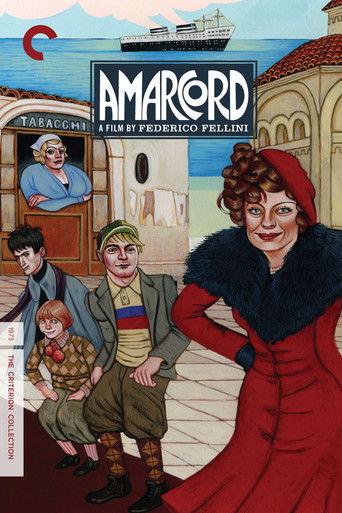
Federico Fellini’s Amarcord (1973) is a nostalgic and whimsical exploration of small-town life in 1930s Fascist Italy. Widely regarded as one of cinema’s greatest directors, Fellini had already cemented his place as a master of the medium with earlier classics like La Dolce Vita and 8½. With Amarcord, he draws on his own childhood to craft yet another semi-autobiographical film. A landmark in his career, the film earned him his fourth Academy Award for Best Foreign Language Film and received nominations for Best Director and Best Original Screenplay.
The title, derived from a local dialect phrase meaning “I remember,” reflects the film’s episodic structure, which captures the absurdities and joys of youth. Through the eyes of young Titta, Amarcord unfolds as a series of vignettes introducing eccentric townsfolk while blending humor, surrealism, and bittersweet nostalgia.
A key factor in the film’s success is Nino Rota’s enchanting score, alongside the meticulously crafted locations, both of which beautifully capture the nostalgic and emotional atmosphere of reflecting on youth. Compared to another 1975 auteur exploration of memory, Tarkovsky’s Mirror, whose abstract approach is transportive but emotionally distant, Amarcord is grounded in standout moments that vividly transport viewers to a specific time and place. These include the family’s chaotic dinner table arguments, children imagining the glory days of a once-grand hotel, a peacock majestically spreading its feathers in the snow, and the mischievous antics of schoolchildren defying their strict teachers. These scenes are vital for a film about childhood memories, and Amarcord delivers them in abundance, with warmth and humor that are both engaging and effective.
However, not every scene works. Some adult-focused sequences, such as the drawn-out story about an emir’s visit, feel sluggish. Additionally, Titta occasionally fades into the background, leaving the narrative somewhat unfocused. The film is at its best when rooted in the children’s perspective, particularly their school dynamics and clashes with authority figures. A tighter focus on the children point of view might have made for an even stronger film.
Still, Amarcord is packed with humor, sharp dialogue, and heartfelt moments. By the end, as another season passes, you’re left with a bittersweet feeling, wishing you could linger in this quirky, vibrant world just a little longer. Despite its imperfections, it’s a film that lingers in the heart like a cherished memory.
- Where to watch
- Rent or buy at Apple TV Store, YouTube
- Where to watch
- Not available for streaming
 Play trailer


- Original title
- Amarcord
- Director
- Federico Fellini
- Cast
- Pupella Maggio, Armando Brancia, Magali Noël, Ciccio Ingrassia, Nando Orfei, Luigi Rossi, Bruno Zanin, Gianfilippo Carcano
- Rated
- R
- Screenwriter
- Tonino Guerra, Federico Fellini
- Composer
- Nino Rota
- Cinematography
- Giuseppe Rotunno
- Editor
- Ruggero Mastroianni
- Country
- Language
- Italian