
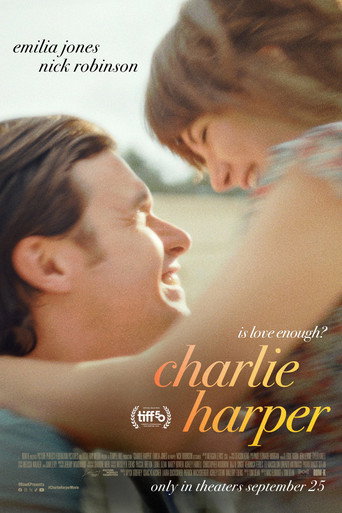
Love is complicated when two people want different things in life, or worse, when they place their own comfort above everything else, a mindset that has only deepened since COVID encouraged retreat into self-absorbed habits. This shift in modern life, and how it has reshaped relationships, is what Mac Eldridge and Tom Dean attempt to explore in their debut feature Charlie Harper. The film has an idea of what it wants to represent, but it never thinks through what it actually wants to say. It begins as a cute ill-fated rom-com, brushes past alcoholism, lack of ambition, and toxic relationships, and somehow manages to walk by all of these themes without ever saying anything meaningful about them. Simply having themes is treated as enough. Add to that a pair of unlikable characters and a clumsy narrative frame, and you get as close to a definition of a “nothing film” as there has ever been.
We meet Charlie, played by Nick Robinson, content to coast through life in a low-effort job, and Harper, played by Emilia Jones, who is described as ambitious and career-driven (though the film rarely shows it). They are drawn together mostly because they are cute, and we watch them cycle through breakups and reconciliations over their differences. And no, despite the title, this is not the origin story of the Two and a Half Men character.
Told across a non-linear structure like last year’s similarly frustrating TIFF entry We Live in Time, the film tries to illustrate how repetitive their actions are while also suggesting two different perceptions of the same relationship. The problem is that both characters are incredibly unlikable, written in the broadest strokes, and communicating through paper-thin dialogue. Charlie is the embodiment of inertia. He turns to alcoholism, forces Harper to sit through hours of history podcasts in the car, and never shows ambition despite being told repeatedly how talented he is. Harper is supposed to be ambitious, yet she also needs others to push her forward, manipulates Charlie into saying he is going to find work, and outright cheats on him. To be fair, she is just as much at fault.
We have seen comedies about selfish, unlikable people before, but the difference here is how Charlie Harper constantly tries to skim past or excuse the worst actions instead of confronting them. Every fight collapses into shallow misunderstandings. Every moment of intimacy is reduced to clichés. It justifies the characters as if they were simply not meant for each other, while never touching on their actual problems. The film skips over the conversations that might have weight and instead spotlights its good-looking leads (he goes shirtless, she has the Superbad-era Emma Stone haircut). Eye-rolling moments pile up, including a rain-soaked kiss staged purely to wring out cheap tears. I groaned more than once.
Giving this my lowest rating might sound extreme. The film is not incompetently made. The cinematography often looks good, and Robinson and Jones are likable performers even if their characters are not. Yet secondary characters clumsily appear and disappear from the narrative, the dialogue is simplistic, the plot beats are obvious, and the voice-over is grating. But what is truly unforgivable is how the film poses as an exploration of toxic relationships, alcoholism, and ambition, while avoiding every thorny truths that might give it weight. It frames everything as a simple case of incompatibility, quietly forgiving actions that demand harder scrutiny.
I can enjoy a fluffy romance between attractive people. I can also enjoy a romance that dives into melancholy if it commits to its ideas. Charlie Harper sells itself as doing both while failing at every turn. It says nothing, does nothing, and has no business being part of a film festival lineup.
This is part of Reviews On Reels TIFF 2025 Coverage. Due to the hectic rhythm of a film festival, it may be tweaked in the future. Still courtesy of TIFF.
- 1Everytime
- 2Hadestown: The Musical
- 3Tuner
- 4Minotaur
- 5You Can See Everything
- 213Charlie Harper#213 of 219
- 1Sentimental Value
- 2Hamnet
- 3Blue Moon
- 4Sirāt
- 5Tuner
- 73Charlie Harper#73 of 74
- Where to watch
- Out of Theaters
- Where to watch
- Coming soon
 Play trailer


- Original title
- Charlie Harper
- Director
- Tom Dean, Mac Eldridge
- Cast
- Nick Robinson, Emilia Jones, Nicholas Cirillo, Jonathan Gregg, Jessica Blackmore, Virginia Tucker, Ja'Quan Monroe-Henderson, Sebastian Delascasas
- Rated
- 14A
- Screenwriter
- Tom Dean
- Composer
- Paul Leonard-Morgan
- Cinematography
- Sharone Meir
- Editor
- Sam Levy
- Country

- Language
- English