
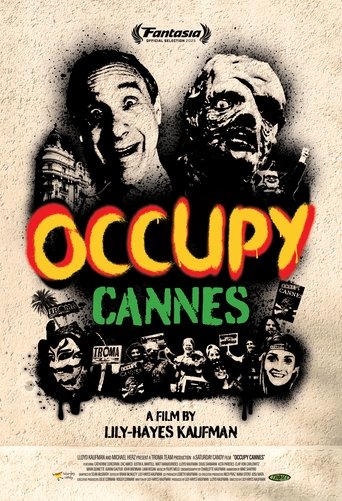
Film festivals are a vital engine of the film industry. They showcase diverse voices giving a platform to both established auteurs and emerging filmmakers while facilitating distribution and promotions, helping films find buyers and theatrical release or streaming deals. Yet today they have become increasingly associated with red carpets and fancy clothes, with people lining up just to catch a glimpse of their favorite actor a few feet away, often without any intention of watching the film they star in. Arguably the biggest of them all, the one every filmmaker dreams of premiering at, is the Cannes Film Festival. For cinephiles, the Cannes logo can feel like a must watch stamp, but for many, the image most associated with the festival is the iconic red steps with a perfectly dressed celebrity posing for photographers.
Occupy Cannes sets out to challenge this image and the festival’s approach in recent years by following the independent studio Troma’s 2013 trip to sell their low budget feature Return to Nuke ’Em High Volume 1. Directed by Lily Hayes Kaufman, the daughter of Lloyd Kaufman, the president of Troma Entertainment, the film follows him and a group of loyal fans as they descend on Cannes with a guerrilla marketing push. The tone of their promotion mirrors the style of their cult films, with outrageous and often juvenile humor. Soon, they are parading around in masks, costumes, and even flashing genitals in the street, all in an effort to get people talking and attract buyers, competing for attention in a space dominated by towering billboards and celebrity photo ops.
That is the goal, at least. From her first interview, Lily makes it clear she is not blind to the theatricality of it all, openly questioning her father’s motivations and the appeal of being the underdog. While the approach does land them in major festival coverage, the film often shows it amounts to making noise rather than following a coherent marketing strategy, and many of those involved do not seem motivated by a love for this particular film. The documentary could have made a stronger case for why this movie, specifically, deserved the extra push, something that we never get other than being from one of the oldest independent studios of all time.
Their antics at the festival itself are entertaining though, and play like a Borat style romp through the fancy streets of Cannes. The group asks why people are waiting outside hotels just to see actors, they sneak selfies with A-listers, and they run a small but extravagant booth in the festival’s market space. The film captures the festival experience well, from showing people being stopped from entering a film for not following their very clearly set rules and revealing the cramped Airbnb they share, with some members sleeping on the floor, practically shoulder to shoulder.
The documentary is candid about Troma’s financial limitations. Without budgets for massive signage, PR teams, or glamorous events, they see their only option as being impossible to ignore. At one point, the film compares their antics to two young men dressed as Pirates of the Caribbean characters for Disney promotion. The implication is that Disney’s costumed performers are welcomed while Troma’s bloodied masks or public flashing are shunned. The film treats these as equivalent, saying that the former is accepted for being attached to a major studio, where the actual reason is very clear.
The film hints at exploring the line where provocation becomes excessive and counterproductive, something that is raised but never fully answered. When what could be a fun act turns into something that misrepresents the festival to the public, is it still worth doing? Imagine if every attendee used Troma’s tactics. At one point, someone suggests they maintain at least one ounce of dignity, but then continues to indirectly encourage the behavior.
By the third act, the honesty and curiosity that framed the opening give way to full on advocacy for the group’s approach. It becomes harder to side with them when their actions clearly cross a line, and when they show their own hypocrisy by using similar attention grabbing tactics to those they criticize. Lloyd is most animated not when discussing why his films should be seen, but when recounting the studio’s connections to Stan Lee and James Gunn, with Gunn even making a virtual appearance to introduce the film at a festival screening.
In the end, Occupy Cannes leaves its central question unanswered, settling instead for celebrating the chaos, which becomes as purposeless as the characters’ journey into Cannes.
- 1Sentimental Value
- 2Hamnet
- 3One Battle After Another
- 4Ne Zha 2
- 5Blue Moon
- 201Occupy Cannes!#201 of 256
- Where to watch
- Not available for streaming
- Where to watch
- Not available for streaming
 Play trailer


- Original title
- Occupy Cannes!
- Director
- Lily Hayes Kaufman
- Genre
- Documentary
- Cast
- Catherine Corcoran, Lloyd Kaufman, Zac Amico, Doug Sakmann, Asta Paredes, Clay von Carlowitz, Bjarni Gautur, Lisbeth Kaufman
- Screenwriter
- Lily Hayes Kaufman
- Cinematography
- Charlotte Kaufman
- Editor
- Brian McNulty, Lily Hayes Kaufman
- Country

- Language
- English