
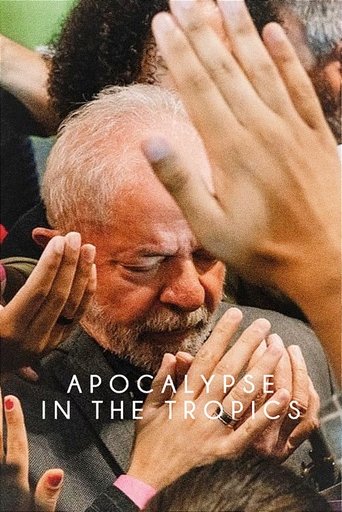
After finding great success, including a surprising Oscar nomination, for her documentary The Edge of Democracy, which focused on the impeachment of Dilma Rousseff and the arrest of Lula, Brazilian filmmaker Petra Costa returns with a spiritual sequel of sorts. This time, she widens her gaze to the years that followed in Brazil’s political landscape, chronicling Jair Bolsonaro’s 2018 election, his presidency, and his eventual defeat in 2022. Rather than offering a broad institutional view, Apocalypse in the Tropics focuses on one element that played a crucial role in Bolsonaro’s rise: his alliance with Brazil’s evangelical movement. Just as The Edge of Democracy wove in Costa’s family history, this film parallels her personal journey of exploring the Bible, particularly the Book of Revelation, and the broader growth of evangelicalism in Brazil, as she reflects on how religion was used to shape the nation’s political narrative.
Technically, this is an impeccably made documentary. It feels cinematic, at times even resembling a high-stakes political thriller. The elections are portrayed with a sense of urgency and drama that could anchor a prestige TV series. For those unfamiliar with Brazilian history, it might even feel unpredictable and suspenseful. Costa introduces the key players with clarity and confidence, blending interviews, real-life footage, and personal reflections in a seamless, compelling way. COVID, and later, the storming of Brazil’s government buildings, are appropriately and effectively framed as apocalyptic events: true horror stories that are tragically, and unbelievably, real. The use of operatic and classical music, precise editing, well-placed interviews, and the efficient chapter structure all contribute to the film’s strong narrative flow.
The documentary is at its most powerful when exploring the figure of Silas Malafaia, a televangelist who emerges as a central force behind Bolsonaro’s success. The film spends a great deal of time with him, not just in public speeches and interviews, but also in glimpses of his private life. We see how he speaks in interviews, how he behaves at public events alongside the former president, and how he navigates personal moments: cursing at a motorcycle driver in traffic, sitting down for a meal at home, and interacting with his wife. His pride in his influence is palpable, constantly bragging about his private jet and his access to Brasília’s halls of power. He answers Costa’s questions with surprising ease, not because he’s evasive, but because he seems entirely unbothered by how his words might be received. The film draws a clear line between his rhetoric and the sway he holds over millions, in a way that reminded me of the Emperor in Star Wars, playing a long game of political chess. It’s deeply unsettling, and, in its own way, fascinating, to see how easily certain narratives take hold when delivered with confidence, especially when presented as divine truth.
That said, while the documentary excels in its execution and access, it is undeniably one-sided. Costa knows exactly what she thinks, and she defends her point effectively, but at times, the film veers into propaganda, especially in how it approaches religion and Bolsonaro’s opposition, Lula. She says she’s exploring religion with curiosity. Still, the film soon gives off a sense that she’s mostly scanning for flaws, at times dismissive, and often framed through a sharply critical, already-decided lens. Even when framing other points of view beyond Malafaia’s, or the history of the Evangelical church in Brazil, there’s a persistent tone of cynicism that makes it unconvincing. Meanwhile, Lula is framed as a near-messianic figure. A perfect president of Brazil who has done nothing but good. It goes so far as to justify actions the current president has taken that are the same as those of Bolsonaro. At one point, Lula says he would never go to church to ask for votes, which he does, the film justifies it as an unfortunate necessity, something that he had to do, just as he once had to meet with bankers in his first campaign. But in the end, it’s using Bolsonaro’s strategy all the same.
With that approach, there’s little room for doubt or nuance. Not that there would be, anyway, when it comes to Bolsonaro, a man whose mishandling of the pandemic may have cost hundreds of thousands of lives, or worse, Malafaia, who has consistently invoked God to serve his own interests. But the film reduces the rise of the evangelical movement to blind faith and manipulation, often sounding more judgmental than curious. It defends its viewpoint with skill and passion, but rarely seems interested in truly understanding, only in persuading.
In this sense, Costa’s approach doesn’t feel all that different from Malafaia’s: both rely on emotionally persuasive storytelling, selective framing, and a confident sense of moral clarity. Where Malafaia uses fiery sermons and televised spectacle, Costa wields a visually stunning, narratively sharp documentary. The packaging is different, but the goal feels eerily similar.
Still courtesy of Netflix
- 1Sentimental Value
- 2Hamnet
- 3One Battle After Another
- 4Ne Zha 2
- 5Blue Moon
- 51Apocalypse in the Tropics#51 of 256
- Where to watch
 Netflix
- Where to watch
- Netflix
 Play trailer


- Original title
- Apocalipse nos Trópicos
- Director
- Petra Costa
- Genre
- Documentary
- Cast
- Silas Malafaia, Elizete Malafaia, Jair Bolsonaro, Luiz Inácio Lula da Silva, Petra Costa, Alexandre de Moraes, Cabo Daciolo, Damares Alves
- Rated
- PG-13
- Screenwriter
- Petra Costa, Alessandra Orofino, Tina Baz, David Barker, Nels Bangerter, Moara Passoni, Carol Pires, Fernando de Barros e Silva, Yaël Bitton
- Composer
- Rodrigo Leão
- Cinematography
- João Atala, Pedro Urano, Murilo Salazar, Ricardo Stuckert
- Editor
- David Barker, Jordana Berg, Tina Baz, Victor Miaciro, Nels Bangerter, Eduardo Gripa
- Country



- Language
- Portuguese
- Distributor (CA)
- Netflix