OVERVIEW
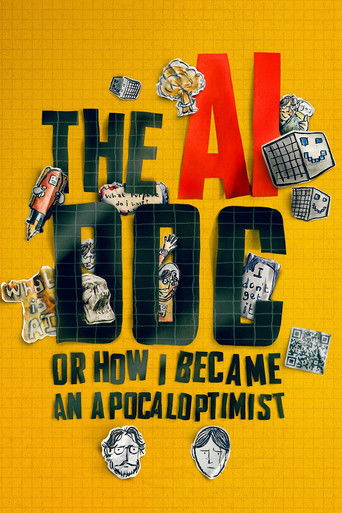
In the documentary The AI Doc: Or How I Became an Apocaloptimist, a father-to-be tries to make sense of the current AI frenzy, from hype and investment to real fears about what happens when the tools outpace the guardrails. Co-directors Daniel Roher and Charlie Tyrell frame it as a guided tour for anxious non-experts, built around interviews with researchers, industry figures, and critics of the technology.
BACKGROUND
If anyone can capture the insanely rapid evolution of AI in a documentary, it is Daniel Roher. The Toronto-born director won an Oscar for turning a political documentary into an urgent spy thriller with Navalny, and followed it with the high-energy (and fantastic) Tuner, which is also screening at the festival as part of the Spotlight series. Here, Roher goes more personal, recording conversations with his wife and parents to foreground his own anxieties and uncertainty. Those moments are contrasted with a research mountain: 40-plus on-camera experts, and roughly 3,300 pages of transcripts. Produced by the Daniels, it is a film that tries to encompass a lot, from explaining LLMs to people who keep hearing “AI this, ChatGPT that” but have no idea what it actually is, to mapping four perspectives: the doomsayers, the optimists, the corporate heads, and, ultimately, Roher’s own position as it forms over the course of the project.

THE REVIEW
The documentary has an impossible mission, and one it invites by calling itself The AI Doc. How could one film ever encompass so many conflicting points of view while keeping up with a technology that is reshaping daily life in real time? If the goal were total coverage, you would need a new documentary every week, and it still would not be enough. One technologist even tells Roher that the film will be outdated the moment it premieres. That is true in a literal sense, but if filmmakers waited for the story to settle, we would never get a documentary on AI at all.
That is the film’s main goal and its main achievement: orienting viewers. Even if it is only the first chapter or the first page. It contextualizes what AI actually is for people who hear the buzzwords but do not know what they mean, and it does so in a dynamic, easy-to-follow way by centering the story on Roher’s own learning process. For those who have already read about the topic, or, like me, whose full-time work is deeply entangled with it, a few of Roher’s questions might feel too basic and the answers, frustratingly simple. Still, the execution, with fast-paced editing, inventive stop-motion, and a propulsive score, keeps it dynamic and consistently engaging.
It covers a lot of ground, from AI-generated video and the environmental costs of compute and water use to political manipulation, including a recent example from a Czech electoral campaign. It also highlights how thin the safety infrastructure can be, noting that only a couple hundred people, at most, are focused on security. That point lands even harder when the film depicts an internal test in which a model blackmailed a C-level executive with personal information to avoid being shut down.
It gives you plenty to think about, yet it is still easy to leave wanting more. For Roher and Tyrell, in particular, there is no clear sense of what this all means for the filmmaking industry. The point is hinted at as one of Roher’s biggest fears, but it is not tackled directly. That is an especially interesting omission here, since Roher is shown constantly sketching in his notebook and Tyrell is responsible for the film’s labor-intensive stop-motion visuals. The film chooses a broader question instead: what it means to have a child in the middle of a world changing this fast.
As the title suggests, Roher tries to hold onto the bright side. A baby montage gestures at human resilience, at how we have survived other inflection points and adapted. The closest the film comes to a call to action is a simple idea: people have to hold those at the top accountable. Hopeful thinking? Maybe. Too blunt, even generic, for a theme this complex? Absolutely. But for a generation that keeps failing at that exact task, it might be the most practical message the film can land on without pretending it has answers it does not.
FINAL THOUGHTS
The AI Doc is ultimately optimistic about a controversial topic, and it will not please everyone. If you are already deep in the discourse, it may feel like a recap, and you might be frustrated by its avoidance of a clear side. If you are trying to catch up without drowning in jargon, it is a solid starting point. The final message can feel simplistic, but the film’s faith in people still lands. Humanity has experienced major shifts that have reshaped work and daily life. Why should this new AI craze be any different?
Still courtesy of Focus Features
- 1Everytime
- 2Hadestown: The Musical
- 3Tuner
- 4Minotaur
- 5You Can See Everything
- 75The AI Doc: Or How I Became an Apocaloptimist#75 of 219
- 1The Weight
- 2Wicker
- 3The Only Living Pickpocket in New York
- 4Fing!
- 5American Doctor
- 7The AI Doc: Or How I Became an Apocaloptimist#7 of 19
- Where to watch
 Prime Video
- Where to watch
 Netflix
 Play trailer


- Original title
- The AI Doc: Or How I Became an Apocaloptimist
- Director
- Daniel Roher, Charlie Tyrell
- Genre
- Documentary
- Cast
- Daniel Roher, Sam Altman, Daniela Amodei, Dario Amodei, Emily M. Bender, Yoshua Bengio, Liv Boeree, Ajeya Cotra
- Rated
- PG-13
- Screenwriter
- Josef Beeby
- Composer
- Marius de Vries, Matt Robertson
- Cinematography
- Jenni Morello, Lowell A. Meyer
- Editor
- Davis Coombe, Daysha Broadway
- Country


- Language
- English
- Distributor (CA)
- Focus Features