
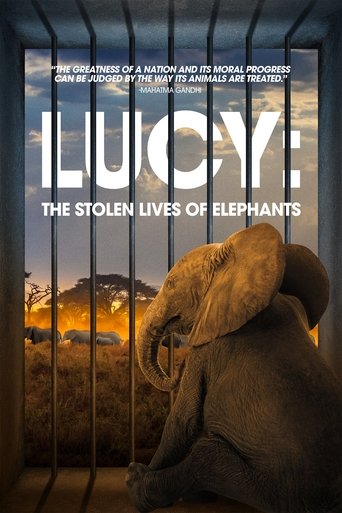
In the documentary Lucy: The Stolen Lives of Elephants, we are invited to reflect on the cruelty of zoos through the heartbreaking journey of Lucy, an elephant who was brutally torn from her family and imprisoned in captivity. The film doesn’t just reveal the harsh conditions and abuse faced by many captive elephants, it forces us to confront the deep emotional suffering of these animals, who have been ripped from their natural habitats and families.
Lucy was taken as a calf from Africa and transported to a zoo, where she endured decades of solitary confinement, without the company of other elephants, which is essential to the mental and emotional well-being of such highly social creatures. Kept in inadequate conditions and subjected to constant mistreatment by her so-called caretakers, her story is just one of many. The documentary also introduces us to other elephants living in similarly tragic situations, while offering a glimpse of hope through the efforts of activists and specialists fighting for their release and rehabilitation.
What’s especially moving is how the film explores the human journey toward awareness. We meet people who spent years working in zoos or safaris and, after witnessing the pain firsthand, finally recognize the harm they’ve caused. It’s in these moments of awakening that a shift in perspective occurs, and the elephants, at long last, begin to receive the care and compassion they were denied for so long.
The film also raises tough questions about human nature. Why do we often need a dramatic push, like illness or a life-altering event, to finally do what’s right? Through these reflections, Lucy: The Stolen Lives of Elephants reminds us that change is possible, but often comes too late for those who’ve already suffered.
One of the most devastating truths revealed in the film is the depth of elephant family bonds, and how those are violently severed when these animals are taken from their herds. It’s shocking, it’s painful, and it’s deeply unjust.
Lucy: The Stolen Lives of Elephants makes it undeniably clear how human greed can blind us to the suffering of other living beings. From zoo directors chasing profit to trainers driven by ego (“Look at me, I can dominate a creature as enormous as an elephant!”), the indifference is staggering. In their pursuit of control and validation, animals are left bruised, physically and emotionally.
Watching this documentary gave me a new perspective on zoos and safaris. It took me beyond the fences and cages, to the other side. As a human, I’ve been entertained. My love for animals led me to believe I was happy to see them up close. But… at what cost? How much pain did they endure for my moment of awe? Yes, I cried during the film, not just at the sad outcome of one particular story, but at the undeniable truth it revealed: elephants are herd animals, built for social connection. And we’ve forced them into lonely, unnatural lives.
May the questions raised by this documentary open our eyes. May we see the sorrow in their eyes, Pocha’s and Guille’s too, trapped in a space far too small and cruel. We owe it to them to fight for a better future, where no animal is condemned to this existence. And beyond that, we must support the liberation of those still in captivity, giving them the chance to heal in sanctuaries designed for their freedom and recovery.
And now you might be wondering: what about Lucy? Was she rescued from the zoo? Was she finally given the chance to experience even a small taste of the life she was meant to live?
Sadly, the answer is no. Lucy remains confined at the Edmonton Valley Zoo in Canada.
To learn more or contribute to her cause, visit: Free the Wild, Lucy the Elephant.
- Where to watch
- Out of Theaters
- Where to watch
- Not available for streaming
 Play trailer


- Original title
- Lucy: The Stolen Lives of Elephants
- Director
- Fern Levitt
- Genre
- Documentary
- Screenwriter
- Fern Levitt
- Language
- English