
The greatest science fiction does not live or die by the complexity of its rules or by how clever or original they might seem. Its power comes from how it uses those rules to place its characters in situations we could never otherwise witness, turning the concept into a tool that deepens the journey and enriches the character study. Back to the Future, 12 Monkeys and Looper each build a smart framework, yet their true strength lies in the journeys those frameworks make possible. Redux Redux understands this instinctively. The McManus brothers take the early-2020s’ favorite sci-fi device, the multiverse, and reshape it into a lean, unflinching revenge tale about a mother trapped in an endless loop of hunting the men who killed her daughter. It is as if, in Kill Bill, the Bride could kill Bill again and again. Would she ever tire of it, or only sink further into the cycle?
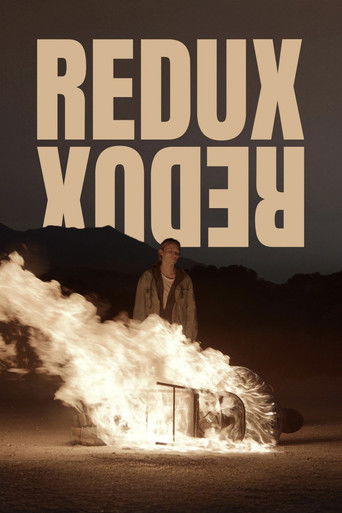
Our Bride here is Irene Kelly, played with as much strength and depth by Michaela McManus as Uma Thurman brought to her iconic role. Irene comes from the only universe to have invented multiverse travel, and she uses it to search for a reality in which her daughter is still alive. She never finds it. Every trip ends the same way: too late to save her, left with only revenge to carry out. If the main theme of the film is not obvious already, I can tell you that the time machine Irene uses to travel is coffin-shaped. Not exactly subtle, but still engrossing nonetheless.
In one of these cycles, Irene meets Mia (Stella Marcus), a teenage girl whose arrival unsettles her rigid pattern of vengeance. Marcus plays her with striking maturity, yet the writing wisely keeps her recognizably a teenager, making her choices believable and understandable. Their relationship becomes the emotional core of Redux Redux, a bond that adds warmth to an otherwise relentless story and gives Irene a reason to look beyond revenge.
This focus on character over mechanics is what drives the film. The first act establishes the cycle with confidence, much like Westworld’s pilot, dropping us into one particular loop and letting the events and character interactions, already repeated many times, explain the rules instead of stopping for lengthy exposition. Supporting characters are sharply constructed, making an impact in limited time, with personalities and traits that carry across their alternate versions. There are standout scenes with these characters too: a one-scene antagonist who appears halfway through, and later, a profound conversation over dinner, both showing the filmmakers’ knack for crafting memorable moments.
The film is at its best during these passages, keeping us leaning forward, revealing just enough to let the tension build. It stumbles when it feels the need to explain too much, offering what it thinks the audience wants. Over-explaining the machine only creates more questions, and the third act’s biggest hiccup comes when it ties up a loose end that would have been more powerful left unresolved, in one unnecessary encounter.
Those missteps never derail the film, largely because the McManus brothers guide it with such assurance. Shootouts and chases are staged with clarity and tension, always keeping the characters at the center and often feeling larger than the budget might suggest. The haunting burst of fire that opens the film sets a mood of inevitability and loss that lingers to the very end. Paired with two commanding performances that ground every moment, this atmosphere secures Redux Redux as one of the standouts of the 2025 Fantasia lineup, a science fiction film that remembers the heart of the genre lies in its people, using its premise not for spectacle but as a lens to explore grief, vengeance, and the faint hope of breaking the cycle.
- 1Hadestown: The Musical
- 2Tuner
- 3Minotaur
- 4The Weight
- 5Wicker
- 37Redux Redux#37 of 207
- Where to watch
- Rent or buy at Apple TV Store, Amazon Video
- Where to watch
 Max
Max
 Play trailer


- Original title
- Redux Redux
- Director
- Kevin McManus, Matthew McManus
- Genre
- Science Fiction, Thriller, Horror, Crime
- Cast
- Michaela McManus, Stella Marcus, Jeremy Holm, Jim Cummings, Taylor Misiak, Dendrie Taylor, Derick Alexander, Raphael Chestang
- Rated
- R
- Screenwriter
- Kevin McManus, Matthew McManus
- Composer
- Paul Koch
- Cinematography
- Alan Gwizdowski
- Editor
- Nate Cormier, Derek Desmond
- Country

- Language
- English