
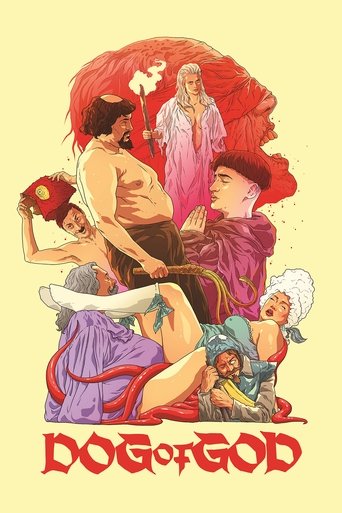
Following Flow, 2024’s Oscar-winning, uplifting animated feature about a cute cat and a band of animals learning to survive in a doomed world, Latvian animation takes a very different turn with Dog of God. This is not cute, not pleasant, and certainly not uplifting. An adaptation of Baltic folklore, specifically the 17th-century werewolf trial of Thiess of Kaltenbrun, the film trades collaboration for chaos, and gentle allegory for rot and rage. Instead of watching animals form bonds, we see them dissociate, decay, and dissolve into time, most memorably through the recurring image of a decomposing body shown in harrowing detail, used to mark the passage of time. And I wouldn’t even count that among the film’s ten most gruesome images.
This is as far from children’s animation as it gets, and the directors seem to wear that fact with pride. Nudity, blood, decapitations, and existential dread fill the frame with a kind of gleeful provocation. In many ways, it reminded me of the God of War trilogy on PS3, and that era of video games that tried to prove their maturity through exaggerated violence and sex, before the industry realized that true maturity comes from character depth. Dog of God leans into that old-school juvenile machismo: loud, bloody, and sexualized for shock value. I rolled my eyes at some of the excesses, but beneath them, I found a moody, atmospheric piece with surprisingly well-defined and complex characters.
The plot, curiously, isn’t far from The Hunchback of Notre Dame. Pastor Buckholz, who shares more than a few traits with Claude Frollo, arrests Neze, a spiritual outsider and tavern healer, accusing her of witchcraft after a religious relic goes missing. But what he’s really doing is masking his own lust and moral corruption. The story explores the tension between religious dogma and folk spirituality, touching on hypocrisy, repression, and the fear of outsiders. It uses Buckholz’s inner conflict effectively, portraying his doubts with more complexity than expected. Things unfold in a familiar rhythm, until a werewolf shows up halfway through, and the film takes a wild, unexpected turn.
Animated through rotoscope (frame-by-frame tracing over live-action footage) and enhanced with bold colors and surrealistic touches, the film boasts a distinct visual identity. The characters often feel grounded, but it’s the world they inhabit that truly impresses, full of decaying textures, dreamlike haze, and beautifully composed shots. There are at least a dozen five-second sequences here that could hang in a gallery, and the trailer does a phenomenal job capturing most of them (if nothing else, go watch that trailer!).
That said, like the other two animated films I’ve seen at Fantasia this year, Death Does Not Exist and I Am Frankelda, there’s a clear sense that the visuals take precedence over the narrative. The third act especially falters, struggling to truly make good use of the werewolf arc, while also not fully satisfying in the conclusion of Neze’s arc, not giving her the resolution she deserves. Yet unlike those other films, Dog of God benefits from a simpler, more direct story that’s easier to follow, allowing you to stay immersed in its style even when the plot doesn’t reach its potential. Much like Flow, there’s real care, creativity and passion behind every frame that frequently inspires, despite its limitations. It’s exciting to see such bold work coming out of Latvia, and I can’t wait to keep exploring its animation scene in the years ahead.
- 1Sentimental Value
- 2Hamnet
- 3One Battle After Another
- 4Ne Zha 2
- 5Blue Moon
- 97Dog of God#97 of 256
- Where to watch
- Not available for streaming
- Where to watch
- Not available for streaming
 Play trailer


- Original title
- Dieva suns
- Director
- Lauris Ābele, Raitis Ābele
- Cast
- Jurģis Spulenieks, Einars Repše, Agate Krista, Kristians Karelins, Regnārs Vaivars, Armands Berģis
- Screenwriter
- Ivo Briedis, Lauris Ābele, Raitis Ābele, Harry Grundmann
- Composer
- Lauris Ābele
- Cinematography
- Mārcis Ābele
- Editor
- Lauris Ābele, Raitis Ābele
- Country


- Language
- Latvian