
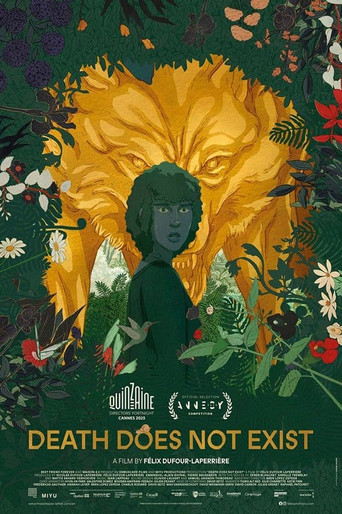
In Death Does Not Exist, writer-director Félix Dufour-Laperrière crafts a Canadian-French animated drama that uses impressionistic visuals to trace a young woman’s grief after surviving an attack in which her comrades were killed. That woman, Hélène, is introduced as part of a group of young activists carrying out an armed assault on a wealthy landowner’s estate. But when the plan falls apart, she freezes, watching in horror as her friends are killed, then hides and escapes into the jungle. Alone and consumed by guilt, Hélène begins to experience visions, particularly of Manon, a former member of the group, as she mentally retraces the attack and the choices that led her there.
Dufour-Laperrière continues his exploration of animation as a poetic, hybrid medium, once again blending fiction and experimental art into a distinctive form of storytelling. Rather than focusing on conventional plot or character development, he crafts a visual journey into Hélène’s fractured emotional state. Through flowing, impressionistic 2D animation, the film reflects her psyche at every turn. Characters blend into their environments; the dead appear slightly transparent; colors shift to match mood and atmosphere; and figures dissolve and reform as memory and trauma intertwine. The result is an immersive experience, at times resembling a moving painting, filled with imagery of death, rebirth, and a growing spiritual connection to nature. As Hélène finds a fragile haven in the forest, the film becomes increasingly ambitious, and more abstract, culminating in a series of interpretive, visually striking sequences in its final act.
The trade-off for this emotional and aesthetic focus is a noticeable loss of narrative momentum. Hélène’s internal journey, though often beautifully rendered, feels too straightforward, and eventually starts to feel repetitive. Part of the problem is that we’re never fully connected to her. The setup, particularly the pivotal early attack, is rushed, and the supporting characters are left entirely undeveloped. Some of these choices may be intentional, even efficient, giving us just enough to grasp Hélène’s and the group’s motivations. But by moving through them so quickly, the film avoids a deeper engagement with the emotional conflict at its core. It also gestures toward weighty themes, like the greed embodied by the system the activists oppose, but doesn’t offer anything particularly new or complex in its commentary. The idea of a world consumed by grief is illustrated with creative visual language, yet remains conceptually shallow.
As more narrative blanks are filled, including encounters with Hélène’s younger self, several poignant moments with Manon, and a tender memory of a comrade who confessed his love before the attack, the film finds flickers of emotional resonance. A late exchange with an older woman provides a touching reflection on grief and healing, though it ultimately feels like it’s stating the obvious rather than revealing something deeper. The film’s unique animation style is undeniably beautiful, but despite its brief 72-minute runtime, it begins to feel drawn out. Fans of Studio Ghibli’s more meditative side may find much to appreciate in its metaphorical richness and painterly visuals. But for those seeking a more grounded narrative, deeper character work, or layered thematic complexity, Death Does Not Exist may feel too elusive to truly resonate.
- Where to watch
- Not available for streaming
- Where to watch
- Not available for streaming
 Play trailer


- Original title
- La Mort n’existe pas
- Director
- Félix Dufour-Laperrière
- Cast
- Zeneb Blanchet, Karelle Tremblay, Mattis Savard-Verhoeven, Barbara Ulrich, Irène Dufour, Félix Dufour-Laperrière
- Screenwriter
- Félix Dufour-Laperrière
- Editor
- Félix Dufour-Laperrière
- Country


- Language
- French