
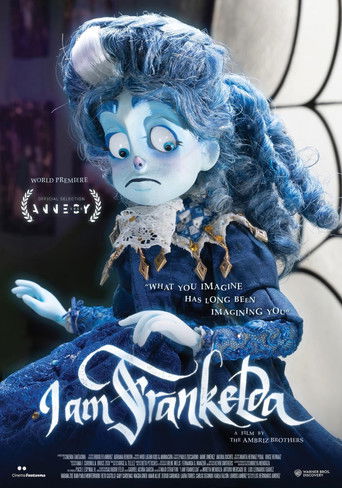
A landmark for a national cinema where animation has long remained on the margins, I Am Frankelda is Mexico’s first feature-length stop-motion film. Directed and written by brothers Roy and Arturo Ambriz, who founded their own Mexico City, based studio, Cinema Fantasma, dedicated to the craft, the film is the culmination of years of resourceful, ground-up work. The duo built toward this moment gradually, starting with shorts before moving on to Cartoon Network Latin America, where their horror anthology mini-series Frankelda’s Book of Spooks eventually gained a cult following on HBO Max. That success led to the announcement of this spin-off feature, which serves as a prequel to the series.
Set in 19th-century Mexico, the film introduces a world connected to a hidden realm, a dimension inhabited by creatures known as Spooks, who rely on human fear to survive. To keep their world alive, they manufacture nightmares which, when experienced by humans, generate the energy they need. It’s a concept that lands somewhere between Monsters, Inc. and The Nightmare Before Christmas, evoking the spirit of Tim Burton’s films, while also recalling the influence of Guillermo del Toro, who served as a mentor to the Ambriz brothers (they affectionately refer to him as their Gandalf).
In the human world, we meet Francisca Imelda, a gifted storyteller stifled by the gender constraints of her time. Herneval, the Prince of Spooks, crosses over in search of a way to save his fading realm and becomes convinced that Francisca’s imagination might be their salvation. The film works best in its quieter, more grounded moments, when it explores Francisca’s creative doubts, the beginnings of impostor syndrome, or her growing bond with Herneval. Her wide-eyed wonder at the strange world she’s invited into is genuinely compelling.
It’s unfortunate, then, that the film gets bogged down by its own ambition, particularly in its leap to feature length. The pacing never quite settles: scenes rush by in a rhythm that feels more suited to short-form storytelling, with dialogue crammed into nearly every moment. Characters rarely get a chance to pause, reflect, or simply exist, making it harder to engage with the emotional stakes. This issue is most apparent in the first act, which spends nearly thirty minutes on world-building and rule-setting, only to repeat and condense all that information in the prince’s first conversation with Frankelda. As a prequel, it’s eager to backfill lore and introduce characters who play little role in the current plot, rather than focus on establishing its leads. We should’ve spent more time with Francisca in the human world before the journey begins, to better contrast how she’s treated in each realm. The film eventually finds firmer footing in its middle stretch as it shifts toward a more character-driven approach, but the third act stumbles once again, concluding in a confusing finale that feels every inch like a handoff to the series instead of a resolution of a movie.
Worsening the problem is the film’s visual density. On one hand, what the studio accomplished is genuinely impressive. As shown in the end credits, through a well-assembled behind-the-scenes featurette (more films should do this!), it’s clear that an extraordinary amount of care and craftsmanship went into the production. One scene in particular, where a character melts away in a stunningly animated demise, is jaw-dropping in its detail. But for all its standout moments, the film’s constant drive to dazzle, whether out of ambition or the directors’ stylistic preference, results in a hyper-detailed aesthetic where character designs, sets, and background motion are always competing for attention. At times, it’s genuinely difficult to separate foreground from background, and while the creativity is undeniable, the visual overload becomes exhausting. Many of the character models themselves aren’t especially appealing either, which only adds to the fatigue.
There’s an adequately gothic, sometimes beautiful score, and the songs are pretty decent. The film gestures toward rich thematic territory, about the struggle to create in a world that silences you, the jealousy that greets new voices, the power of writing, and the energy that horror stories gives to the world, but none of it lands with the weight it should. For a film that marks such an important step for Mexican animation, you wish the emotion had been given the same attention as the spectacle.
Still courtesy of Netflix
- 1Sentimental Value
- 2Hamnet
- 3One Battle After Another
- 4Ne Zha 2
- 5Blue Moon
- 195I Am Frankelda#195 of 256
- Where to watch
 Netflix
- Where to watch
- Netflix
 Play trailer


- Original title
- Soy Frankelda
- Director
- Roy Ambriz, Arturo Ambriz
- Cast
- Mireya Mendoza, Arturo Mercado Jr., Luis Leonardo Suarez, Gaby Cárdenas, Beto Castillo, Magda Giner, Carlos Segundo, Idzi Dutkiewicz
- Rated
- NR
- Screenwriter
- Roy Ambriz, Arturo Ambriz
- Composer
- Kevin Smithers
- Cinematography
- Irene Melis, Fernanda G. Manzur
- Editor
- Gabriel Acuña
- Country

- Language
- Spanish
- Box office
- $2.709 million
- Distributor (CA)
- Netflix