
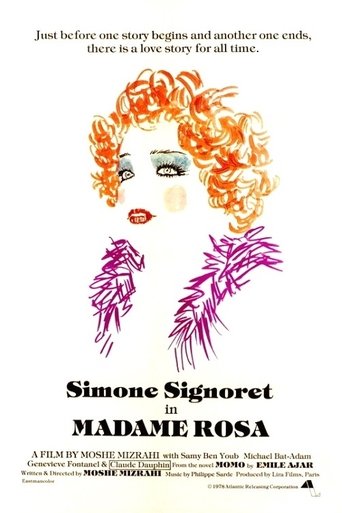

The Best Foreign Language Film winner of the 1978 Oscars marked a real step up from the previous year. Black and White in Color, which also dealt with the clash of different cultures, leaned heavily into satire and largely forgot the human element. Madame Rosa, by contrast, succeeds thanks to the depth of its two central characters and the way their relationship is slowly and movingly built. It gets its point across far more effectively, and with much greater emotional resonance.
Based on the award-winning novel La Vie devant soi (The Life Before Us), Madame Rosa centers on the bond between an elderly Holocaust survivor and former prostitute, and Momo (short for Mohammad), a young orphan boy she raises. Through their relationship, the film explores themes of found family, solidarity, aging, and dignity in the final stages of life. It’s not the most polished film—some transitions feel rough, and a few side performances are uneven—but that hardly matters when the heart of the story is this strong. Simone Signoret brings immense strength and complexity to Rosa, and her dynamic with Momo is what truly makes the film shine.
There’s something deeply moving about how they become exactly what the other needs. Momo, abandoned at a young age, finds in Rosa a mother figure who raises him not just with love, but with an understanding that bridges their cultural and religious differences. Rosa, in turn, finds in Momo someone who offers loyalty and care just as her health begins to decline. Despite her tough exterior, her care for Momo runs deep, and she raises him not only as her own but in a way she believes his biological mother would have wanted.
Released in 1977, the film captures a France in transition—still grappling with the legacy of war while facing new waves of immigration and changing social norms. Set in Belleville, a working-class Paris neighborhood with large immigrant communities, the story unfolds in a space that feels both lived-in and quietly political. Rosa’s apartment becomes a refuge for society’s forgotten: Jewish and Muslim children, sex workers, undocumented residents. It’s a world where identity lines blur and human connection becomes the only thing that truly matters.
Madame Rosa may not be flawless, but at its core is a deeply human, quietly powerful story about how love and solidarity can transcend culture, language, and religion.
- 1Sorcerer
- 2Annie Hall
- 3The Ascent
- 4Star Wars
- 5Close Encounters of the Third Kind
- 16Madame Rosa#16 of 40
- Where to watch
- Not available for streaming
- Where to watch
- Not available for streaming


- Original title
- La Vie devant soi
- Director
- Moshé Mizrahi
- Cast
- Simone Signoret, Michal Bat-Adam, Gabriel Jabbour, Mohamed Zinet, Costa-Gavras, Nadia Samir, Samy Ben-Youb, Bernard Lajarrige
- Screenwriter
- Moshé Mizrahi
- Composer
- Dabket Loubna, Philippe Sarde
- Cinematography
- Néstor Almendros
- Editor
- Sophie Coussein
- Country

- Language
- French