
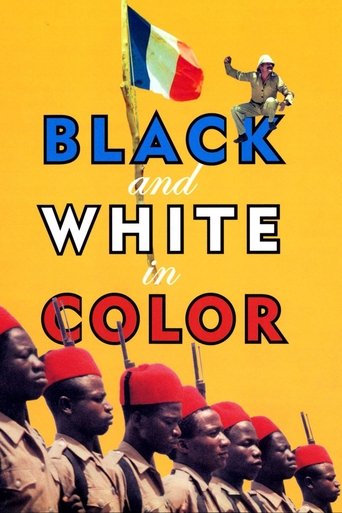

One of the biggest surprises of the 49th Academy Awards was Côte d’Ivoire winning Best Foreign Language Film for Black and White in Color, beating out the heavy favorite, Italy’s Seven Beauties. While I’m always up for rooting for the underdog, and it’s certainly exciting to see a smaller film get international recognition, it’s frustrating that this particular win came from a film that ultimately offers such a narrow, counterproductive portrayal of the very people it should have centered.
Set during World War I in a remote French colonial outpost in Africa, the film opens with the colonists living comfortably, largely untouched by the global conflict. That changes when they learn France is at war with Germany. Eager to mirror the motherland, they mobilize their community, recruiting, training, and ultimately sending local Africans to fight against neighboring German settlers.
There’s real potential in this premise. A war film that shifts away from the battlefield and into the daily life of a colonial village could have offered a fresh lens on how global conflict ripples out to people far removed from the centers of power. But instead of leaning into that, the film sidelines its most intriguing characters, the Africans, and keeps the spotlight squarely on the French colonists. Their perspective dominates the story, while the locals are mostly reduced to background figures, occasionally reacting with quiet bemusement to the absurdity around them. At times, the film cuts to a villager delivering a dry, humorous line, like, “Good that they [the colonists] are celebrating. Tomorrow they will leave us alone”, but these moments are never developed into anything sharper or more meaningful.
Instead, the film puts its energy into making the Europeans look foolish, without much consequence or variation. They’re clearly meant to be mocked for their imperial arrogance, but since we’re stuck with them for the entire runtime, the satire quickly wears thin, and their behavior isn’t particularly funny. Their cartoonish traits never evolve or deepen, and the experience becomes tedious, even at just 90 minutes. Making things worse, much of that runtime is occupied by long, meandering travel sequences and interludes that feel like padding. By the end, it feels as though very little has actually happened.
The film marks the debut of Jean-Jacques Annaud, who would later go on to make far more thoughtful works like The Name of the Rose and Seven Years in Tibet, films that explore cultural clashes in much more nuanced ways. That’s part of what makes this so frustrating: the premise is rich with possibility, which only makes its shortcomings feel like an even greater missed opportunity.
In the end, Black and White in Color is a film whose historical significance far outweighs its artistic success. While it brought international attention to a lesser-seen corner of the world, it failed to give its most compelling voices the space they deserved. A film of great potential, but one that falls short of delivering a nuanced and comprehensive portrayal of its subject matter.
- 1Rocky
- 2Taxi Driver
- 3Assault on Precinct 13
- 4Kings of the Road
- 5All the President's Men
- 50Black and White in Color#50 of 51
- Where to watch
 Prime Video
- Where to watch
- Not available for streaming


- Original title
- La Victoire en chantant
- Director
- Jean-Jacques Annaud
- Cast
- Jean Carmet, Jacques Dufilho, Catherine Rouvel, Jacques Spiesser, Dora Doll, Maurice Barrier, Benjamin Memel Atchory, Peter Berling
- Screenwriter
- Jean-Jacques Annaud, Georges Conchon
- Composer
- Pierre Bachelet
- Cinematography
- Claude Agostini
- Editor
- Françoise Bonnot, Michèle Boëhm
- Country




- Language
- French